





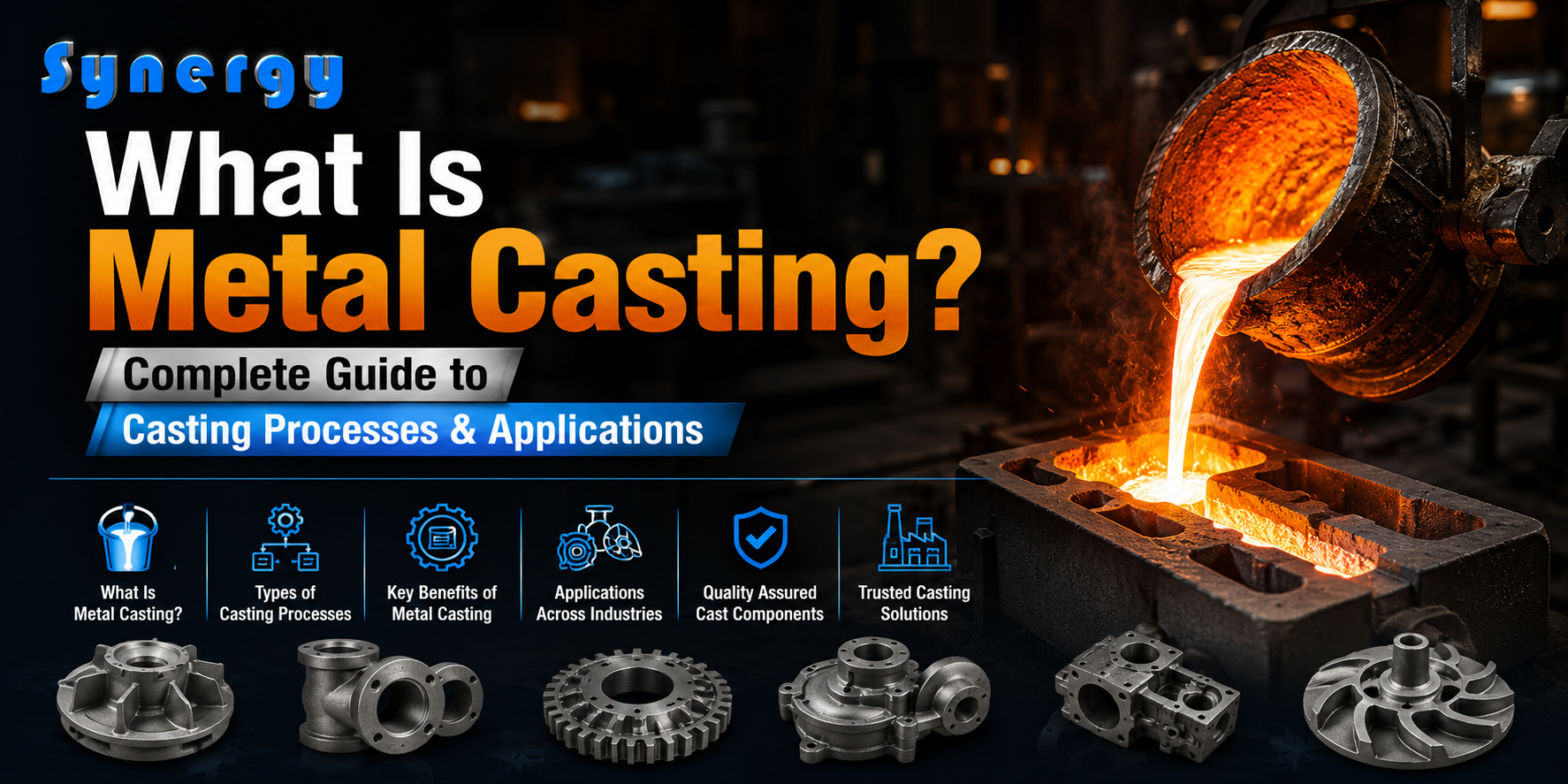
 Metal casting is one of the oldest and most widely used manufacturing processes in the world. From industrial machinery to pumps, valves, railway equipment, and heavy engineering parts, metal casting plays a critical role in modern manufacturing. Businesses seeking cost-effective, durable, and complex metal components often rely on custom metal casting services to produce parts that would be difficult or expensive to manufacture using other production methods.
In this comprehensive guide, India Synergy explains what metal casting is, how the metal casting process works, the different types of casting methods available, and the industries that depend on high-quality industrial castings for their operations.
Whether you are an OEM, product designer, procurement professional, or industrial manufacturer, understanding metal casting can help you make informed sourcing and manufacturing decisions.
What Is Metal Casting?
Metal casting is a manufacturing process in which molten metal is poured into a specially designed mold cavity and allowed to solidify into a desired shape. Once the metal cools and hardens, the casting is removed from the mold, cleaned, inspected, and finished according to application requirements.
The metal casting process enables manufacturers to create simple or highly complex parts in a wide range of sizes, materials, and production volumes.
Because of its flexibility and cost efficiency, metal casting is widely used to produce:
- Industrial machinery components
- Pump and valve bodies
- Railway components
- Agricultural equipment
- Mining machinery parts
- Construction equipment components
- Aerospace components
- Power generation equipment
Today, custom metal casting services are an essential part of global manufacturing and supply chains.
Why Is Metal Casting Important in Modern Manufacturing?
Metal casting offers unique advantages that make it one of the most preferred manufacturing methods for industrial applications.
Ability to Produce Complex Shapes
One of the biggest advantages of metal casting is the ability to manufacture intricate geometries and complex designs that would be difficult to achieve through machining or fabrication alone.
Engineers can create:
- Internal cavities
- Thin walls
- Complex contours
- Integrated features
- Large structural components
This design flexibility makes casting suitable for a broad range of industries.
Cost-Effective Manufacturing Solution
For many applications, casting is more economical than machining parts from solid metal blocks.
Benefits include:
- Reduced material waste
- Lower production costs
- Reduced machining time
- Faster manufacturing cycles
- Economical large-scale production
This is why OEM metal castings remain a preferred solution for manufacturers worldwide.
Wide Material Selection
Metal casting supports various ferrous and non-ferrous alloys, allowing manufacturers to select materials based on strength, durability, corrosion resistance, thermal performance, and operating conditions.
Common casting materials include:
- Carbon steel
- Stainless steel
- Ductile iron
- Grey iron
- Aluminum
- Brass
- Bronze
- Zinc alloys
This flexibility enables manufacturers to optimize performance for specific applications.
Scalability for Different Production Volumes
Metal casting can accommodate:
- Prototype production
- Low-volume manufacturing
- Medium-volume production
- High-volume manufacturing
This makes casting suitable for both custom projects and large-scale industrial production programs.
How Does the Metal Casting Process Work?
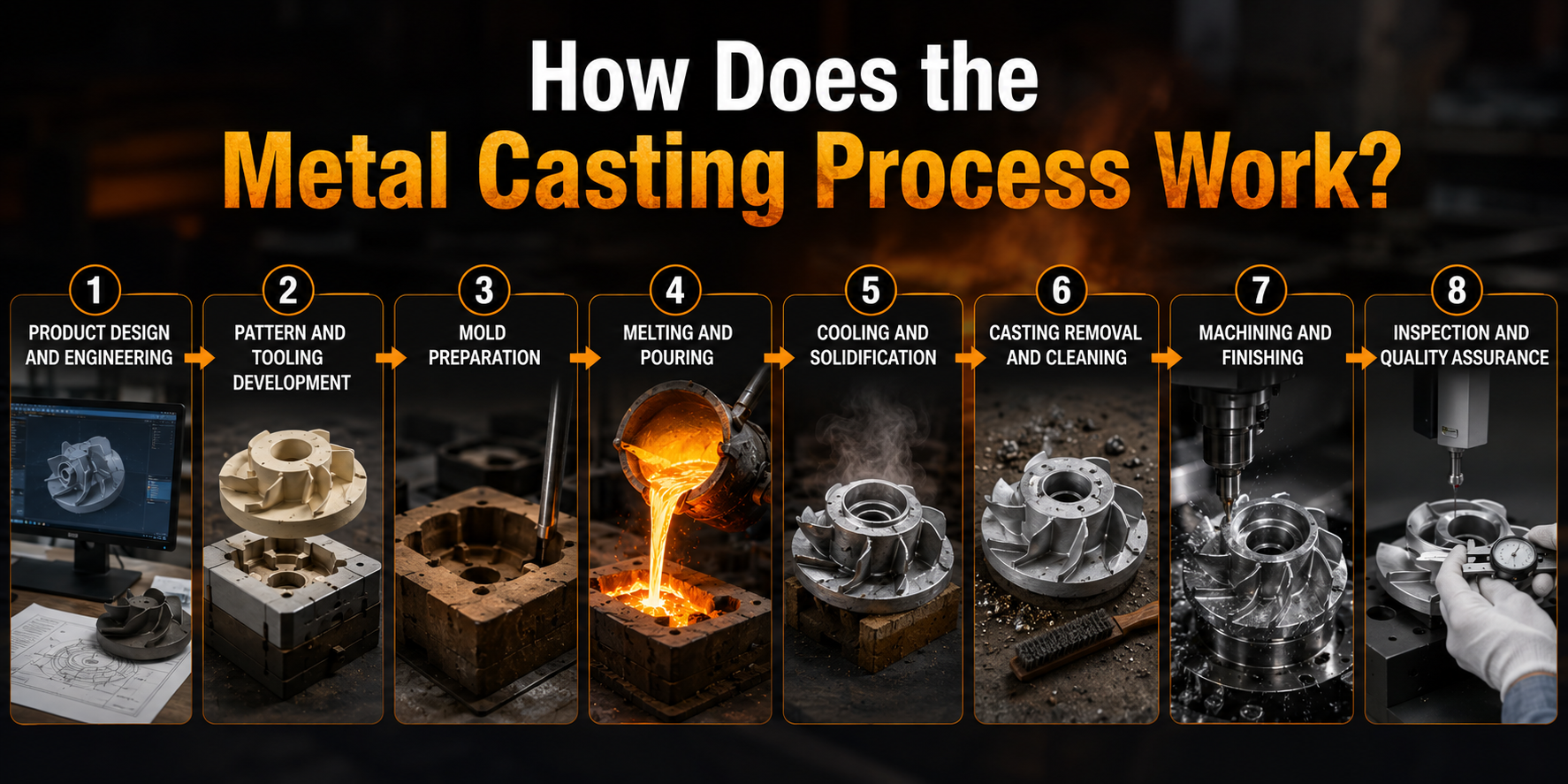
While individual casting methods vary, most metal casting processes follow a similar workflow.
Step 1: Product Design and Engineering
The process begins with product design and engineering evaluation.
Engineers review:
- Technical drawings
- CAD models
- Functional requirements
- Material specifications
- Manufacturing feasibility
At India Synergy, this stage helps identify the most suitable casting process for the project.
Step 2: Pattern and Tooling Development
A pattern or mold is created based on the component design.
The tooling stage is critical because it determines:
- Dimensional accuracy
- Surface quality
- Production consistency
- Manufacturing efficiency
Proper tooling development reduces defects and improves overall casting performance.
Step 3: Mold Preparation
The mold cavity is prepared according to the selected casting process.
Depending on the manufacturing method, molds may be:
- Sand molds
- Ceramic molds
- Metal molds
- Shell molds
The mold serves as the negative impression of the final component.
Step 4: Melting and Pouring
The selected metal alloy is melted in a furnace at controlled temperatures.
Molten metal is then carefully poured into the mold cavity where it fills the designed shape.
Accurate temperature control is essential for:
- Material quality
- Structural integrity
- Surface finish
- Defect prevention
Step 5: Cooling and Solidification
After pouring, the molten metal cools and solidifies inside the mold.
The cooling process significantly affects:
- Mechanical properties
- Grain structure
- Strength
- Dimensional stability
Controlled cooling helps ensure consistent product quality.
Step 6: Casting Removal and Cleaning
Once solidified, the casting is removed from the mold and cleaned.
This stage may involve:
- Sand removal
- Gate removal
- Surface cleaning
- Grinding
- Shot blasting
The goal is to prepare the component for inspection and finishing operations.
Step 7: Machining and Finishing
Many cast components undergo secondary operations to achieve final dimensions and surface requirements.
These may include:
- CNC machining
- Drilling
- Milling
- Threading
- Heat treatment
- Surface coating
This ensures the finished product meets customer specifications.
Step 8: Inspection and Quality Assurance
Before shipment, castings are inspected and tested to verify compliance with quality standards.
Typical inspections include:
- Dimensional verification
- Material testing
- Mechanical testing
- Non-destructive testing
- Visual inspection
This ensures reliability and long-term performance in demanding industrial environments.
Types of Metal Casting Processes: Choosing the Right Casting Method for Your Application
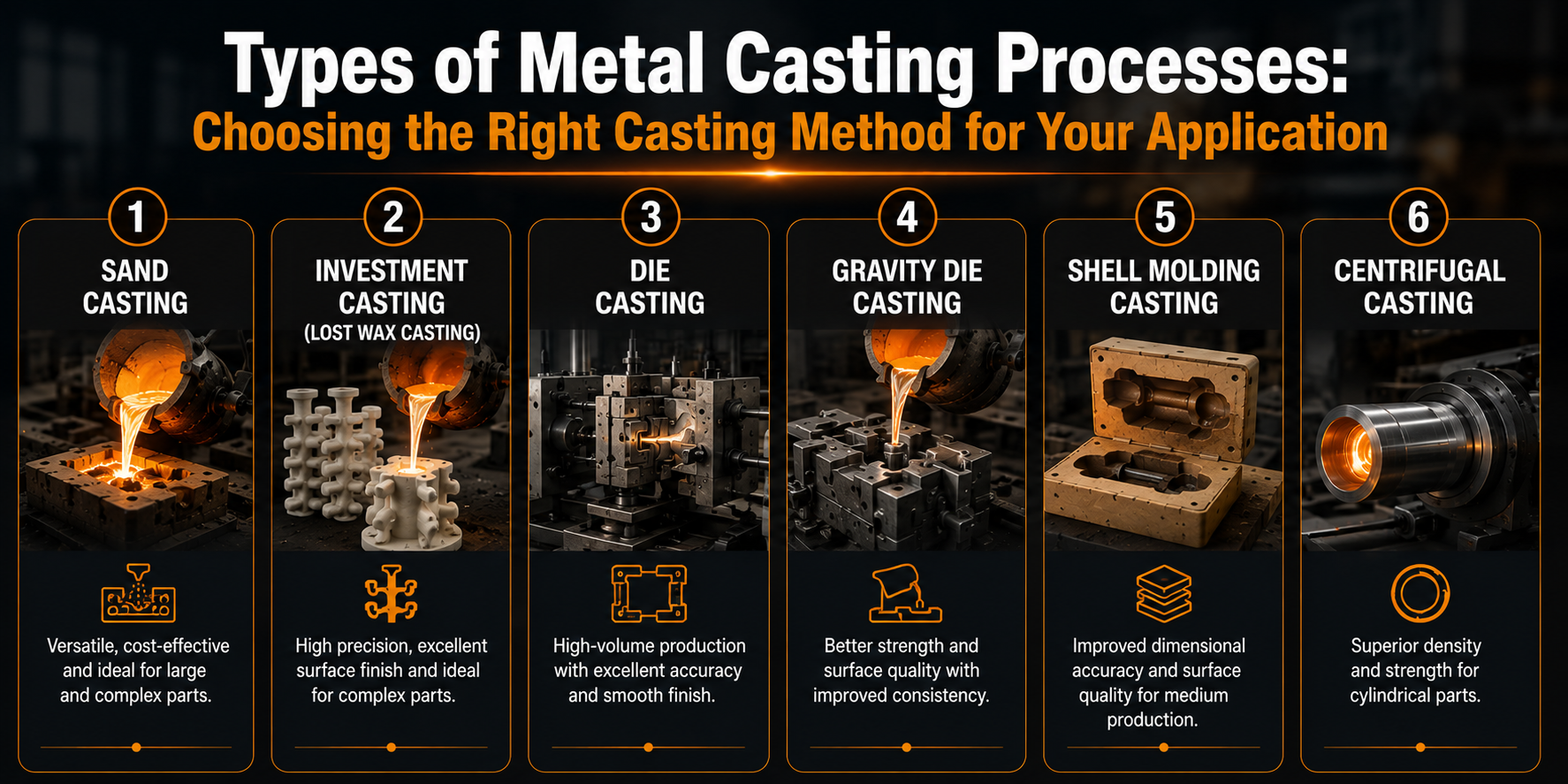
Selecting the right metal casting process is one of the most important decisions in any manufacturing project. Different casting methods offer unique advantages in terms of cost, dimensional accuracy, production volume, material compatibility, surface finish, and mechanical performance.
At India Synergy, we help customers identify the most suitable casting solution based on component design, industry requirements, production goals, and budget considerations.
Below are the most commonly used industrial metal casting processes and their applications.
Sand Casting Process: The Most Versatile Industrial Casting Method
Sand casting is one of the oldest and most widely used metal casting processes. It involves creating a mold from specially prepared sand and then pouring molten metal into the mold cavity.
Because of its flexibility and cost-effectiveness, sand casting is commonly used for large and complex components.
Advantages of Sand Casting
- Suitable for large parts
- Low tooling costs
- Supports a wide range of metals
- Ideal for low and medium production volumes
- Cost-effective for custom metal castings
Applications of Sand Castings
Sand casting is commonly used for manufacturing:
- Pump bodies
- Valve housings
- Industrial machinery components
- Agricultural equipment parts
- Mining equipment components
- Heavy engineering castings
Best Materials for Sand Casting
- Carbon Steel
- Stainless Steel
- Grey Iron
- Ductile Iron
- Aluminum Alloys
- Bronze Alloys
For businesses seeking custom industrial castings, sand casting often provides the best balance between cost and manufacturing flexibility.
Investment Casting Process (Lost Wax Casting): High Precision Metal Castings
Investment casting, commonly known as lost wax casting, is used when exceptional dimensional accuracy and surface finish are required.
The process involves creating a wax pattern that is coated with ceramic material to form a mold. Once the mold is prepared, the wax is removed and molten metal is poured into the cavity.
Advantages of Investment Casting
- Excellent dimensional accuracy
- Superior surface finish
- Complex geometries
- Reduced machining requirements
- Tight tolerances
Applications of Precision Investment Castings
Investment casting is widely used in:
- Aerospace components
- Medical equipment
- Pump and valve components
- Industrial engineering parts
- Defense equipment
Why OEMs Prefer Investment Casting
OEM manufacturers often choose investment casting because it allows complex parts to be produced with minimal secondary machining, reducing production costs and improving consistency.
Die Casting Process: High-Volume Precision Manufacturing
Die casting is a metal casting process that uses high-pressure injection of molten metal into reusable steel molds known as dies.
It is widely used for high-volume production of precision metal components.
Advantages of Die Casting
- Fast production cycles
- Excellent repeatability
- Smooth surface finish
- Tight tolerances
- Suitable for mass production
Common Die Casting Applications
Industries using die casting include:
- Electronics
- Consumer products
- Industrial equipment
- Electrical enclosures
Metals Used in Die Casting
Common die casting materials include:
- Aluminum
- Zinc
- Magnesium
For high-volume manufacturing programs, die casting is often one of the most efficient production methods available.
Gravity Die Casting: Improved Strength and Surface Quality
Gravity die casting uses permanent metal molds rather than disposable sand molds. Molten metal is poured into the mold using gravity instead of high pressure.
This process offers improved mechanical properties compared to traditional sand casting.
Benefits of Gravity Die Casting
- Better dimensional accuracy
- Improved mechanical strength
- Enhanced surface finish
- Lower porosity
- Consistent quality
Industries Using Gravity Die Casting
Gravity die cast components are commonly found in:
- Industrial machinery
- Hydraulic equipment
- Engineering assemblies
- Transportation equipment
This process is particularly effective for aluminum and non-ferrous alloy castings.
Shell Molding Casting: High-Quality Industrial Castings
Shell molding casting combines the benefits of sand casting and precision casting to produce components with improved dimensional accuracy and surface quality.
The mold is created using resin-coated sand that forms a rigid shell around the pattern.
Advantages of Shell Molding
- Improved surface finish
- Better dimensional consistency
- Reduced machining requirements
- Suitable for medium-volume production
- Enhanced repeatability
Typical Shell Molded Components
Shell molding is widely used for:
- Pump components
- Valve bodies
- Industrial equipment parts
- Engineering components
For manufacturers requiring consistent quality and tighter tolerances, shell molding offers a strong alternative to conventional sand casting.
Centrifugal Casting Process: Superior Density and Strength
Centrifugal casting is a specialized casting process used to manufacture cylindrical parts by rotating the mold at high speeds while molten metal is poured into it.
The centrifugal force distributes the molten metal evenly, producing dense and defect-resistant castings.
Benefits of Centrifugal Casting
- Improved material density
- Reduced porosity
- Enhanced mechanical properties
- Excellent structural integrity
- Long service life
Components Manufactured Through Centrifugal Casting
Typical products include:
- Bushings
- Sleeves
- Cylinders
- Rings
- Bearings
- Pipes
Industries requiring durable rotational components frequently rely on centrifugal casting for critical applications.
Metal Casting Process Comparison: Which Casting Method Is Best?
| Casting Process | Accuracy | Surface Finish | Production Volume | Best For |
| Sand Casting | Moderate | Moderate | Low to High | Large Industrial Components |
| Investment Casting | Very High | Excellent | Low to Medium | Precision Components |
| Die Casting | High | Excellent | High Volume | Consumer Products |
| Gravity Die Casting | High | Good | Medium to High | Aluminum Components |
| Shell Molding | High | Good | Medium Volume | Industrial Equipment Parts |
| Centrifugal Casting | High | Good | Medium to High | Cylindrical Components |
How to Choose the Right Metal Casting Process
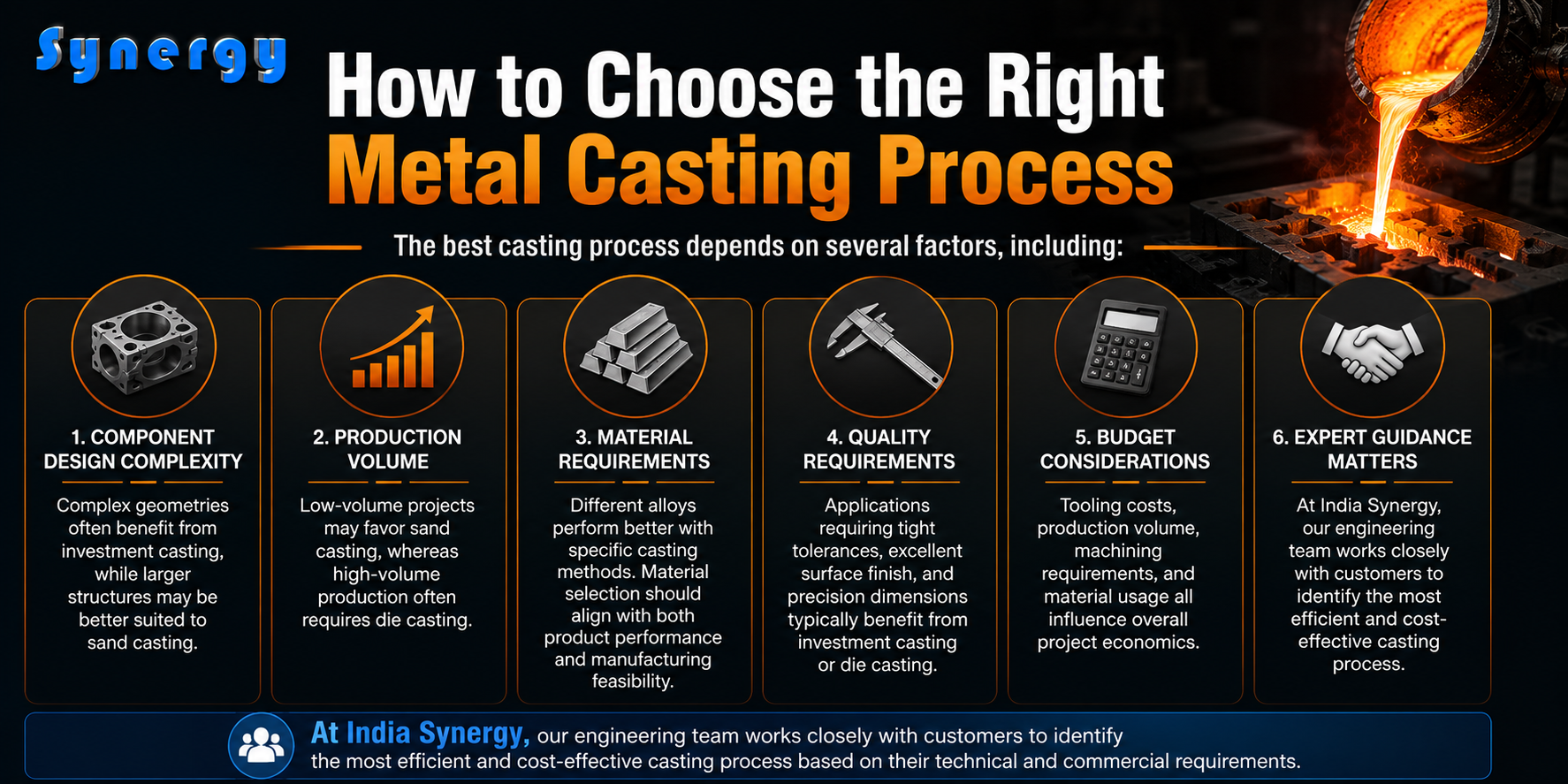
The best casting process depends on several factors, including:
Component Design Complexity
Complex geometries often benefit from investment casting, while larger structures may be better suited to sand casting.
Production Volume
Low-volume projects may favor sand casting, whereas high-volume production often requires die casting.
Material Requirements
Different alloys perform better with specific casting methods. Material selection should align with both product performance and manufacturing feasibility.
Quality Requirements
Applications requiring tight tolerances, excellent surface finish, and precision dimensions typically benefit from investment casting or die casting.
Budget Considerations
Tooling costs, production volume, machining requirements, and material usage all influence overall project economics.
At India Synergy, our engineering team works closely with customers to identify the most efficient and cost-effective casting process based on their technical and commercial requirements.
Materials Used in Metal Casting: Choosing the Right Metal for Industrial Applications
The success of any casting project depends not only on selecting the right casting process but also on choosing the appropriate material. Material selection directly impacts strength, durability, corrosion resistance, machinability, weight, heat resistance, and overall product performance.
Whether you are sourcing custom metal castings, OEM cast components, or precision-engineered industrial castings, understanding material properties is essential for making informed manufacturing decisions.
At India Synergy, we help customers identify the most suitable casting materials based on application requirements, operating environments, industry standards, and budget considerations.
Why Material Selection Is Important in Metal Casting
The casting material determines how a component performs throughout its lifecycle.
Choosing the wrong material can lead to:
- Premature component failure
- Excessive wear
- Corrosion issues
- Increased maintenance costs
- Reduced operational efficiency
Selecting the correct alloy ensures:
- Longer service life
- Improved reliability
- Better mechanical performance
- Reduced total ownership costs
- Enhanced product quality
This is why material selection is one of the most critical stages of any custom metal casting project.
Ferrous vs Non-Ferrous Metal Castings
Metal castings are generally classified into two categories:
Ferrous Metal Castings
Ferrous metals contain iron as their primary element.
These materials are widely used because of their strength, toughness, and cost-effectiveness.
Common ferrous casting materials include:
- Carbon Steel
- Stainless Steel
- Grey Iron
- Ductile Iron
- Alloy Steel
Advantages of Ferrous Castings
- High strength
- Excellent wear resistance
- Cost-effective production
- Suitable for heavy-duty applications
- Good structural performance
Ferrous castings are commonly used in industrial machinery, mining equipment, railways, construction equipment, and heavy engineering industries.
Non-Ferrous Metal Castings
Non-ferrous metals contain little or no iron.
These materials are often selected for their lightweight properties, corrosion resistance, conductivity, and precision manufacturing capabilities.
Common non-ferrous casting materials include:
- Aluminum
- Brass
- Bronze
- Zinc
- Magnesium
Advantages of Non-Ferrous Castings
- Lightweight construction
- Corrosion resistance
- Excellent machinability
- Better thermal conductivity
- Improved electrical conductivity
Non-ferrous castings are widely used in aerospace, marine, electrical, and consumer product applications.
Steel Castings: High-Strength Industrial Castings
Steel castings are among the most versatile and durable casting materials available today.
They are widely used in industries where strength, impact resistance, and durability are critical.
Key Benefits of Steel Castings
Exceptional Mechanical Strength
Steel castings provide excellent tensile strength and structural integrity, making them ideal for demanding industrial environments.
High Impact Resistance
Steel components can withstand heavy loads, vibrations, and mechanical stress without failure.
Excellent Wear Resistance
Steel castings perform well in abrasive operating conditions commonly found in mining and construction equipment.
Common Applications of Steel Castings
- Mining equipment
- Construction machinery
- Railway components
- Industrial valves
- Heavy engineering equipment
- Power generation systems
For critical industrial applications, steel remains one of the most trusted casting materials.
Stainless Steel Castings: Corrosion-Resistant Precision Components
Stainless steel castings are widely used in environments where corrosion resistance and long-term reliability are essential.
Advantages of Stainless Steel Castings
Corrosion Resistance
Stainless steel offers superior resistance to rust, chemicals, moisture, and harsh operating environments.
High Temperature Performance
Many stainless steel grades maintain strength and stability under elevated temperatures.
Hygienic Properties
This makes stainless steel ideal for food processing, pharmaceutical, and medical applications.
Industries Using Stainless Steel Castings
- Food processing
- Pharmaceutical manufacturing
- Chemical processing
- Marine engineering
- Industrial pumps and valves
- Water treatment systems
Stainless steel castings are often selected when durability and corrosion protection are top priorities.
Ductile Iron Castings: Strength and Flexibility Combined
Ductile iron is one of the most widely used materials for industrial castings due to its excellent balance of strength, toughness, and cost efficiency.
Unlike traditional cast iron, ductile iron contains nodular graphite structures that improve flexibility and mechanical performance.
Benefits of Ductile Iron Castings
- High tensile strength
- Excellent fatigue resistance
- Good impact resistance
- Superior machinability
- Cost-effective manufacturing
Common Applications
- Agricultural machinery
- Hydraulic systems
- Industrial equipment
- Pipe fittings
- Valve bodies
For many industrial applications, ductile iron offers an excellent alternative to steel while reducing manufacturing costs.
Grey Iron Castings: Cost-Effective Industrial Manufacturing
Grey iron remains one of the most commonly used casting materials worldwide.
Its excellent vibration damping characteristics make it particularly valuable for machinery and equipment applications.
Advantages of Grey Iron Castings
Excellent Machinability
Grey iron is relatively easy to machine, reducing production costs and processing time.
Vibration Absorption
Machine tools and industrial equipment often rely on grey iron for vibration control and operational stability.
Cost Efficiency
Grey iron provides a highly economical solution for many industrial applications.
Typical Grey Iron Applications
- Machine bases
- Engine blocks
- Pump housings
- Compressor components
- Gear housings
- Industrial machinery parts
Grey iron remains a preferred choice for manufacturers seeking cost-effective and durable cast components.
Aluminum Castings: Lightweight and High-Performance Manufacturing
Aluminum is one of the most popular non-ferrous casting materials due to its excellent strength-to-weight ratio.
Industries focused on weight reduction often rely on aluminum castings to improve efficiency and performance.
Advantages of Aluminum Castings
- Lightweight construction
- Corrosion resistance
- Excellent thermal conductivity
- Good machinability
- High-dimensional stability
Industries Using Aluminum Castings
- Aerospace
- Electronics
- Renewable energy
- Industrial machinery
Aluminum castings are particularly valuable in applications where reducing component weight can improve operational efficiency.
Brass Castings: Corrosion-Resistant Components for Industrial and Marine Applications
Brass castings are widely used across industries that require excellent corrosion resistance, good machinability, and attractive surface finishes. Brass is an alloy primarily composed of copper and zinc, offering a combination of strength and durability.
Benefits of Brass Castings
Excellent Corrosion Resistance
Brass performs exceptionally well in environments exposed to moisture, chemicals, and varying temperatures.
Good Machinability
Brass castings are easy to machine and finish, helping manufacturers reduce production costs and improve efficiency.
Attractive Appearance
The natural finish of brass makes it suitable for both industrial and decorative applications.
Common Applications of Brass Castings
- Valve components
- Plumbing fittings
- Marine hardware
- Electrical connectors
- Industrial equipment
- Architectural hardware
Brass castings remain a preferred choice for applications requiring durability and corrosion resistance.
Bronze Castings: High Wear Resistance for Critical Engineering Components
Bronze castings are valued for their excellent wear resistance, strength, and performance in harsh operating environments.
Bronze alloys typically contain copper combined with tin and other alloying elements that enhance mechanical properties.
Advantages of Bronze Castings
Superior Wear Resistance
Bronze performs exceptionally well in sliding and friction-based applications.
Excellent Corrosion Protection
Bronze is highly resistant to seawater and aggressive environments.
Long Service Life
Its durability makes bronze suitable for heavy-duty industrial applications.
Industries Using Bronze Castings
- Marine engineering
- Mining equipment
- Heavy machinery
- Industrial pumps
- Bearings and bushings
- Power generation equipment
For applications involving constant motion and heavy wear, bronze castings often provide outstanding long-term performance.
Zinc Castings: High-Precision Components for Mass Production
Zinc casting is widely used for manufacturing high-precision components with excellent dimensional stability and surface finish.
Because zinc alloys flow easily during casting, they can produce intricate shapes and complex geometries with minimal machining.
Benefits of Zinc Castings
Excellent Dimensional Accuracy
Zinc castings can achieve tight tolerances and consistent part quality.
Cost-Effective Production
The process supports high-volume manufacturing while maintaining competitive costs.
Superior Surface Finish
Zinc components often require minimal post-processing.
Common Applications of Zinc Castings
- Electrical components
- Consumer products
- Hardware components
- Electronic housings
- Precision engineering parts
Zinc remains a popular choice for manufacturers requiring precision metal castings at scale.
How to Choose the Right Casting Material for Your Project
Selecting the best metal casting material requires careful evaluation of the application’s operating conditions, performance requirements, and cost objectives.
At India Synergy, we help customers analyze several key factors before finalizing a material selection.
Mechanical Strength Requirements
The material must withstand expected loads, stress levels, and operating conditions.
Applications involving heavy loads often require:
- Steel castings
- Ductile iron castings
- Alloy steel castings
High-strength materials help improve product durability and operational reliability.
Corrosion Resistance Requirements
Components exposed to moisture, chemicals, seawater, or harsh environments require materials with superior corrosion resistance.
Common choices include:
- Stainless steel castings
- Brass castings
- Bronze castings
- Aluminum castings
Selecting the right material helps extend service life and reduce maintenance costs.
Temperature and Heat Resistance
Some industrial applications operate under elevated temperatures and require materials capable of maintaining performance under thermal stress.
Examples include:
- Stainless steel castings
- Heat-resistant steel castings
- Specialized alloy castings
These materials help ensure long-term stability and safety.
Weight Reduction Requirements
Many industries seek lightweight components to improve energy efficiency and reduce overall equipment weight.
Preferred materials include:
- Aluminum castings
- Magnesium castings
- Zinc castings
Lightweight castings are particularly important in and aerospace applications.
Cost and Production Considerations
Material selection should also align with project budgets and production volumes.
Factors influencing cost include:
- Raw material pricing
- Tooling requirements
- Machining requirements
- Production volume
- Quality requirements
A balanced approach ensures both performance and cost-effectiveness.
Best Casting Materials by Industry
Different industries have unique performance requirements, which influence material selection.
Pump and Valve Castings
Fluid handling equipment often operates in demanding environments involving pressure, corrosion, and continuous operation.
Recommended materials include:
- Stainless steel castings
- Ductile iron castings
- Bronze castings
- Cast steel components
These materials provide durability and long-term performance.
Mining Equipment Castings
Mining applications require exceptional wear resistance and structural strength.
Frequently used materials include:
- Steel castings
- Alloy steel castings
- Ductile iron castings
These materials can withstand abrasive environments and heavy loads.
Railway Industry Castings
Railway systems demand reliable components capable of operating under constant mechanical stress.
Typical casting materials include:
- Carbon steel castings
- Alloy steel castings
- Ductile iron castings
Applications include:
- Structural components
- Brake systems
- Couplings
- Mechanical assemblies
Oil and Gas Industry Castings
Oil and gas equipment often operates in highly corrosive and high-pressure environments.
Preferred materials include:
- Stainless steel castings
- Alloy steel castings
- Carbon steel castings
These materials provide strength, corrosion resistance, and operational safety.
Power Generation Equipment Castings
Power plants require components capable of performing under extreme temperatures and demanding operating conditions.
Common materials include:
- Heat-resistant steel castings
- Stainless steel castings
- Alloy steel castings
Applications include:
- Turbine components
- Pump housings
- Valve bodies
- Structural equipment
How India Synergy Helps Customers Select the Right Casting Material
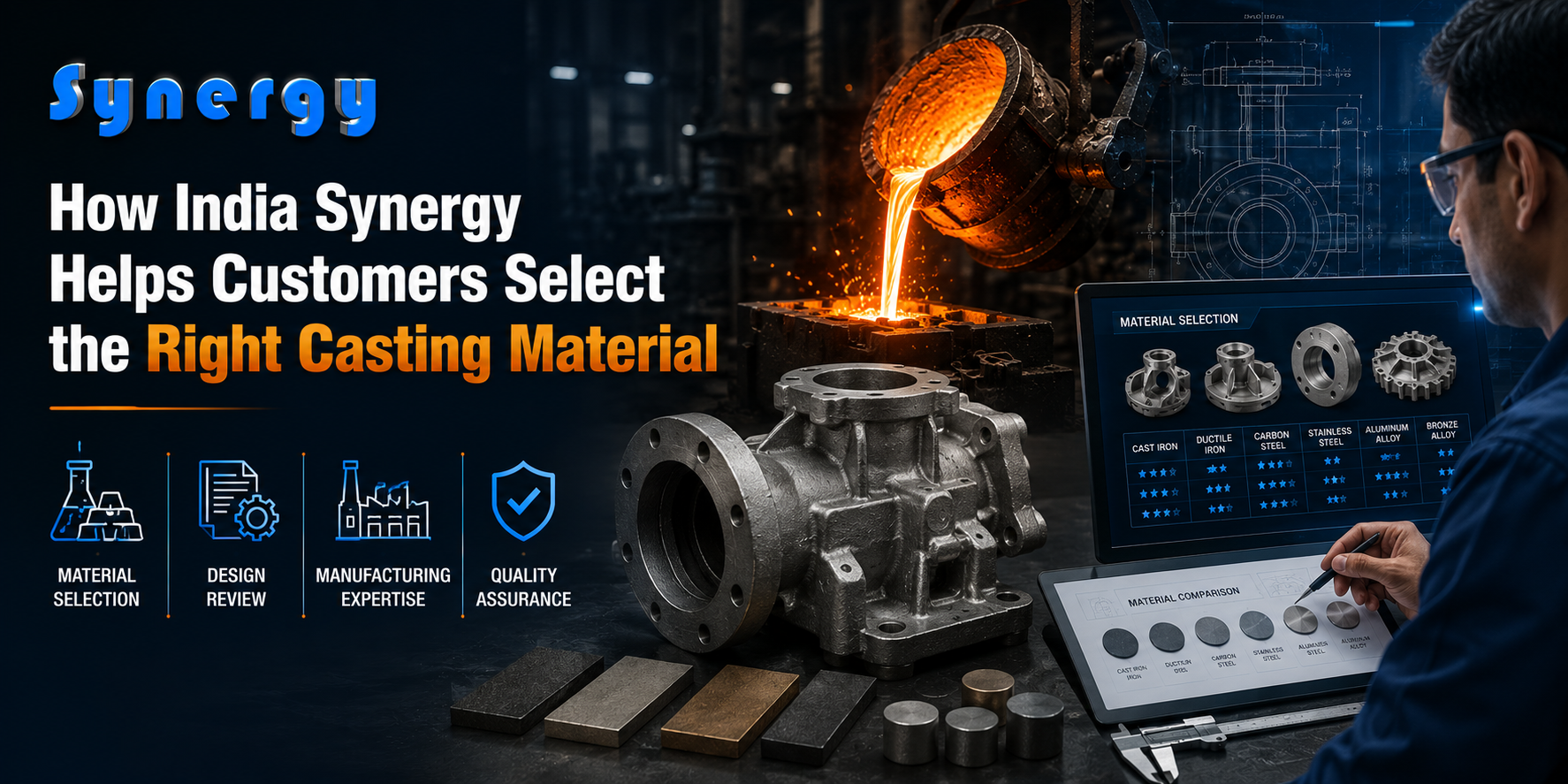
Choosing the right casting material is not always straightforward. Factors such as product design, operating conditions, production volume, industry standards, and budget constraints must all be considered.
India Synergy works closely with OEMs, industrial manufacturers, engineering companies, and sourcing professionals to recommend the most suitable materials and manufacturing processes for their applications.
Our technical support includes:
- Material selection guidance
- Casting process recommendations
- Design optimization support
- Supplier qualification
- Quality assurance planning
- Manufacturing feasibility reviews
By combining engineering expertise with a strong manufacturing network, India Synergy helps customers source high-quality custom metal castings that meet both technical and commercial objectives.
As a trusted partner for custom metal casting services in India, we support projects ranging from prototype development to large-scale OEM production programs across multiple industries worldwide.
Industries That Use Metal Casting: Applications Across Global Manufacturing
Metal casting is one of the most versatile manufacturing processes used across virtually every major industry. Its ability to produce complex shapes, large structural components, and high-precision parts makes it an essential part of modern industrial production.
From heavy engineering companies to power plants and infrastructure projects, metal castings support critical operations worldwide.
At India Synergy, we help customers source custom metal castings for a wide range of industrial applications through our trusted manufacturing network and engineering-driven sourcing solutions.
Industrial Machinery and Equipment Castings
Industrial machinery manufacturers depend on durable cast components capable of with standing demanding operating conditions.
Typical Industrial Machinery Castings
- Machine bases
- Gear housings
- Equipment frames
- Structural supports
- Mechanical assemblies
These components often require excellent dimensional stability, vibration resistance, and long-term reliability.
Pump and Valve Industry Castings
Pumps and valves are among the most common applications for industrial castings.
These components must perform reliably under pressure, temperature variations, and corrosive operating environments.
Common Pump and Valve Castings
- Pump casings
- Impellers
- Valve bodies
- Covers
- Flow control components
Materials such as stainless steel, ductile iron, and bronze are frequently used for these applications.
Oil and Gas Industry Castings
The oil and gas sector demands high-performance cast components capable of operating in extreme environments.
Applications Include
- Pipeline equipment
- Valve systems
- Drilling equipment
- Pressure control systems
- Processing plant machinery
Castings used in oil and gas operations must meet strict quality and safety standards while providing exceptional strength and corrosion resistance.
Mining Equipment Castings
Mining operations require heavy-duty components capable of handling abrasive materials and extreme working conditions.
Common Mining Castings
- Crusher components
- Wear-resistant parts
- Structural housings
- Conveyor system components
- Excavation equipment parts
Steel castings and alloy castings are widely used due to their superior durability and wear resistance.
Railway and Transportation Castings
Railway systems rely on precision-engineered castings to ensure safety, reliability, and long service life.
Typical Railway Casting Applications
- Brake system components
- Couplings
- Structural parts
- Mechanical assemblies
- Infrastructure equipment
These components often require high strength and strict dimensional accuracy.
Agriculture Equipment Castings
Agricultural machinery manufacturers use cast components in equipment designed to operate in challenging outdoor environments.
Agricultural Casting Applications
- Tractor components
- Gear housings
- Hydraulic system parts
- Equipment frames
- Irrigation equipment components
Castings provide the durability and cost efficiency required for modern farming operations.
Power Generation Equipment Castings
Power plants require robust cast components capable of operating under high temperatures and demanding conditions.
Applications Include
- Turbine housings
- Valve bodies
- Pump components
- Structural assemblies
- Process equipment
Precision casting and alloy casting technologies are often used in these critical applications.
Benefits of Custom Metal Casting Services
Businesses increasingly choose custom metal casting services because they offer significant advantages over alternative manufacturing methods.
Design Flexibility
Casting allows engineers to create complex shapes that would be difficult or expensive to produce through machining or fabrication.
Benefits include:
- Intricate geometries
- Internal cavities
- Reduced assembly requirements
- Optimized product designs
Cost-Effective Production
Metal casting minimizes material waste and reduces machining requirements, making it a cost-effective solution for many applications.
Advantages include:
- Lower material consumption
- Reduced manufacturing costs
- Efficient production cycles
- Competitive pricing for large volumes
Scalability
Custom casting solutions support:
- Prototype production
- Low-volume manufacturing
- Medium-volume production
- High-volume OEM manufacturing
This flexibility makes casting suitable for projects of all sizes.
Wide Material Options
Manufacturers can select from a broad range of materials based on application requirements.
Options include:
- Carbon steel
- Stainless steel
- Ductile iron
- Grey iron
- Aluminum
- Brass
- Bronze
- Zinc alloys
This allows components to be optimized for performance, durability, and cost.
Consistent Quality
Modern casting technologies provide repeatable manufacturing processes that ensure consistent product quality across production runs.
Quality-focused manufacturing helps improve:
- Reliability
- Product performance
- Dimensional accuracy
- Operational lifespan
Why Global OEMs Source Metal Castings from India
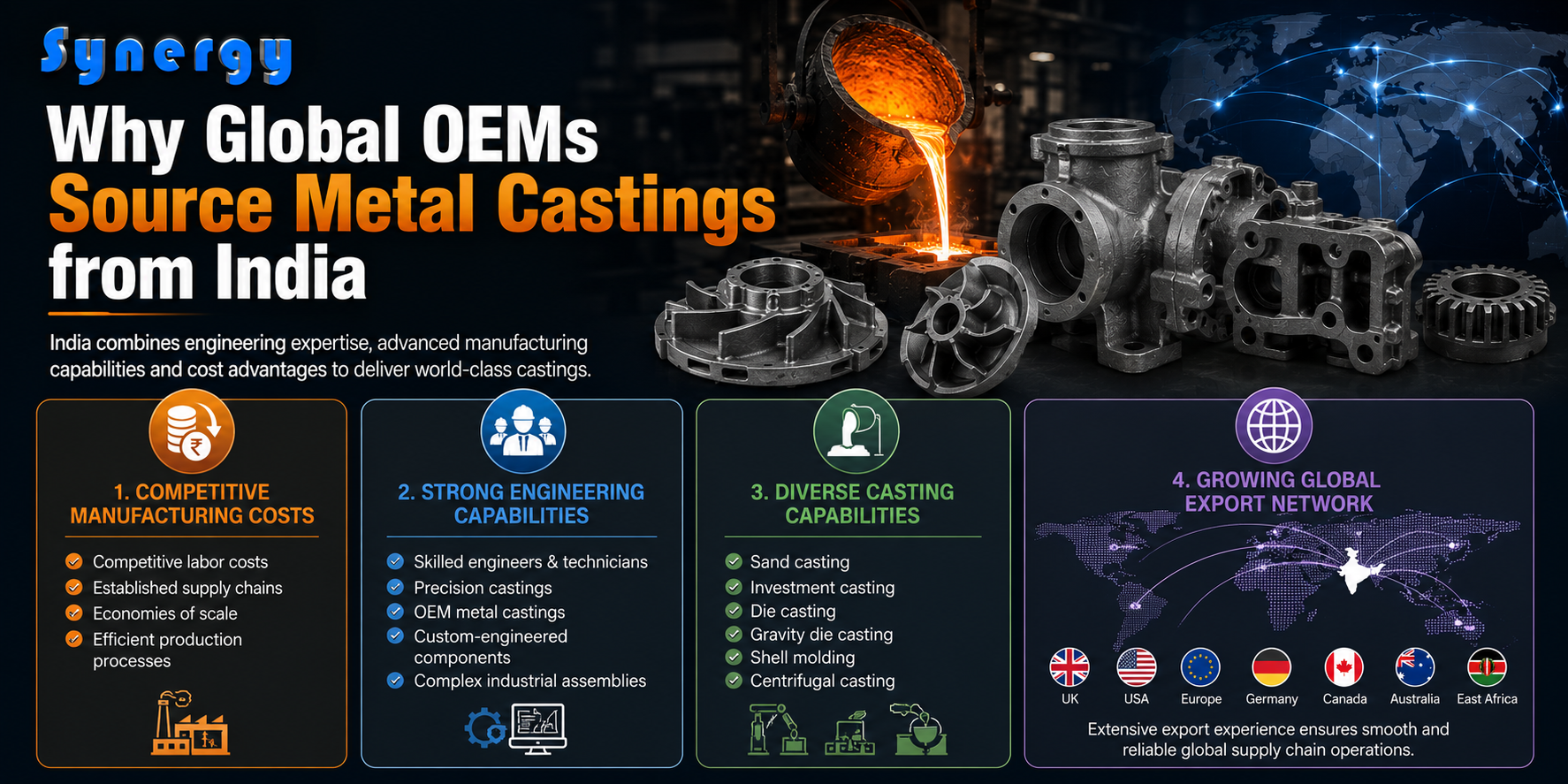
India has become one of the world’s leading manufacturing destinations for industrial castings and engineered metal components.
Many international buyers choose India for their casting requirements due to a combination of technical expertise, manufacturing capabilities, and cost advantages.
Competitive Manufacturing Costs
India offers significant cost efficiencies without compromising product quality.
Manufacturers benefit from:
- Competitive labor costs
- Established supply chains
- Economies of scale
- Efficient production processes
Strong Engineering Capabilities
India’s manufacturing sector is supported by highly skilled engineers, technicians, and production specialists.
This expertise enables the production of:
- Precision castings
- OEM metal castings
- Custom-engineered components
- Complex industrial assemblies
Diverse Casting Capabilities
Indian manufacturers support multiple casting technologies, including:
- Sand casting
- Investment casting
- Die casting
- Gravity die casting
- Shell molding
- Centrifugal casting
This diversity allows buyers to source a wide range of products from a single manufacturing region.
Growing Global Export Network
Indian casting manufacturers supply products to:
This extensive export experience helps ensure smooth international supply chain operations.
Why Choose India Synergy for Custom Metal Casting Solutions
Finding the right manufacturing partner is just as important as selecting the right casting process or material.
India Synergy helps global OEMs, industrial manufacturers, procurement professionals, and engineering companies source high-quality metal castings through a structured and reliable sourcing approach.
Our Capabilities Include:
- Custom metal casting services
- Precision casting solutions
- OEM metal castings
- Industrial casting sourcing
- Supplier qualification
- Quality assurance management
- Machining and fabrication support
- Export logistics coordination
What Sets India Synergy Apart?
- Strong manufacturing partner network
- Engineering-focused sourcing support
- Comprehensive quality management
- End-to-end project coordination
- Global export expertise
- Cost-effective manufacturing solutions
Whether you require prototype components, precision castings, large industrial castings, or high-volume OEM production, India Synergy provides complete casting solutions tailored to your technical and commercial requirements.
By combining engineering knowledge, manufacturing expertise, and global sourcing capabilities, India Synergy helps customers achieve reliable, high-quality, and cost-effective casting outcomes across diverse industries and applications.
Common Metal Casting Defects and How Manufacturers Prevent Them
Even with advanced manufacturing processes, metal casting defects can occur if process controls, tooling, materials, or production parameters are not properly managed. Understanding common casting defects helps manufacturers improve quality, reduce waste, and ensure consistent product performance.
At India Synergy, quality assurance and process control are integrated throughout the manufacturing cycle to minimize defects and improve casting reliability.
Porosity in Metal Castings
Porosity is one of the most common casting defects and occurs when gas becomes trapped within the molten metal during solidification.
Causes of Porosity
- Excess gas in molten metal
- Improper mold design
- Poor venting systems
- Inadequate process control
Prevention Methods
- Controlled pouring techniques
- Proper mold design
- Degassing procedures
- Optimized process parameters
Reducing porosity improves mechanical strength and overall casting performance.
Shrinkage Defects
Shrinkage occurs when molten metal contracts during cooling and solidification.
Common Causes
- Insufficient feeding systems
- Poor gating design
- Improper solidification control
Prevention Techniques
- Proper riser placement
- Optimized mold design
- Controlled cooling rates
- Casting simulation analysis
Effective shrinkage control helps improve structural integrity and dimensional consistency.
Surface Defects
Surface imperfections can affect appearance, performance, and customer acceptance.
Examples Include
- Surface cracks
- Rough finishes
- Sand inclusions
- Metal penetration
Prevention Methods
- High-quality mold preparation
- Proper mold coatings
- Process monitoring
- Controlled pouring temperatures
Surface quality is especially important for precision metal castings and export-quality castings.
Dimensional Variations
Dimensional inaccuracies can create assembly problems and increase machining requirements.
Causes
- Tooling wear
- Pattern inaccuracies
- Mold movement
- Process inconsistencies
Quality Improvement Measures
- Precision tooling
- Regular inspection
- Process validation
- Statistical quality control
Maintaining dimensional accuracy is critical for OEM metal castings and industrial components.
Quality Control in Metal Casting Manufacturing
Quality assurance plays a critical role in ensuring castings meet customer requirements, industry standards, and application-specific performance expectations.
Modern metal casting companies utilize comprehensive inspection and testing procedures throughout production.
Raw Material Inspection
Quality begins with verifying incoming materials.
Typical inspections include:
- Material certification review
- Chemical composition analysis
- Traceability verification
- Supplier quality assessment
Process Monitoring
Continuous monitoring helps ensure consistency during production.
Key controls include:
- Furnace temperature monitoring
- Pouring parameter control
- Mold quality verification
- Process documentation
Dimensional Inspection
Manufacturers use advanced measurement techniques to verify dimensional accuracy.
Methods may include:
- Coordinate Measuring Machines (CMM)
- Precision gauges
- 3D scanning systems
- Digital measurement tools
Mechanical Testing
Mechanical testing confirms that components meet performance requirements.
Common tests include:
- Tensile strength testing
- Hardness testing
- Yield strength evaluation
- Impact resistance testing
Non-Destructive Testing (NDT)
NDT methods help identify defects without damaging the component.
Popular techniques include:
Ultrasonic Testing (UT)
Detects internal flaws and discontinuities.
Magnetic Particle Inspection (MPI)
Identifies surface and near-surface defects in ferrous materials.
Dye Penetrant Testing (DPT)
Used to detect cracks and surface imperfections.
Radiographic Testing (X-Ray)
Provides detailed inspection of internal structures.
These quality control procedures help ensure reliable performance in critical applications.
Future Trends in Metal Casting Manufacturing
The metal casting industry continues to evolve through technological innovation, automation, and digital manufacturing technologies.
Companies investing in advanced casting solutions are achieving improved quality, productivity, and sustainability.
Casting Simulation Software
Modern casting simulation tools allow engineers to predict and eliminate defects before production begins.
Benefits include:
- Reduced development costs
- Faster product launches
- Improved quality
- Optimized tooling design
Automation and Smart Manufacturing
Automated systems are transforming casting operations.
Examples include:
- Robotic pouring systems
- Automated mold handling
- Digital quality monitoring
- Smart production tracking
Automation improves consistency and manufacturing efficiency.
Precision Manufacturing Technologies
Demand for tighter tolerances and improved performance is driving growth in precision casting services.
Industries such as aerospace, medical equipment, and advanced engineering increasingly require high-accuracy cast components.
Sustainable Metal Casting
Manufacturers are focusing on environmentally responsible production practices.
Key initiatives include:
- Recycled metal usage
- Energy-efficient furnaces
- Reduced material waste
- Sustainable manufacturing processes
Sustainability is becoming an important factor in global sourcing and supplier selection decisions.
Conclusion
Metal casting remains one of the most important manufacturing processes in modern industry. From large industrial machinery systems to precision-engineered OEM components, castings play a vital role in supporting global manufacturing operations.
Understanding casting processes, material selection, quality control requirements, and industry applications allows businesses to make informed sourcing and production decisions.
Whether you require sand castings, investment castings, die castings, steel castings, aluminum castings, or fully customized OEM components, selecting the right manufacturing partner is essential for long-term success.
Partner with India Synergy for Reliable Metal Casting Solutions
India Synergy provides custom metal casting services, precision casting solutions, OEM manufacturing support, quality assurance management, machining services, fabrication solutions, and global sourcing expertise.
With access to qualified manufacturing partners, engineering support, and export-quality production capabilities, India Synergy helps businesses source high-quality metal castings that meet demanding technical and commercial requirements.
Contact India Synergy today to discuss your project requirements and discover the most suitable casting solution for your application.
Frequently Asked Questions About Metal Casting
What is metal casting?
Metal casting is a manufacturing process where molten metal is poured into a mold and allowed to solidify into a desired shape. It is widely used for producing industrial components, OEM parts, and engineering products.
What are the main types of metal casting?
The most common metal casting processes include sand casting, investment casting, die casting, gravity die casting, shell molding, and centrifugal casting.
Which industries use metal castings?
Metal castings are widely used in industrial machinery, oil and gas, mining, agriculture, railways, power generation, marine, and construction industries.
What materials can be used for metal casting?
Common casting materials include steel, stainless steel, ductile iron, grey iron, aluminum, brass, bronze, zinc, and specialized alloy metals.
What is the difference between casting and machining?
Casting forms a component by pouring molten metal into a mold, while machining removes material from a solid workpiece to create the desired shape.
What is precision casting?
Precision casting, often referred to as investment casting, is a manufacturing process used to produce highly accurate components with excellent surface finish and tight dimensional tolerances.
What are OEM metal castings?
OEM metal castings are custom components manufactured according to an original equipment manufacturer’s drawings, specifications, and performance requirements.
Why is India a preferred destination for metal casting services?
India offers strong engineering capabilities, diverse casting technologies, competitive manufacturing costs, skilled labor, and extensive export experience.
How do manufacturers ensure casting quality?
Quality is maintained through material testing, process monitoring, dimensional inspection, mechanical testing, non-destructive testing, and final quality verification procedures.
How can I select the right metal casting company?
Businesses should evaluate manufacturing capabilities, quality systems, industry experience, engineering expertise, supplier reliability, and export capabilities before selecting a casting partner.
