





ABSTRACT:
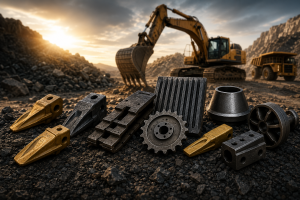
The process of Mineral Excavation and its Processing, Earth Works and even Shredding of wastes/discharges takes the help of Metal Parts having high hardness and they can be branded as WEAR PARTS. In the work field, these parts wear out and are replaced when they reach their unusable conditions. The present submission outlines the wear, its phenomena, its metallurgical factors and how to curtail down this inevitable phenomenon – as the replacements of the parts are a cost. An attempt has also been done to outline the nature of wear, with a simple discussion on the commonly used metal grades – Steels and Irons – Their Metallurgical Characteristics and essential features which govern the wear. All this has been attempted in layman’s language. However, for more clarity and doubts the Author is available through E Mail – expressed above.
INTRODUCTION:
Operations like Mineral Excavation/Processing and similar ones in other fields have actions like Mining, Crushing and Grinding which take the help of commonly used Handling Machines like Shovels, Dumpers etc. They also have their moving and transporting activities dependent on their own wear parts. The material processed and handled are usually quite abrasive and the machine parts in contact with the minerals wear out. This damage to the equipment by the abrasion is of enormous value and is a continuing challenge to engineers and metallurgists. In short, the components should be of high Hardness which is possible in Ferrous Metal grades only. Unfortunately, while developing high hardness the Metals become brittle losing their toughness. Over the last century, some Ferrous grades with Chromium have been zeroed down and have become popular. However, lot of research work is still going on taking specific cases and there is no closing of research work.
The vast increase in size and scale of equipment used in the above-mentioned activities, while contributing to a manifold increase in production targets, has also a cost creating an emphasis on cost cutting. This definitely provides an incentive to take a closer look at the recent development of newer abrasion resistant material. To bring down the operational costs.
UNDERSTANDING “WEAR”:
All the Wear parts, as the name suggests, undergo relative movement of mineral, parts of earth surface or even effected by material being shredded, causing indentation and scratching. This phenomenon can be described as similar to the case of grinding or polishing due to abrasive wear taking place. However, in the former case it is a desired effect of enforced moving contact of 2 materials. This abrasive wear is generally segregated into 3 categories: Low Stress, Grinding and Gouging wear.
- The low stress abrasion is defined as a condition in which the stress imposed on abrasive particles does not exceed the crushing strength of the particles and wear occurs due to scratching only leaving the abrasive material This condition arises during pumping of sand slurries, conveying of ore concentrates, earth moving etc. to mention few examples.
- In the Grinding Wear, the stress is of medium level but nevertheless is large enough to exceed the crushing strength of the abrasive being ground: as a result, fresh cutting surfaces are continuously generated during the operation. Grinding in rotary mills with balls and rods – named as grinding media – fall in this category.
- In the Gouging Wear, the abrasive is assumed to plough rigidly into the material; often under impact and high stress condition. These conditions exist in jaw crushing, pulverising or even crack forming on surfaces.
In the abrasion of ductile metals, not all of the material displaced from the groove or the furrow created by the passage of the abrasive is removed as a chip. Depending upon a number of factors some material may be merely displaced sideways to form of raised hammocks along the edges of the grooves. The chip forming and hammock forming mechanism are generally referred as cutting and ploughing respectively which are to be controlled to develop the quality of wear resistance.
METALLURGICAL ASPECTS:
Wear resistance of a material is a property by virtue of which it resists removal of its surface material. Since it is a material property, it will in turn be decided by its other material characteristics viz. chemical composition, strength, toughness, hardness, types of microstructural constituents, their properties and distribution etc.
The wear characteristics of various materials vary considerably. Brittle materials like glasses, ceramics and intermetallic compounds that exhibit elastic fracture are quite different from ductile metals that can be considered as rigid plastics. Although under some conditions classically brittle materials can be induced to form chips, indentation often results in crack formation and spalling and for this reason wear resistance under same condition can be lower than that of ductile material of same hardness.
From the list of these contributing factors, it should be understood that wear resistance is a very complex property. To add to these complexities, the wear resistance of a given material also depends upon the type of wear (i.e. low stress, grinding or gouging) to which the material is subjected to, type of abrasive in terms of its hardness and crushing strength, ratio of material hardness to abrasive hardness, presence or absence of corrosive media etc.
Without going into details of each of the factors as enumerated above, the user of wear parts should let us concentrate on the characteristic material properties only, which contribute to its wear resistance. Hardness and Toughness are the main characteristics. Unfortunately, there exists an inverse relationship between the two. An ideal material thus would be balancing the two properties and this is what metallurgists have been trying to do in developing suitable alloys.
The broad array of wear resistant materials, based on alloys of iron range from ordinary plain carbon steels for grinding and crushing of soft materials to highly alloyed complex iron alloys, are used in grinding and crushing of hard silicious and aluminous minerals or similar ones. In general, with increasing carbon content, wear resistance of steel increases. However further modification of wear resistance is possible by addition of various alloying elements and heat treatment. The popular wear resistant brands of materials like Hadfield Manganese Steel (Austenitic Manganese Steel*), Hyper Steel, White Cast Iron, High-Chrome White Iron, Chrome-Moly Iron, Ni-Hard are based on these principles. The names or brands apart, in the metallurgical language these fall into the following basic categories:
- Ferritic + Pearlitic
- Pearlitic
- Pearlitic + Cementite
- Low-alloy Martensitic
- Austenitic Manganese
- Pearlitic White
- Austenitic White
- Martensitic White
Varieties (i) through (v) fall in the steel category characterized by less than 2% carbon, while varieties (vi) through (viii) belong to the cast iron family essentially with more than 2% carbon.
The names Ferrite, Pearlite, Cementite, Austenite, Martensite refer to the microstructural constituents present in the alloy. An alloy can, in principle, contain any one or more or all the microconstituents mentioned. As can be expected, the mechanical properties of the steel will be an average of the properties of the individual constituents and their relative proportions and distribution in the matrix.
Ferrite is almost pure iron and is the lowest in hardness. Cementite is the name given to a compound Fe3C composed of iron and carbon atoms. Hence, all steel, in whatever form, will essentially contain this constituent. In ordinary unheat-treated plain carbon steels, this is the hardest constituent. Pearlite is a
mixture of ferrite and cementite in an approximate proportion of 7.5 to 1 and hence hardness of pearlite is somewhere in between that of ferrite and cementite. In addition, it shows a range of hardness depending upon the fineness of the mixture.
Martensite is formed when the steel is subjected to heat-treatment in which it is heated to a temperature range of 800 to 1000°C depending upon carbon content and quenched in water or oil. Ability of steel to respond to such a treatment is called hardenability which increases with increasing carbon content.
However, with increasing carbon content and thickness there is a danger of cracking of the component during water or oil quenching. Addition of alloying elements like Manganese, Chromium, Nickel, Molybdenum in small or moderate amounts eliminates this risk of cracking by increasing the hardenability and one can get Martensite even by air cooling the steel if composition is properly adjusted. This has given rise to a class of alloy steels called Low-Alloy Hardenable Steels. Hardness of Martensite depends upon its carbon content and increases with increasing amount of carbon.
The Austenite is obtained by heating the steel above a certain temperature and it breaks up into the constituents as mentioned above once it is cooled to room temperature. However, by alloying the steel with large amounts of alloying elements, the austenite can be retained even at room temperature as evidenced in Austenitic Manganese Steel (with 10 to 14% Mn and 1.0 to 1.4% C) or in Austenitic Stainless Steels (with 18% Cr and 8 to 12% Ni). Unlike Martensite, however, Austenite is a soft constituent as indicated in Table-I.
* Manganese Steel – Also known as Hadfield Steel, named on its inventor Dr. Hadfield – has a typical phenomenon of getting hardened under impacts and thus getting converted to abrasive grades. As heat treated the micro structure of Austenite Grains which, having RC 20 Hardness, are very soft. But after impacts in cold (No Heating) conditions, the Austenite changes to Martensite reaching Hardness of about RC 55 and gets into the brand of wear resistant material.
As indicated earlier, Cementite is a carbide of iron and has high hardness. The desirable property is offset by its extreme brittleness and presence of excessive amounts of this constituent in steels or white cast irons makes them brittle. This is why white cast irons or Ni-hard (which essentially contain more than 2% C) on account of having large amount of cementite are very brittle.
The nature of each of the above constituents and its hardness are listed in Table-I. In addition, it shows a range of hardness depending upon the fineness of the mixture.
TABLE – I
CONSTITUENTS OF STEELS AND CAST IRONS AND THEIR HARDNESS VALUES
| Constituent | Vickers Hardness (HV) | Rockwell Hardness (RC) |
| Ferrite | 90 | — |
| Pearlite | 220 – 350 | 20 – 35 |
| Cementite | 550 | 55 |
| Martensite | 350 (at 0.15% C) | 38 – 68 |
| to 900 (at 0.8% C) | ||
| Austenite | ||
| a- (12% Manganese Steel) | 220 | 20 |
| b- (316 Stainless Steel) | 190 | 18 |
TABLE – II (A)
(Effect of Carbon on Mechanical Properties of Steels & White Irons)
| Carbon Increase | Effect |
| Hardness | Increases |
| Toughness | Decreases |
| Strength | Increases |
| Ductility | Decreases |
| Wear Resistance | Increases |
(Effect of Carbon on the Amount of Microstructural Constituents and Overall Properties of the Steel or Iron)
In the case of wear resistant materials, indicates that with increase in carbon content both hardness and wear resistance of all the constituents increase but the toughness progressively decreases. Hence, from the point of view of applications, appropriate choice of carbon content should be made.
Further distinction between the properties of Pearlite, Martensite and Carbides can be made as shown in Table-I and on that basis, it can be said that they show increasing wear resistance in the same order.
Now if we produce a mixture of these constituents in steels and cast irons by suitable compositional adjustments, series of alloys with increasing hardness and wear resistance can be developed. Thus, the series as stated earlier in page 2 for the varieties developed (Repeated again in sequential order.
- i) Ferritic, ii) Ferritic + Pearlitic, iii) Pearlitic + Cementite, iv) Pearlitic + Martensitic, v) Pearlitic + Martensitic + Cementite, vi) Martensitic, vii) Martensitic + Cementite
The last one has highest hardness and wear resistance and well-known Ni-Hard belongs to this class. However, with increasing hardness and wear resistance in this series, the toughness decreases continuously and we are always in a paradoxical situation with respect to these two properties.
An ideal material would thus be a composite material containing hard brittle particles (Carbides) dispersed in a softer ductile matrix (Austenite, Martensite or Ferrite Carbide Aggregate). In this sense they are very similar to sintered tungsten carbide (Tungsten Carbide in a Cobalt matrix), a softer cushioning area of high toughness with hard particles to face the abrasion.
It is observed that under condition of gouging abrasion, wear resistance seems to be favoured slightly by the presence of Martensite in microstructure. Carbides control wear behaviour in low stress wear & their attrition occurs in uniform scratching, preferential chipping at leading edges & cracking spalling.
It should also be kept in mind that unalloyed & low alloy iron carbon alloys have low toughness in the Martensite condition with carbon contents above 0.4% and their toughness is very low in the case of hyper-eutectoid steels and white iron because of the morphology of the Cementite that they contain. Heat treatment, however, improves the same.
If alloying elements are added in sufficient quantities Carbides of a type different from Cementite can be obtained which have a higher hardness thus enhancing the abrasion resistance. These Carbides also have a morphology that is more favourable for the toughness. Such alloys reduce the Carbon content of the matrix which in turn allows simultaneous improvement of both Toughness & Abrasion Resistance
It should, however, be kept in mind that the wear resistance of a wear part does not only depend on its own hardness and microstructure but also depend on the hardness of the mineral or material with which it engages itself. The basic rule that the harder material can scratch the softer always holds good. In view of these attempts are made to make the wear part as harder as possible to effect grinding or crushing of the mineral, earthwork or material to be shredded.
CONCLUDING:
The variables which affect wear are identifiable and this information can be used in a qualitative sense to improve overall wear resistance and field performance improvement. The item under wear, its geometry, size and the engaging material are main factors to select best material. Lot of information and feedbacks are available. A new methodology of micro alloying of elements like Titanium, Vanadium, Niobium and Boron have successfully been used to reduce the wear and improve the working life.
In practice the Buyer of the Wear Parts – Generally High-Level Engineering Original Equipment Manufacturers – come out with their own Designs and Material/Specifications. The Foundries doing these parts follow the RFQs given by the Buyer and the Foundries do follow the requirements. But some foundries having their R&D set ups do keep on experimenting on Metallurgical parameters – with some effective life improvement – on the Chemical Composition (Even Micro Alloying), Heat Treatment Practices and Mico examination including the Grain Size and distribution of different phases. This helps in developing Tailor made Materials for same wear part but different field applications.
The attached Annexures do cover the mineral and metal phase needed for best results, as a guideline, along with a list of main wear parts and photos will help the readers to frame up their minds.