





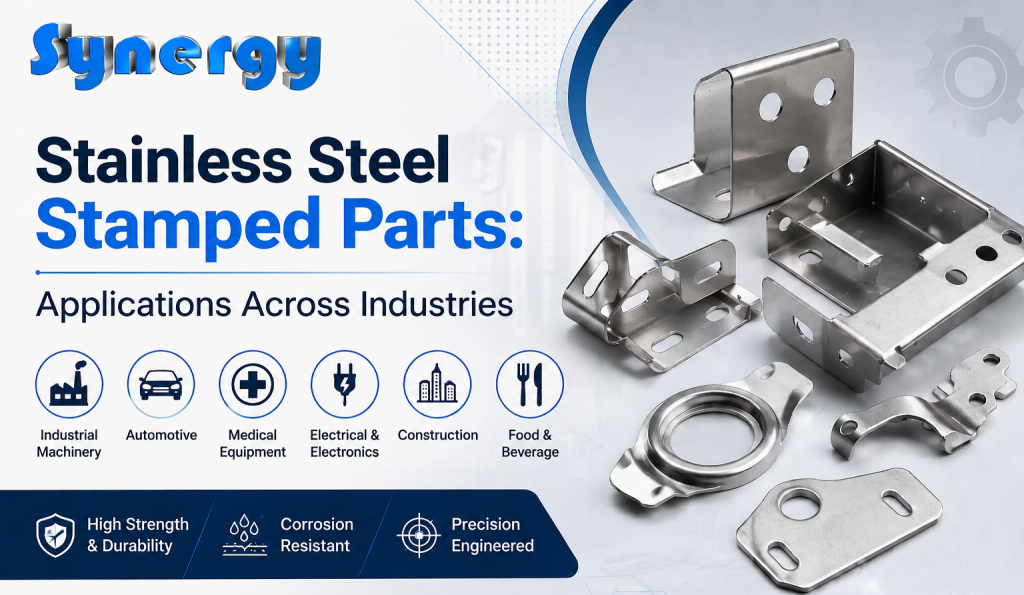
Stainless steel stamped parts are precision-engineered components manufactured by shaping stainless steel sheets or strips through controlled stamping operations. These components are widely used across automotive, electrical, electronics, medical, aerospace, construction, food processing, machinery, and renewable energy industries because of their strength, corrosion resistance, dimensional stability, and long service life.
With growing demand for reliable and customized metal components, India Synergy provides stainless steel stamped parts solutions designed to meet the requirements of OEMs, industrial manufacturers, and engineering companies. From simple brackets and clips to complex precision components, stainless steel stamping offers an efficient solution for both small and high-volume production requirements.
What Are Stainless Steel Stamped Parts?
Stainless steel stamped parts are components produced from stainless steel sheets, strips, or coils using specialized stamping presses and dies. During the stamping process, controlled force is applied to the material to create the required shape, size, holes, bends, or contours.
Depending on the component design, manufacturers can use operations such as blanking, punching, bending, forming, drawing, and embossing.
The process enables manufacturers to produce consistent components with repeatable dimensions, making stainless steel stamping suitable for applications where quality, accuracy, and production efficiency are important.
Why Is Stainless Steel Used for Stamped Parts?
Stainless steel combines mechanical strength with excellent resistance to corrosion and environmental exposure. These properties make it suitable for components used in demanding industrial conditions.
Key advantages include:
- High corrosion resistance
- Excellent mechanical strength
- Good dimensional stability
- Long service life
- Resistance to moisture and many chemicals
- Good surface finish
- Hygienic characteristics
- Suitable for high-temperature applications depending on grade
- Excellent suitability for precision forming
- Compatibility with high-volume production
For industries requiring durable components with consistent performance, stainless steel stamped parts can provide a practical and reliable manufacturing solution.
How Are Stainless Steel Stamped Parts Manufactured?
The manufacturing process depends on the component geometry, material grade, thickness, tolerance, and production volume.
1. Material Selection
The appropriate stainless steel grade is selected according to the application’s mechanical, corrosion, temperature, and forming requirements.
Common grades include SS 301, SS 304, SS 316, and SS 430.
2. Tool and Die Design
A stamping die is designed according to the required dimensions and geometry of the component. Proper die design is essential for achieving consistent results and minimizing material deformation.
3. Sheet or Coil Preparation
Stainless steel sheets or coils are prepared according to the required dimensions and fed into the stamping equipment.
4. Stamping Operation
The material is pressed between the die and punch to create the required component shape. Depending on the design, multiple operations may be performed.
5. Secondary Operations
Some components may require additional processes such as deburring, bending, trimming, piercing, surface finishing, or assembly.
6. Quality Inspection
Finished components are inspected for dimensions, surface condition, tolerances, and other customer-specific requirements.
Types of Stainless Steel Stamped Parts
Manufacturers can produce a wide variety of components through stainless steel stamping. Some commonly produced parts include:
- Stainless steel brackets
- Mounting plates
- Clips
- Clamps
- Washers
- Covers
- Housings
- Electrical terminals
- Connector components
- Retainers
- Fittings
- Precision formed components
- Industrial machine components
- Custom OEM components
The exact component design can be customized according to drawings, samples, technical specifications, and application requirements.
Applications of Stainless Steel Stamped Parts Across Industries
The versatility of stainless steel stamping allows these components to be used across numerous industrial sectors.
Automotive Industry
The automotive industry uses stamped stainless steel components for applications requiring strength, precision, and resistance to environmental conditions.
Typical applications include:
- Mounting brackets
- Clips and retainers
- Support components
- Electrical terminals
- Heat-resistant components
- Engine and under-hood components
- Exhaust-related components
As automotive manufacturing increasingly focuses on lightweight, efficient, and durable components, precision stamping continues to play an important role in component production.
Electrical and Electronics Industry
Electrical and electronic products require small, accurate, and reliable metal components. Stainless steel stamping can produce components with consistent dimensions and repeatability.
Applications include:
- Electrical terminals
- Connector components
- Contact parts
- Mounting components
- Shielding components
- Small precision parts
- Electronic hardware
The ability to produce large quantities of identical components makes stamping particularly suitable for electronics manufacturing.
Medical and Healthcare Industry
Medical equipment and devices often require materials that offer corrosion resistance, durability, and hygienic properties.
Stainless steel stamped components may be used in:
- Medical equipment
- Device housings
- Equipment brackets
- Support components
- Precision medical hardware
- Healthcare equipment assemblies
Material selection and manufacturing controls are especially important for components intended for demanding medical applications.
Aerospace Industry
Aerospace applications require components capable of performing reliably under demanding environmental and operational conditions.
Stainless steel stamped parts can be used for:
- Brackets
- Mounting components
- Support parts
- Fittings
- Precision sheet metal components
- Specialized hardware
For aerospace-related applications, manufacturers need to carefully control material specifications, dimensions, tolerances, and quality requirements.
Industrial Machinery
Industrial equipment manufacturers use stamped stainless steel components in machinery, production equipment, automation systems, and other engineered products.
Common applications include:
- Machine brackets
- Mounting plates
- Covers
- Guards
- Clamps
- Support components
- Fastening components
Stamped parts can help manufacturers achieve consistent production when the same component is required in large quantities.
Construction Industry
Stainless steel stamped components are also used in construction-related hardware and engineered systems.
Applications may include:
- Structural brackets
- Clips
- Connectors
- Mounting hardware
- Fittings
- Support components
Their corrosion resistance makes stainless steel particularly useful in applications exposed to moisture or changing environmental conditions.
Food Processing Industry
Food processing equipment requires components that can withstand moisture, cleaning procedures, and frequent use. Stainless steel is widely selected because of its corrosion resistance and hygienic characteristics.
Stamped components can be used for:
- Equipment brackets
- Covers
- Fittings
- Machine components
- Mounting parts
- Support components
The appropriate stainless steel grade and surface finish should be selected according to the application’s requirements.
Renewable Energy Industry
The expansion of solar, wind, and other renewable energy systems is creating demand for durable precision metal components.
Stainless steel stamped parts may be used in:
- Solar equipment
- Mounting systems
- Electrical components
- Brackets
- Support parts
- Energy equipment assemblies
Their resistance to environmental exposure can be beneficial for outdoor applications.
Telecommunications Industry
Telecommunications equipment requires compact and reliable components for mounting, connecting, and protecting equipment.
Applications include:
- Equipment brackets
- Mounting components
- Connector parts
- Enclosure components
- Precision fittings
- Support hardware
Benefits of Stainless Steel Stamped Parts
Choosing stamped stainless steel components can provide several manufacturing advantages.
High Production Efficiency
Stamping enables manufacturers to produce large quantities of components efficiently once the required tooling is developed.
Consistent Dimensions
Properly designed stamping tools can produce components with repeatable dimensions, which is important for OEM assembly.
Cost Efficiency for High Volumes
For large production runs, stamping can offer competitive per-piece costs because the process can be highly automated and repeatable.
Reduced Material Waste
Efficient tooling and nesting strategies can help manufacturers optimize material utilization.
Custom Designs
Stamping dies can be developed for specific component shapes, dimensions, and functional requirements.
Reliable Performance
Stainless steel provides a combination of strength, corrosion resistance, and durability suitable for many industrial environments.
Which Stainless Steel Grades Are Commonly Used for Stamping?
Different stainless steel grades offer different combinations of strength, corrosion resistance, formability, and other characteristics.
| Stainless Steel Grade | General Characteristics | Typical Considerations |
| SS 301 | High strength and good formability | Springs, clips, precision components |
| SS 304 | Good corrosion resistance and versatility | Industrial, electrical, food equipment |
| SS 316 | Enhanced corrosion resistance | Chemical, marine, demanding environments |
| SS 430 | Good corrosion resistance and magnetic properties | Automotive, appliances, industrial applications |
The appropriate grade should be selected based on the component’s operating environment, forming requirements, strength requirements, and customer specifications.
Stainless Steel Stamping vs Other Manufacturing Methods
Different metal manufacturing methods are suitable for different component requirements.
| Manufacturing Method | Main Advantage | Common Applications |
| Stainless Steel Stamping | Efficient high-volume production | Brackets, clips, terminals |
| CNC Machining | High precision and complex machining | Engineered components |
| Laser Cutting | Flexible sheet profiles | Prototypes and sheet parts |
| Casting | Complex three-dimensional shapes | Heavy industrial components |
| Forging | High strength | Load-bearing components |
For high-volume production of repeatable sheet metal components, stamping can be an effective manufacturing method.
What Should You Consider When Choosing Stainless Steel Stamped Parts?
Before manufacturing a component, several technical factors should be evaluated:
- Stainless steel grade
- Material thickness
- Component dimensions
- Required tolerances
- Component geometry
- Production volume
- Surface finish
- Operating environment
- Tooling requirements
- Secondary operations
- Inspection requirements
- Packaging and delivery requirements
Early involvement of the stamping manufacturer can help identify potential design or tooling issues before production begins.
Custom Stainless Steel Stamped Parts for OEMs
OEMs often require components manufactured according to their drawings, specifications, samples, or application requirements.
India Synergy works with industrial customers requiring customized stainless steel stamped components for different applications. Depending on the project, the manufacturing process can include tooling development, stamping, secondary operations, inspection, and production support.
Custom manufacturing can be particularly useful when standard off-the-shelf components cannot meet specific dimensional or functional requirements.
Why Choose India Synergy for Stainless Steel Stamped Parts?
India Synergy focuses on providing engineered metal component solutions for industrial and OEM requirements. Stainless steel stamping can be developed around the customer’s component design, material specification, production volume, and quality expectations.
Key areas to consider when working with India Synergy include:
- Custom stainless steel stamped components
- OEM-focused manufacturing
- Precision component production
- Multiple stainless steel material options
- High-volume production support
- Custom tooling and die requirements
- Quality inspection
- Application-oriented engineering support
Whether the requirement involves a simple bracket or a complex precision-formed component, selecting the appropriate material, tooling, process, and inspection method is essential for achieving consistent production results.
Stainless Steel Stamped Parts India for Industrial and OEM Applications
The demand for stainless steel stamped parts India continues to grow as manufacturers look for reliable, durable, and cost-effective metal components. India’s expanding automotive, electronics, machinery, renewable energy, electrical, and engineering sectors are creating opportunities for precision metal component manufacturers.
For OEMs and industrial buyers, sourcing from an experienced Indian manufacturer can provide access to customized production, competitive manufacturing capabilities, and support for both domestic and export-oriented requirements.
India Synergy supports industrial customers looking for stainless steel stamped component solutions tailored to specific engineering and production requirements.
Future of Stainless Steel Stamping in India
The Indian manufacturing sector is increasingly adopting automation, advanced tooling, precision inspection, and efficient production technologies. These developments are expected to support the growth of stainless steel stamping for domestic and international markets.
Several trends are influencing the sector:
- Increasing OEM demand
- Growth of electronics manufacturing
- Expansion of electric vehicle production
- Increasing automation
- Advanced stamping technologies
- Higher precision requirements
- Growth of renewable energy equipment
- Increasing export opportunities
As industries continue to demand lightweight, durable, corrosion-resistant, and precisely manufactured components, stainless steel stamping is likely to remain an important manufacturing process.
Conclusion
Stainless steel stamped parts have become important components across a wide range of industries because they combine durability, corrosion resistance, dimensional consistency, and efficient production. From automotive brackets and electrical terminals to industrial machinery components and renewable energy hardware, stainless steel stamping can support diverse manufacturing requirements.
For businesses searching for stainless steel stamped parts India, the right manufacturing partner should be able to understand the application, select suitable materials, develop appropriate tooling, maintain dimensional consistency, and support the required production volume.
With its focus on industrial and OEM component solutions, India Synergy can support customers seeking customized stainless steel stamped parts for demanding applications across multiple industries.
Frequently Asked Questions
What are stainless steel stamped parts?
Stainless steel stamped parts are components manufactured by forming stainless steel sheets, strips, or coils using stamping presses and specially designed dies.
Which industries use stainless steel stamped parts?
They are used in automotive, electrical, electronics, aerospace, medical, construction, food processing, industrial machinery, renewable energy, and telecommunications applications.
Which stainless steel grade is best for stamping?
There is no single grade that is best for every application. SS 301, SS 304, SS 316, and SS 430 are commonly considered depending on the required strength, corrosion resistance, formability, and application environment.
Can stainless steel stamped parts be customized?
Yes. Stainless steel stamped parts can be manufactured according to engineering drawings, samples, dimensions, material specifications, and application requirements.
Are stainless steel stamped parts suitable for high-volume production?
Yes. Stamping is particularly suitable for high-volume production because properly designed tooling can produce large quantities of consistent components efficiently.
What factors affect the cost of stainless steel stamped parts?
Material grade, material thickness, component complexity, tooling requirements, production volume, tolerances, secondary operations, surface finish, and inspection requirements can all affect the overall cost.
How do I choose a stainless steel stamped parts manufacturer in India?
Consider the manufacturer’s stamping capabilities, tooling expertise, material options, production capacity, quality systems, inspection facilities, customization capabilities, and experience with OEM requirements.
Are stainless steel stamped parts corrosion resistant?
Stainless steel generally provides good corrosion resistance, although the level of resistance depends on the stainless steel grade, surface condition, and operating environment.