





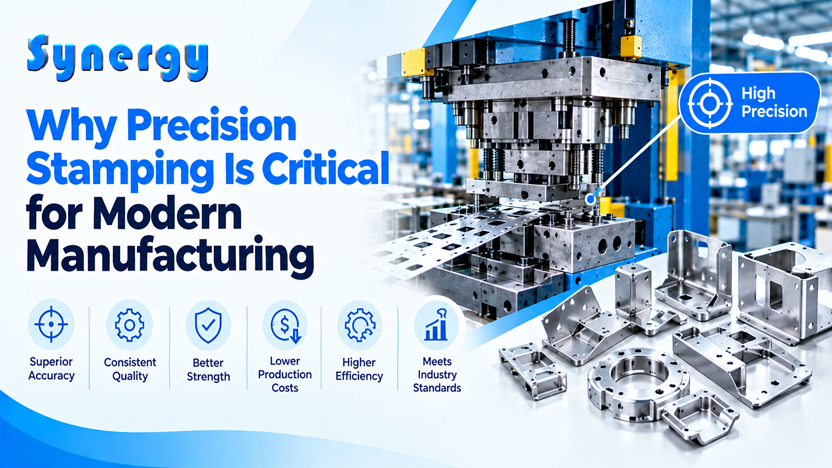
Modern manufacturing requires more than simply producing metal components quickly. OEMs and industrial manufacturers need parts that are accurate, consistent, durable, cost-effective, and capable of meeting increasingly demanding engineering specifications.
This is where precision stamping plays an important role.
Precision stamping is a metal forming process designed to manufacture components with controlled dimensions, repeatable geometries, and consistent quality. By combining advanced stamping equipment, accurately engineered dies, suitable materials, controlled production parameters, and systematic inspection, manufacturers can produce large quantities of components while maintaining required specifications.
For industries such as automotive, electrical and electronics, industrial equipment, appliances, medical equipment, and consumer products, precision stamping can improve production consistency and support efficient large-scale manufacturing.
India Synergy provides custom metal stamping and precision manufacturing solutions for OEMs and global sourcing teams looking for reliable, repeatable, and application-specific components.
What Is Precision Stamping?
Precision stamping is a manufacturing process in which sheet metal or metal strip is formed into a specific shape using a stamping press and engineered tooling.
Depending on the component design, precision stamping can include operations such as:
- Blanking
- Punching
- Bending
- Forming
- Piercing
- Embossing
- Coining
- Drawing
- Progressive stamping
The objective is to achieve accurate and repeatable component dimensions while maintaining consistent production quality.
Unlike basic stamping applications where dimensional requirements may be relatively broad, precision stamping is typically used when tighter tolerances, repeatability, complex geometries, or high production consistency are required.
Why Is Precision Stamping Critical for Modern Manufacturing?
1. Provides High Dimensional Accuracy
Modern products often contain multiple components that must fit together precisely.
A small dimensional variation in a stamped component can affect:
- Assembly fit
- Component alignment
- Product performance
- Mounting accuracy
- Mechanical movement
- Overall product reliability
Precision stamping uses carefully engineered dies, controlled press parameters, and appropriate material specifications to produce components within defined dimensional requirements.
This makes it valuable for applications where consistent part dimensions are essential.
2. Improves Production Consistency
Manufacturing quality depends heavily on repeatability.
Producing one accurate component is not enough for modern high-volume manufacturing. Thousands or millions of components may need to meet the same specifications.
Precision stamping helps maintain consistency in:
- Dimensions
- Bend angles
- Hole positions
- Part profiles
- Thickness-related requirements
- Surface condition
- Overall geometry
Consistent production reduces variation between batches and makes downstream assembly more predictable.
3. Supports High-Volume Manufacturing
One of the biggest advantages of stamping is its suitability for high-volume production.
Once the appropriate tooling has been developed and production parameters are established, stamping presses can manufacture large quantities of components efficiently.
This makes precision stamping suitable for industries that require:
- Large production volumes
- Repeatable components
- Consistent cycle times
- Automated material feeding
- Reduced manual intervention
For OEMs with ongoing production requirements, precision stamping can provide a scalable manufacturing solution.
4. Reduces Manufacturing Variation
Variation can occur because of differences in material properties, tooling condition, machine settings, or production processes.
Precision stamping focuses on controlling these variables.
A well-controlled stamping process can help reduce variation through:
- Accurate die design
- Controlled press settings
- Consistent material quality
- Tool maintenance
- In-process inspection
- Production monitoring
Lower variation can result in more predictable component quality.
5. Improves Product Quality
Product quality is directly influenced by component accuracy and consistency.
Precision stamped parts can provide improved:
- Dimensional control
- Surface consistency
- Component fit
- Repeatability
- Mechanical performance
- Assembly compatibility
For products containing multiple stamped components, maintaining consistent part quality can help improve the overall manufacturing process.
Precision Stamping and Modern Automation
Automation has become increasingly important in modern manufacturing.
Precision stamping can be integrated with automated systems for:
- Coil feeding
- Material handling
- Part transfer
- Inspection
- Sorting
- Packaging
- Production monitoring
Automated feeding systems can provide a consistent supply of material to the stamping press, while automated inspection systems can help identify defects during production.
This reduces dependence on repetitive manual operations and can improve production efficiency.
Precision Stamping Improves Material Utilization
Material cost is an important consideration in metal component manufacturing.
Poorly planned production can result in excessive scrap and unnecessary material consumption.
Precision stamping can help improve material utilization through:
- Optimized strip layouts
- Accurate blanking
- Efficient nesting
- Controlled forming
- Reduced rejection
- Progressive die design
For high-volume production, improving material utilization can have a significant impact on overall manufacturing economics.
Progressive Stamping for Material and Production Efficiency
Progressive die stamping allows multiple operations to be performed sequentially as material moves through a stamping die.
Depending on the component design, operations can include:
- Feeding
- Punching
- Blanking
- Bending
- Forming
- Embossing
- Final separation
This approach can reduce manual handling and support consistent high-volume production.
Precision Stamping Supports Complex Component Designs
Modern products often require components with more complex geometries than traditional stamped parts.
Precision stamping can support features such as:
- Small holes
- Multiple bends
- Embossed sections
- Formed profiles
- Mounting points
- Tabs
- Slots
- Deep features
- Complex contours
The feasibility of a particular design depends on material properties, thickness, component geometry, tooling, press capacity, and required tolerances.
Early design-for-manufacturing analysis can help identify potential production challenges before tooling is developed.
Importance of Tooling in Precision Stamping
Tooling is one of the most important elements of a precision stamping operation.
The quality of the die directly affects the quality of the finished component.
Precision stamping dies are designed according to:
- Component geometry
- Material type
- Material thickness
- Required tolerances
- Production volume
- Press specifications
- Forming sequence
Poorly designed or worn tooling can cause:
- Dimensional variation
- Burrs
- Incorrect bends
- Surface damage
- Cracks
- Increased rejection
- Production downtime
Regular tooling inspection and maintenance are therefore essential for maintaining consistent production quality.
Precision Stamping for Different Materials
Precision stamping can be used with a wide range of metals, depending on the component requirements.
Common materials include:
- Stainless steel
- Mild steel
- Carbon steel
- Aluminum
- Copper
- Brass
- Galvanized steel
- Other engineered metal alloys
Each material behaves differently during stamping.
Material characteristics such as strength, hardness, ductility, thickness, and springback can influence:
- Tool design
- Press force
- Forming sequence
- Lubrication
- Production speed
- Final component accuracy
Selecting the right material and stamping process is therefore an important part of precision manufacturing.
Precision Stamping and Quality Control
Quality control should be integrated throughout the production process.
A comprehensive precision stamping quality system can include:
Material Inspection
Incoming materials can be checked for:
- Material grade
- Thickness
- Surface condition
- Dimensional consistency
- Required documentation
First-Part Inspection
The first production component can be inspected against the approved engineering drawing and specifications.
In-Process Inspection
Critical dimensions can be monitored during production to identify process variation early.
Final Inspection
Finished components can be inspected for:
- Dimensions
- Hole locations
- Bend angles
- Surface condition
- Burrs
- Overall geometry
- Functional requirements
This approach helps manufacturers identify problems before large quantities of non-conforming components are produced.
How Precision Stamping Reduces Production Costs
Although precision stamping may require an initial investment in tooling, it can provide manufacturing cost advantages for suitable production volumes.
Potential cost benefits include:
- Faster production cycles
- Reduced labor requirements
- Lower material waste
- Reduced rejection
- Less rework
- Consistent production
- Efficient automation
- High-volume output
The economic benefits depend on factors such as component complexity, production volume, material, tooling requirements, and process design.
For low-volume applications, other manufacturing processes may sometimes be more appropriate. For high-volume repeat production, stamping can become increasingly cost-effective.
Precision Stamping vs Other Manufacturing Processes
Precision stamping is one of several processes available for manufacturing metal components.
The appropriate process depends on:
- Component geometry
- Material
- Volume
- Tolerances
- Surface requirements
- Production timeline
- Cost targets
Precision Stamping
Best suited for repeatable components and medium- to high-volume production where accurate tooling can be justified.
CNC Machining
Useful for components requiring machining-based geometries, complex features, or lower production volumes where stamping tooling may not be economical.
Laser Cutting
Useful for flexible sheet cutting and prototypes, particularly when dedicated stamping tooling is not required.
Sheet Metal Fabrication
Suitable when a component requires a combination of cutting, bending, welding, and assembly processes.
The right manufacturing process should be selected based on the complete production requirement rather than one isolated factor.
Industries That Use Precision Stamping
Precision stamping is used across a wide range of industries.
Automotive
Applications can include:
- Brackets
- Clips
- Retainers
- Mounting components
- Shields
- Structural parts
- Electrical components
Electrical and Electronics
Applications include:
- Contacts
- Terminals
- Shields
- Enclosures
- Connectors
- Mounting components
Industrial Equipment
Precision stamped parts can be used for:
- Machine components
- Brackets
- Supports
- Covers
- Retainers
- Hardware
Appliances
Applications can include:
- Internal brackets
- Supports
- Clips
- Panels
- Mounting components
Medical Equipment
Precision stamped components may be used for:
- Equipment brackets
- Housings
- Clips
- Mounting parts
- Small precision components
Consumer Products
Precision stamping can support the production of:
- Housings
- Brackets
- Decorative components
- Hardware
- Internal structural components
Precision Stamping for OEM Manufacturing
OEMs require manufacturing partners that can maintain consistency across production batches.
Precision stamping can support OEM requirements by providing:
- Repeatable components
- Controlled tolerances
- High-volume production
- Custom tooling
- Consistent material utilization
- Scalable production
- Quality inspection
- Application-specific manufacturing
For international OEMs, choosing an experienced manufacturing partner can also help streamline sourcing, tooling development, production, inspection, and delivery.
Key Benefits of Precision Stamping
The major benefits of precision stamping include:
- High dimensional accuracy
- Consistent component quality
- Repeatable production
- High-volume manufacturing capability
- Reduced material waste
- Improved production efficiency
- Lower manual handling
- Support for complex geometries
- Better assembly compatibility
- Controlled manufacturing variation
- Scalable production
- Consistent quality control
Why Choose India Synergy for Precision Stamping?
India Synergy provides custom metal stamping and precision manufacturing solutions for OEMs, industrial manufacturers, and global sourcing teams.
Our manufacturing capabilities can support requirements such as:
- Precision metal stamping
- Custom metal stamping
- Progressive die stamping
- Deep draw stamping
- Sheet metal stamping
- Precision sheet metal forming
- Custom tooling and dies
- High-volume stamped components
- OEM manufacturing
- Custom metal components
India Synergy focuses on aligning the manufacturing process with the required material, component geometry, production volume, tolerances, and quality requirements.
For companies looking for precision stamping services in India, a suitable manufacturing approach can be developed around the specific technical and production requirements of the component.
Conclusion
Precision stamping is critical for modern manufacturing because it combines accuracy, repeatability, production efficiency, and scalability.
As OEMs demand increasingly consistent components and higher production efficiency, manufacturers need processes capable of maintaining quality while producing parts at scale.
Precision stamping can help manufacturers achieve accurate dimensions, consistent component geometry, efficient material utilization, reduced production variation, and reliable high-volume output.
The success of a precision stamping project depends on more than the stamping press itself. Material selection, die engineering, component design, process control, tooling maintenance, inspection, and production planning all contribute to the final result.
India Synergy supports precision stamping and custom metal manufacturing requirements for OEMs and global sourcing teams, helping businesses develop reliable stamped components according to their material, design, tolerance, volume, and quality requirements.
Read More: How Precision Sheet Metal Forming Improves Product Quality
Frequently Asked Questions
What is precision stamping in manufacturing?
Precision stamping is a metal forming process that uses specialized dies and stamping presses to manufacture components with controlled dimensions, repeatable geometries, and consistent quality.
Why is precision stamping important for modern manufacturing?
Precision stamping is important because it helps manufacturers produce accurate and repeatable components efficiently, particularly for applications requiring high production volumes and consistent quality.
Is precision stamping suitable for high-volume production?
Yes. Precision stamping is particularly suitable for high-volume production because automated presses and specialized tooling can produce large quantities of repeatable components efficiently.
What materials can be precision stamped?
Materials such as stainless steel, mild steel, carbon steel, aluminum, copper, brass, and galvanized steel can be precision stamped, depending on the material grade, thickness, component design, and forming requirements.
Does precision stamping reduce manufacturing costs?
Precision stamping can reduce per-part manufacturing costs in suitable production volumes by improving production speed, material utilization, automation, and repeatability. Actual costs depend on tooling, material, component complexity, and production volume.
What is progressive die stamping?
Progressive die stamping is a process in which a metal strip moves through multiple stations within a single die, with each station performing a specific operation such as punching, bending, forming, or blanking.
How does precision stamping improve product quality?
Precision stamping improves product quality through accurate tooling, controlled production parameters, repeatable forming operations, material consistency, and systematic quality inspection.