





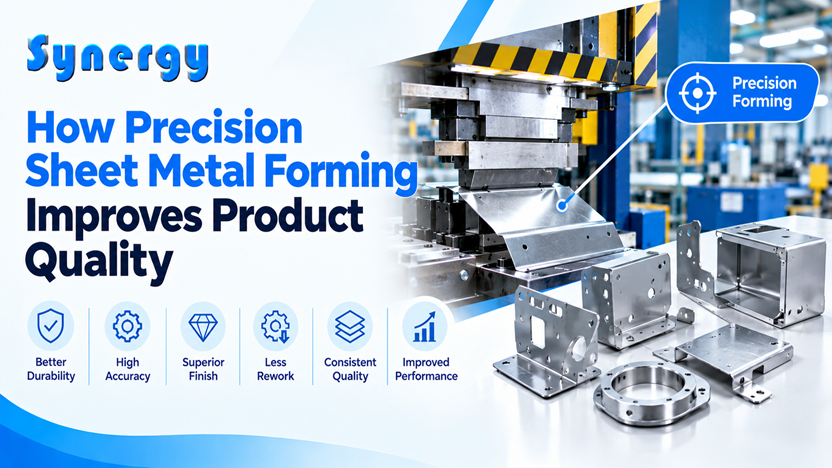
Product quality is a critical factor for OEMs and manufacturers operating in industries such as automotive, industrial equipment, electrical and electronics, medical equipment, aerospace, construction, and consumer products. When sheet metal components are produced with inconsistent dimensions, poor surface quality, excessive deformation, or inaccurate bends, the final product can experience assembly problems, performance issues, increased waste, and higher manufacturing costs.
Precision sheet metal forming helps manufacturers produce components with controlled dimensions, repeatable geometries, consistent bends, and reliable mechanical performance. By combining accurate tooling, advanced forming equipment, suitable materials, controlled production parameters, and quality inspection, manufacturers can improve the consistency and reliability of sheet metal parts.
At India Synergy, precision sheet metal forming solutions are designed to support OEM requirements for accurate, repeatable, and application-specific metal components. This approach helps businesses maintain consistent product quality while supporting efficient production and scalable manufacturing.
What Is Precision Sheet Metal Forming?
Precision sheet metal forming is a manufacturing process used to shape flat metal sheets into specific geometries while maintaining controlled dimensions and tolerances.
Depending on the component design, precision forming can involve processes such as:
- Bending
- Press forming
- Punching
- Stamping
- Deep drawing
- Folding
- Roll forming
- Flanging
- Embossing
- Piercing
- Progressive forming
The objective is not simply to shape a sheet of metal. Precision sheet metal forming focuses on producing parts that consistently meet defined specifications throughout production.
This is especially important when components must fit together accurately during final assembly.
How Precision Sheet Metal Forming Improves Product Quality
1. Improves Dimensional Accuracy
Dimensional accuracy is one of the most important factors affecting sheet metal component quality.
Precision forming uses carefully designed tooling, controlled machinery, and defined process parameters to maintain the required dimensions of a component.
Accurate dimensions help ensure that:
- Components fit correctly during assembly
- Mounting holes remain properly positioned
- Bends are formed at the required angles
- Part-to-part variation is minimized
- Finished products maintain consistent geometry
For OEM components where dimensional tolerances are critical, precision forming can significantly improve manufacturing consistency.
2. Provides Consistent Component Geometry
Producing one accurate part is not enough for high-volume manufacturing. Every component must maintain the same geometry throughout production.
Precision sheet metal forming helps create repeatable:
- Bend angles
- Radii
- Flanges
- Holes
- Embossments
- Profiles
- Overall dimensions
Consistency is particularly important for components manufactured in large quantities.
When every part follows the same design specifications, downstream assembly becomes more predictable and quality control becomes easier.
3. Reduces Manufacturing Defects
Poorly controlled forming processes can result in defects such as:
- Cracks
- Wrinkles
- Distortion
- Excessive springback
- Surface marks
- Incorrect bend angles
- Dimensional variation
- Deformation
Precision manufacturing reduces the likelihood of these issues by controlling the interaction between material properties, tooling, machine settings, and forming forces.
Proper process planning also allows manufacturers to identify potential forming problems before large-scale production begins.
4. Improves Bend Accuracy
Bending accuracy directly affects the final shape and functionality of many sheet metal components.
Even a small variation in bend angle can create problems during assembly.
Precision sheet metal forming considers factors such as:
- Material thickness
- Material grade
- Bend radius
- Grain direction
- Springback
- Tool geometry
- Forming force
- Machine calibration
By controlling these variables, manufacturers can achieve more consistent bends and improve the dimensional quality of finished components.
5. Controls Material Deformation
Sheet metal behaves differently depending on its grade, thickness, strength, and mechanical properties.
During forming, uncontrolled deformation can affect the final geometry of the component.
Precision forming techniques help manage material flow and deformation so that the finished part remains within the required specifications.
This is especially important for:
- Deep-drawn components
- Complex formed parts
- Thin sheet components
- High-strength materials
- Tight-tolerance components
6. Improves Surface Quality
Product quality is not limited to dimensional accuracy. Surface appearance can also be important.
Poor forming conditions can create:
- Scratches
- Dents
- Tool marks
- Wrinkles
- Surface deformation
Proper tooling design, material handling, lubrication where applicable, and controlled forming parameters can help minimize unwanted surface defects.
For visible components, consistent surface quality can improve the appearance and perceived quality of the finished product.
7. Improves Assembly Accuracy
Sheet metal components often form part of a larger assembly.
If individual parts have inconsistent dimensions, assembly can become difficult and may require additional adjustments.
Precision sheet metal forming helps maintain:
- Hole positions
- Bend locations
- Flange dimensions
- Part profiles
- Mounting points
- Overall component dimensions
As a result, components can be assembled more consistently with fewer manual corrections.
8. Supports Tight Tolerances
Some industrial applications require components to meet relatively tight dimensional tolerances.
Precision forming enables manufacturers to design production processes around specific tolerance requirements.
Achieving consistent tolerances requires more than advanced machinery. It also depends on:
- Tooling accuracy
- Material consistency
- Machine condition
- Process control
- Operator expertise
- Inspection procedures
- Production environment
A controlled manufacturing system helps reduce variation between individual components.
Role of Tooling in Precision Sheet Metal Forming
Tooling plays a major role in determining the quality of formed components.
Poorly designed or improperly maintained tooling can cause:
- Dimensional inconsistencies
- Uneven bends
- Surface damage
- Increased tool wear
- Higher rejection rates
- Production downtime
Precision tooling is designed according to the material, thickness, component geometry, required tolerances, and production volume.
Common tooling considerations include:
- Die geometry
- Punch dimensions
- Bend radius
- Clearance
- Material flow
- Tool material
- Tool surface condition
Regular inspection and maintenance of tooling also help maintain consistent production quality.
Importance of Material Selection
The material used for sheet metal forming has a direct impact on the final component.
Common sheet metals include:
- Stainless steel
- Mild steel
- Carbon steel
- Aluminum
- Galvanized steel
- Copper
- Brass
Each material has different characteristics related to:
- Strength
- Ductility
- Formability
- Hardness
- Thickness
- Corrosion resistance
- Springback
- Surface finish
Selecting the right material for the intended application helps improve both manufacturability and product performance.
For example, aluminum may be selected when lightweight construction is important, while stainless steel may be preferred for applications requiring corrosion resistance and durability.
How Precision Forming Reduces Material Waste
Material waste can increase manufacturing costs and negatively affect production efficiency.
Precision sheet metal forming helps reduce waste through:
- Optimized part layouts
- Accurate cutting
- Controlled forming
- Reduced rejection rates
- Better material utilization
- Optimized tooling
- Consistent production parameters
Before production begins, manufacturers can evaluate component geometry and material utilization to identify opportunities for reducing scrap.
For high-volume manufacturing, even a small reduction in material waste can create significant cost savings over time.
Precision Sheet Metal Forming and Production Consistency
Production consistency is essential for OEM manufacturing.
When components are manufactured repeatedly using controlled processes, manufacturers can achieve greater consistency in:
- Dimensions
- Shape
- Surface quality
- Bend angles
- Hole positions
- Component weight
- Assembly fit
This repeatability helps OEMs maintain consistent product specifications across different production batches.
Quality Control in Precision Sheet Metal Forming
Quality control should be integrated throughout the manufacturing process rather than performed only at the end.
A comprehensive quality process may include:
Incoming Material Inspection
Raw material can be checked for:
- Grade
- Thickness
- Surface condition
- Dimensions
- Material certification where required
First-Part Inspection
The first manufactured component can be inspected against the approved drawing and specifications before full production begins.
In-Process Inspection
During production, critical dimensions can be monitored to identify process variation early.
Final Inspection
Finished components can be inspected for:
- Dimensions
- Bend angles
- Hole locations
- Surface condition
- Overall geometry
- Functional requirements
This layered approach helps identify quality issues before defective components reach the customer.
How Technology Improves Precision Sheet Metal Forming
Modern manufacturing technologies can improve accuracy, repeatability, and production efficiency.
Depending on the application, manufacturers may use:
- CNC press brakes
- CNC punching machines
- Precision stamping presses
- Automated feeding systems
- Laser cutting systems
- CAD/CAM software
- Digital inspection equipment
- Coordinate measuring systems
- Automated production monitoring
Digital design and manufacturing workflows allow component specifications to move more efficiently from engineering to production.
This can reduce manual errors and improve process repeatability.
Precision Sheet Metal Forming for OEM Manufacturing
OEMs often require components to meet specific engineering drawings and quality standards.
Precision sheet metal forming can support OEM manufacturing by providing:
- Repeatable component dimensions
- Controlled tolerances
- Consistent production quality
- Scalable manufacturing
- Custom tooling
- Application-specific materials
- Reduced assembly problems
- Better production planning
For OEMs sourcing components internationally, working with an experienced manufacturing partner can also simplify supplier coordination and production management.
Applications of Precision Sheet Metal Forming
Precision sheet metal forming is used across many industries.
Automotive Industry
Applications include:
- Brackets
- Mounting components
- Structural parts
- Shields
- Enclosures
- Automotive assemblies
Electrical and Electronics
Common applications include:
- Electrical enclosures
- Panels
- Mounting brackets
- Component housings
- Shields
- Cabinets
Industrial Equipment
Precision formed components can be used for:
- Machine housings
- Supports
- Brackets
- Frames
- Covers
- Equipment components
Medical Equipment
Precision sheet metal components can be used in:
- Equipment housings
- Instrument components
- Mounting structures
- Medical equipment frames
Consumer Products
Applications may include:
- Appliance components
- Product housings
- Decorative panels
- Internal supports
- Mounting components
Precision Sheet Metal Forming vs Conventional Forming
The primary difference is the level of process control and dimensional consistency.
Conventional forming may be suitable for applications where tolerances and repeatability are less demanding.
Precision sheet metal forming focuses more heavily on:
- Dimensional control
- Tooling accuracy
- Process repeatability
- Material behavior
- Quality inspection
- Production consistency
For components used in demanding OEM applications, these factors can have a direct impact on final product quality.
Key Benefits of Precision Sheet Metal Forming
The major benefits include:
- Improved dimensional accuracy
- Better repeatability
- Consistent bend geometry
- Reduced manufacturing defects
- Lower material waste
- Improved surface quality
- Better assembly fit
- More consistent production
- Support for tight tolerances
- Improved production efficiency
- Better quality control
- Scalable OEM manufacturing
Why Choose India Synergy for Precision Sheet Metal Forming?
India Synergy provides custom manufacturing solutions for OEMs and businesses requiring precision sheet metal components.
Our manufacturing approach focuses on matching the right material, forming method, tooling, production process, and inspection requirements to the component specification.
Precision sheet metal manufacturing solutions can support requirements such as:
- Custom sheet metal forming
- Precision sheet metal forming
- Sheet metal fabrication
- Metal stamping
- Precision metal stamping
- CNC-based manufacturing
- Custom brackets
- Formed sheet metal components
- OEM components
- High-volume production
- Custom tooling and dies
For international buyers, India Synergy can support custom component sourcing and manufacturing requirements from India while focusing on consistency, quality control, and production requirements.
Read More: Stainless Steel vs Aluminum Stamping: Which Is Better?
Conclusion
Precision sheet metal forming improves product quality by combining accurate tooling, controlled forming processes, appropriate material selection, repeatable production parameters, and systematic quality inspection.
For manufacturers, the benefits extend beyond dimensional accuracy. Precision forming can improve assembly fit, reduce defects, minimize material waste, maintain consistent surface quality, and support reliable production at scale.
For OEMs requiring accurate and repeatable sheet metal components, selecting the right manufacturing partner is an important part of maintaining product quality.
India Synergy supports precision sheet metal forming and custom metal manufacturing requirements for OEMs and global sourcing teams, helping businesses develop components according to their required material, geometry, tolerances, production volume, and quality specifications.
Frequently Asked Questions
What is precision sheet metal forming?
Precision sheet metal forming is a manufacturing process used to shape metal sheets into accurately defined geometries while maintaining controlled dimensions, tolerances, and repeatability.
How does precision sheet metal forming improve product quality?
It improves product quality by providing better dimensional accuracy, consistent bends, repeatable component geometry, controlled material deformation, improved surface quality, and reduced manufacturing defects.
What materials can be used for precision sheet metal forming?
Common materials include stainless steel, mild steel, carbon steel, aluminum, galvanized steel, copper, and brass. The appropriate material depends on the application’s strength, corrosion, weight, conductivity, and forming requirements.
Is precision sheet metal forming suitable for high-volume production?
Yes. Precision sheet metal forming can be used for high-volume manufacturing when appropriate tooling, machinery, material handling, and process controls are implemented.
Can precision sheet metal forming reduce manufacturing costs?
It can help reduce costs by improving material utilization, lowering rejection rates, reducing rework, improving production consistency, and supporting efficient high-volume manufacturing.
What industries use precision sheet metal forming?
Automotive, electrical and electronics, industrial equipment, medical equipment, consumer products, appliances, construction, and other manufacturing industries use precision sheet metal forming for different types of components.
What is the difference between sheet metal forming and sheet metal fabrication?
Sheet metal forming primarily changes the shape of sheet material through processes such as bending, pressing, drawing, and forming. Sheet metal fabrication is a broader manufacturing category that can include cutting, forming, welding, joining, and finishing.