





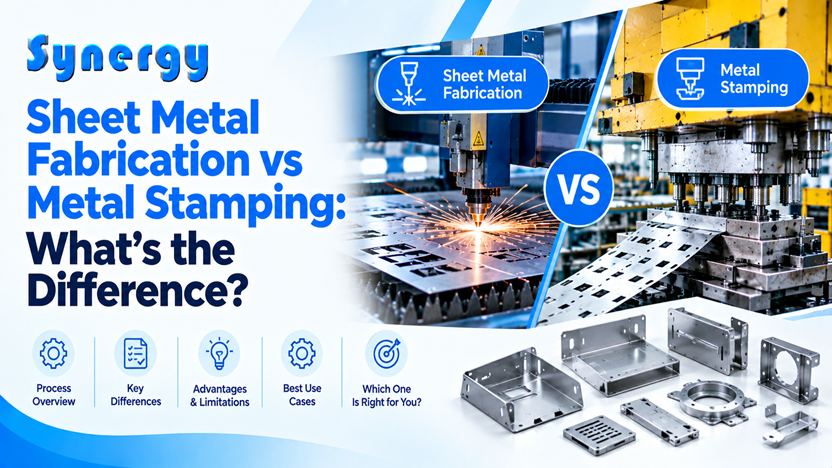
When manufacturing metal components, choosing the right production process can have a significant impact on product quality, production efficiency, tooling investment, material utilization, and overall cost.
Two commonly used manufacturing approaches are sheet metal fabrication and metal stamping. Although both processes can transform flat metal sheets into functional components, they use different manufacturing methods and are suited to different production requirements.
Sheet metal fabrication generally involves a combination of cutting, bending, forming, welding, and assembly processes. Metal stamping uses specialized dies and presses to rapidly produce repeatable components from sheet metal or metal coil.
Understanding the difference between sheet metal fabrication vs metal stamping can help OEMs, engineers, procurement teams, and manufacturers select the appropriate process for their component.
At India Synergy, we provide custom sheet metal fabrication, precision metal stamping, forming, tooling, and OEM manufacturing solutions based on component design, material, production volume, tolerances, and application requirements.
What Is Sheet Metal Fabrication?
Sheet metal fabrication is a broad manufacturing process used to convert flat sheets of metal into finished components or assemblies.
It can involve several different operations, including:
- Laser cutting
- CNC punching
- Shearing
- Bending
- Forming
- Rolling
- Welding
- Riveting
- Fastening
- Assembly
- Surface finishing
The exact process depends on the component’s design and manufacturing requirements.
For example, a sheet metal enclosure may require laser cutting, CNC bending, welding, grinding, and powder coating before it becomes a finished product.
Sheet metal fabrication is therefore highly flexible and can accommodate a wide range of component shapes and production volumes.
What Is Metal Stamping?
Metal stamping is a manufacturing process that uses a stamping press and specialized tooling or dies to shape sheet metal or metal coil.
Common stamping operations include:
- Blanking
- Punching
- Bending
- Forming
- Piercing
- Embossing
- Coining
- Deep drawing
Metal stamping can be performed as a single operation or through multiple operations within progressive or transfer dies.
Once the tooling has been developed, stamping can produce large quantities of consistent components efficiently.
This makes metal stamping particularly suitable for repeat production and high-volume manufacturing.
Sheet Metal Fabrication vs Metal Stamping: Quick Comparison
| Factor | Sheet Metal Fabrication | Metal Stamping |
| Manufacturing Method | Cutting, bending, welding, forming, assembly | Press and die-based forming |
| Tooling Investment | Generally lower for basic jobs | Can be higher due to custom dies |
| Production Volume | Low to high | Medium to very high |
| Flexibility | Very high | More specialized |
| Prototyping | Excellent | Less flexible once tooling is designed |
| Complex Assemblies | Well suited | Better for repeatable formed components |
| Production Speed | Depends on operations | Very high for suitable parts |
| Repeatability | High with CNC equipment | Very high |
| Part-to-Part Consistency | Good to excellent | Excellent |
| Material Utilization | Depends on cutting method | Can be highly optimized |
| Best Use | Custom and varied components | High-volume repeat components |
| Automation | Available | Highly suited |
The right process depends on the component and production requirements.
Key Difference Between Sheet Metal Fabrication and Metal Stamping
The primary difference is how the metal component is produced.
Sheet metal fabrication typically uses a sequence of individual manufacturing operations to create a component. Metal stamping uses a press and die system to form components quickly and repeatedly.
In simple terms:
Sheet metal fabrication focuses on process flexibility.
Metal stamping focuses on repeatability and production efficiency.
However, modern manufacturing can combine both processes depending on the product.
Sheet Metal Fabrication Process
A typical sheet metal fabrication workflow can include the following stages.
1. Design and Engineering
The process begins with an engineering drawing or CAD model.
The design defines:
- Dimensions
- Material
- Thickness
- Holes
- Bends
- Cutouts
- Tolerances
- Assembly requirements
2. Material Selection
The appropriate material is selected based on:
- Strength
- Weight
- Corrosion resistance
- Formability
- Conductivity
- Operating environment
- Cost
Common materials include stainless steel, mild steel, aluminum, galvanized steel, copper, and brass.
3. Cutting
The sheet is cut into the required profile.
Methods may include:
- CNC laser cutting
- CNC punching
- Shearing
- Plasma cutting
- Other precision cutting methods
4. Bending and Forming
The cut sheet is formed using equipment such as CNC press brakes or other forming machinery.
The process can create:
- Angles
- Flanges
- Channels
- Boxes
- Curves
- Brackets
- Complex profiles
5. Welding and Assembly
If the component consists of multiple parts, they may be joined using:
- MIG welding
- TIG welding
- Spot welding
- Riveting
- Mechanical fastening
6. Finishing
Depending on the application, components may receive:
- Powder coating
- Painting
- Anodizing
- Plating
- Brushing
- Polishing
- Passivation
7. Quality Inspection
The finished component is inspected according to the required engineering specifications.
Metal Stamping Process
Metal stamping follows a different manufacturing approach.
1. Component and Die Design
Engineers develop the component design and determine the required stamping operations.
The die may be designed for:
- Blanking
- Punching
- Bending
- Forming
- Drawing
- Embossing
2. Tooling Development
A stamping die is manufactured according to the component design.
Tooling represents an important part of the initial investment in a stamping project.
3. Material Feeding
Sheet or coil material is positioned and fed into the stamping press.
Automated coil feeding can support continuous production.
4. Press Operation
The stamping press applies controlled force through the die to cut or form the material.
Depending on the tooling design, several operations may be completed in sequence.
5. Inspection
Stamped components are inspected to ensure that they meet dimensional and quality requirements.
6. Secondary Operations
Some stamped components may require additional processes such as:
- Deburring
- Threading
- Welding
- Plating
- Heat treatment
- Assembly
When Is Sheet Metal Fabrication Better?
Sheet metal fabrication can be a suitable option when flexibility and customization are important.
1. Prototypes
For prototypes, product designs may change frequently.
Fabrication can allow manufacturers to modify cutting and bending programs without requiring a dedicated stamping die.
2. Low-Volume Production
For smaller production quantities, the tooling investment associated with stamping may not be economical.
Fabrication can provide a more flexible approach.
3. Large or Complex Components
Large enclosures, frames, cabinets, machine covers, and structural assemblies can often be efficiently manufactured using fabrication processes.
4. Frequent Design Changes
When designs change frequently, CNC fabrication can adapt relatively quickly by modifying digital manufacturing programs.
5. Welded Assemblies
When a product requires multiple sheet metal components joined together, fabrication can be advantageous because cutting, bending, welding, and assembly can be integrated into one manufacturing workflow.
When Is Metal Stamping Better?
Metal stamping is particularly useful when repeatability and production volume are major priorities.
1. High-Volume Production
Stamping is highly suitable for producing large quantities of the same component.
Once the die is developed, production can be performed rapidly.
2. Repeatable Components
If thousands or millions of identical components are required, stamping can provide consistent part-to-part production.
3. High Production Speed
Stamping presses can perform forming operations quickly, particularly when automated feeding and progressive dies are used.
4. Consistent Dimensions
A properly designed and maintained die can provide highly repeatable component geometry.
5. Reduced Per-Part Cost at Scale
Although stamping requires an initial tooling investment, the cost per component can become attractive at sufficiently high production volumes.
Tooling Cost: Fabrication vs Stamping
Tooling is one of the most significant differences between the two manufacturing processes.
Sheet Metal Fabrication
Basic fabrication may require standard machine tooling rather than a dedicated die for each component.
This can reduce initial tooling investment.
Metal Stamping
Stamping typically requires dedicated tooling designed specifically for the component.
Tooling costs can include:
- Die design
- Die manufacturing
- Die components
- Tool testing
- Tool modifications
- Maintenance
The initial investment can therefore be higher.
However, for high production volumes, the tooling cost can be distributed across a large number of components, potentially reducing the tooling cost per part.
Production Volume Comparison
Production volume is one of the most important factors when selecting between fabrication and stamping.
Low Volume
Sheet metal fabrication may be suitable because it provides flexibility without requiring significant dedicated tooling.
Medium Volume
Both fabrication and stamping can be considered depending on part complexity, tooling investment, cycle time, and target cost.
High Volume
Metal stamping often becomes attractive because high production rates and repeatability can offset the initial tooling investment.
The exact break-even point depends on the component and project economics.
Cost Comparison
There is no universal answer to which process is cheaper.
The total manufacturing cost depends on:
- Material
- Production volume
- Component complexity
- Tooling
- Machine time
- Labor
- Scrap rate
- Finishing
- Secondary operations
- Quality requirements
- Packaging
- Transportation
For low-volume projects, fabrication may have a lower initial investment.
For high-volume projects, stamping may achieve a lower cost per part because the tooling investment is spread over a larger production quantity.
Accuracy and Repeatability
Both modern CNC fabrication and metal stamping can achieve accurate components.
However, the production method affects repeatability.
CNC fabrication can provide strong dimensional control through computer-controlled cutting and bending.
Stamping can provide highly consistent geometry because each component is formed using the same die.
The required tolerance should always be evaluated against the component’s function and manufacturing process capability.
Material Utilization
Material utilization is another important consideration.
CNC fabrication systems can optimize cutting paths and nesting layouts to reduce sheet metal waste.
Stamping dies can also be engineered to optimize strip layouts and material flow.
Progressive stamping can be particularly effective for high-volume components where material utilization is carefully optimized.
The best approach depends on the component geometry and material thickness.
Sheet Metal Fabrication vs Metal Stamping Applications
Sheet Metal Fabrication Applications
Common applications include:
- Electrical enclosures
- Control cabinets
- Machine covers
- Equipment frames
- Brackets
- Panels
- HVAC components
- Industrial assemblies
- Custom structures
Metal Stamping Applications
Common applications include:
- Automotive brackets
- Clips
- Retainers
- Terminals
- Electrical contacts
- Appliance components
- Mounting parts
- Precision hardware
- Structural components
Industries Using Both Processes
Many industries use both sheet metal fabrication and metal stamping.
Automotive
Fabrication can be used for prototypes, larger assemblies, and custom structures, while stamping can be used for high-volume brackets, clips, panels, and structural components.
Electrical and Electronics
Fabrication can produce cabinets, enclosures, and panels, while stamping can manufacture terminals, contacts, brackets, and small precision components.
Industrial Equipment
Fabrication is useful for machine frames and enclosures, while stamping can support repeatable brackets and formed components.
Appliances
Both processes can be used for internal supports, brackets, panels, housings, and other components.
Medical Equipment
Fabrication can support equipment housings and frames, while stamping can produce smaller repeatable components.
Can Sheet Metal Fabrication and Stamping Be Used Together?
Yes.
Manufacturers do not always need to choose only one process.
A finished product may combine:
- Laser-cut fabricated components
- Stamped brackets
- CNC-bent parts
- Welded assemblies
- Machined components
- Purchased hardware
For example, an industrial enclosure may use CNC laser cutting and bending for the main body, stamping for small brackets, and welding or fastening for final assembly.
Using multiple processes can allow manufacturers to select the most appropriate method for each component.
How to Choose Between Sheet Metal Fabrication and Metal Stamping
Consider the following factors before selecting a manufacturing process:
1. Production Volume
Higher volumes may justify stamping tooling.
2. Component Complexity
Complex assemblies may benefit from fabrication, while repeatable formed components may suit stamping.
3. Tooling Budget
If minimizing upfront tooling investment is important, fabrication may be more suitable for smaller projects.
4. Required Production Speed
High-volume requirements may benefit from automated stamping.
5. Component Dimensions
Large components may be more practical to fabricate depending on equipment and design.
6. Design Changes
Frequent design changes can favor flexible CNC fabrication.
7. Tolerances
Required tolerances should be evaluated against the capabilities of the selected process.
8. Material
Material type and thickness can influence tooling, forming, cutting, and production requirements.
9. Finishing Requirements
Consider whether the finished part requires welding, coating, plating, polishing, or other secondary processes.
Why Choose India Synergy for Sheet Metal Fabrication and Metal Stamping?
India Synergy provides custom manufacturing solutions covering both sheet metal fabrication and metal stamping requirements.
Our capabilities can support:
- Custom sheet metal fabrication
- CNC sheet metal fabrication
- Precision sheet metal forming
- Metal stamping
- Precision metal stamping
- Progressive die stamping
- Deep draw stamping
- Custom tooling and dies
- CNC laser cutting
- CNC bending
- Welded assemblies
- Custom brackets
- OEM components
- High-volume production
The appropriate process can be evaluated based on component design, material, production volume, tolerances, tooling requirements, finishing, and target manufacturing cost.
For international OEMs looking for sheet metal fabrication and metal stamping services in India, India Synergy can support custom manufacturing and sourcing requirements according to project-specific specifications.
Conclusion
The difference between sheet metal fabrication vs metal stamping primarily comes down to manufacturing approach, flexibility, tooling, production volume, and repeatability.
Sheet metal fabrication provides flexibility and is often suitable for prototypes, custom components, low-to-medium production volumes, large assemblies, and products requiring cutting, bending, welding, and assembly.
Metal stamping is highly suitable for repeatable components and medium- to high-volume production where dedicated tooling can provide efficient, consistent, and scalable manufacturing.
Neither process is universally suitable for every application. The correct choice depends on the component design, material, volume, tolerance requirements, tooling investment, production speed, and total manufacturing cost.
India Synergy supports both sheet metal fabrication and metal stamping for OEMs and global sourcing teams, helping businesses select and implement manufacturing solutions based on their specific component and production requirements.
Read More: CNC Sheet Metal Fabrication: Benefits, Applications, and Process
Frequently Asked Questions
What is the difference between sheet metal fabrication and metal stamping?
Sheet metal fabrication uses processes such as cutting, bending, welding, and forming to manufacture components, while metal stamping uses specialized dies and presses to cut and form metal quickly and repeatedly.
Is metal stamping cheaper than sheet metal fabrication?
It depends on production volume and component requirements. Stamping can have higher initial tooling costs but may provide lower per-part costs at high production volumes. Fabrication may be more economical for prototypes and smaller production runs.
Which process is better for high-volume production?
Metal stamping is often suitable for high-volume production because specialized dies and automated presses can produce repeatable components rapidly. The appropriate process still depends on component design and production requirements.
Is sheet metal fabrication better for prototypes?
Sheet metal fabrication can be advantageous for prototypes because it provides flexibility and generally does not require the same dedicated tooling investment as metal stamping.
Can stamping and fabrication be used for the same product?
Yes. A product can use stamped components alongside laser-cut, CNC-bent, welded, or fabricated components.
Which process provides better accuracy?
Both CNC sheet metal fabrication and precision metal stamping can provide high accuracy. The achievable tolerance depends on the equipment, tooling, material, component geometry, and process control.
What materials can be used for both processes?
Materials commonly used include stainless steel, mild steel, carbon steel, aluminum, galvanized steel, copper, and brass. Material selection depends on the component’s performance and manufacturing requirements.
How do I decide between sheet metal fabrication and stamping?
Consider production volume, component size, complexity, tolerances, tooling budget, material, design changes, production speed, finishing requirements, and total cost per finished component.