





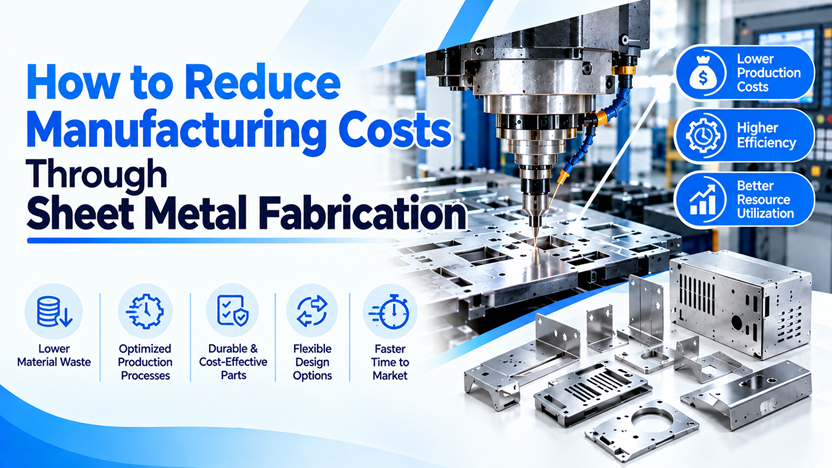
Manufacturing costs directly affect product pricing, profit margins, production scalability, and overall competitiveness. For OEMs and industrial manufacturers, sheet metal fabrication can be a highly effective way to control production expenses without compromising product quality, durability, or performance.
By optimizing material selection, part design, fabrication processes, tooling, production volumes, and quality control, manufacturers can significantly reduce unnecessary manufacturing costs. Efficient sheet metal fabrication services also help companies minimize material waste, reduce labor requirements, improve production speed, and achieve consistent part quality.
For businesses sourcing components from India, partnering with an experienced sheet metal fabrication manufacturer can provide additional opportunities to optimize production costs while maintaining international quality standards.
This guide explains how manufacturers can reduce costs through sheet metal fabrication and what OEMs should consider when selecting a fabrication partner.
What Is Sheet Metal Fabrication?
Sheet metal fabrication is the process of converting flat metal sheets into finished components, structures, enclosures, brackets, panels, frames, and assemblies through various manufacturing techniques.
Common sheet metal fabrication processes include:
- Laser cutting
- CNC punching
- Bending
- Press brake forming
- Welding
- Cutting and shearing
- Rolling
- Deburring
- Grinding
- Surface finishing
- Assembly
Depending on the component design and production requirements, manufacturers can combine multiple processes to create finished parts with the required dimensions, strength, appearance, and functionality.
The overall cost of a fabricated component depends on several factors, including material, design complexity, production volume, labor, tooling, processing time, finishing, and quality requirements.
Why Is Cost Reduction Important in Sheet Metal Manufacturing?
Cost reduction does not simply mean choosing the cheapest material or manufacturer. Effective cost optimization focuses on reducing unnecessary expenses throughout the complete manufacturing process.
For OEMs, reducing sheet metal fabrication costs can help:
- Improve product margins
- Reduce overall manufacturing expenses
- Increase production efficiency
- Minimize material waste
- Reduce assembly time
- Improve production consistency
- Lower tooling expenses
- Reduce rework and rejection rates
- Improve supply chain efficiency
- Support competitive product pricing
The best results are achieved when cost optimization begins during the product design stage rather than after production has already started.
1. Optimize Sheet Metal Design for Manufacturing
One of the most effective ways to reduce fabrication costs is to design components specifically for manufacturing.
A complex design may require additional cutting, bending, welding, tooling, and finishing operations. By simplifying the design while maintaining the required performance, manufacturers can reduce processing time and production costs.
Design-for-manufacturing considerations include:
- Reducing unnecessary bends
- Avoiding overly complex geometries
- Standardizing hole sizes
- Maintaining practical bend radii
- Reducing unnecessary features
- Minimizing weld locations
- Using standard material thicknesses
- Designing components for efficient nesting
- Reducing the number of separate parts
A manufacturing-friendly design allows fabrication equipment to process components more efficiently and consistently.
Why Design Optimization Reduces Cost
A well-designed sheet metal component may require fewer manufacturing operations. Fewer operations generally mean:
Less processing time + less labor + less material waste = lower manufacturing cost
For this reason, OEMs should involve their fabrication partner early in the product development process.
2. Select the Right Sheet Metal Material
Material selection has a major impact on the final cost of a fabricated component.
Common sheet metal materials include:
- Mild steel
- Stainless steel
- Aluminum
- Galvanized steel
- Carbon steel
- High-strength steel
- Brass
- Copper
The most expensive material is not always necessary for every application. Material selection should be based on the component’s strength, corrosion resistance, operating environment, weight requirements, appearance, and performance.
For example, if a component does not require high corrosion resistance, selecting stainless steel when mild steel would meet the application requirements could unnecessarily increase material costs.
At the same time, choosing an unsuitable low-cost material can increase long-term costs through premature failure, corrosion, replacement, or maintenance.
Therefore, material optimization should focus on total cost and application requirements, not simply the initial material price.
3. Reduce Material Waste Through Efficient Nesting
Material waste can significantly increase sheet metal fabrication costs.
Efficient nesting involves arranging multiple component profiles on a sheet to maximize material utilization before cutting.
Advanced CAD/CAM and CNC programming software can help manufacturers optimize part placement and reduce unused areas.
Efficient nesting can provide several benefits:
- Higher sheet utilization
- Lower scrap generation
- Reduced material purchasing requirements
- Lower production cost per component
- Better utilization of raw materials
This becomes especially important for high-volume production, where even a small reduction in material waste can create meaningful savings over thousands of components.
4. Use Standard Sheet Thicknesses and Sizes
Using standard sheet thicknesses and commercially available sheet sizes can help reduce procurement and inventory costs.
Custom or uncommon material specifications may have:
- Higher purchase prices
- Longer lead times
- Higher minimum order quantities
- Limited supplier availability
- Increased inventory requirements
Whenever product performance allows, using commonly available material grades and thicknesses can simplify sourcing and improve production efficiency.
However, standardization should never compromise engineering requirements. The selected thickness must still provide the required strength, rigidity, durability, and dimensional performance.
5. Reduce the Number of Fabrication Operations
Every additional manufacturing operation can add time and cost to a component.
For example, a component requiring:
- Laser cutting
- Multiple bending operations
- Several welding stages
- Grinding
- Drilling
- Surface finishing
- Assembly
will generally cost more to manufacture than a properly optimized design requiring fewer operations.
During design review, manufacturers should identify opportunities to combine or eliminate unnecessary processes.
For example, a design can sometimes be modified to eliminate secondary drilling by incorporating the required holes directly during CNC punching or laser cutting.
6. Optimize Laser Cutting Parameters
Laser cutting provides high levels of precision and flexibility for sheet metal manufacturing. However, cutting time and machine utilization directly affect production costs.
Cost optimization can involve:
- Efficient part nesting
- Appropriate cutting speeds
- Optimized tool paths
- Reduced unnecessary piercings
- Standardized hole sizes
- Efficient sheet utilization
- Batch processing of similar components
For high-volume production, optimizing laser cutting programs can reduce machine time and improve throughput.
7. Optimize Bending and Forming Operations
Press brake bending is another important area for cost control.
Poorly planned bending sequences can increase:
- Setup time
- Machine time
- Handling requirements
- Tool changes
- Production errors
Manufacturers can reduce costs by optimizing bend sequences and using appropriate tooling.
Designers should also consider bend radii, flange lengths, material thickness, and bend orientation during the product design stage.
A fabrication partner with strong CNC bending capabilities can help identify design changes that improve manufacturability without affecting component functionality.
8. Minimize Welding Requirements
Welding can be essential for sheet metal assemblies, but unnecessary welds increase labor and processing time.
Welding costs may include:
- Welder labor
- Equipment time
- Consumables
- Fixtures
- Preparation
- Grinding
- Inspection
- Rework
Where engineering requirements allow, designs can sometimes be modified to reduce the number of welds.
For example, properly designed bends, tabs, slots, and interlocking features can sometimes reduce assembly complexity.
The objective is not to eliminate welding completely but to use it only where it provides necessary structural or functional value.
9. Use Automation for High-Volume Production
Automation can help reduce per-unit costs when production volumes are high.
Depending on the component, manufacturers can use:
- CNC laser cutting
- CNC punching
- Automated bending
- Robotic welding
- Automated material handling
- CNC machining
- Automated inspection
Automation reduces repetitive manual work and can improve consistency across large production runs.
However, automation is not automatically economical for every project. The investment must be evaluated against production volume, cycle time, tooling requirements, and expected product life.
10. Increase Production Volume Where Practical
Production volume has a significant influence on sheet metal fabrication costs.
Higher volumes can allow manufacturers to distribute:
- Tooling costs
- Programming costs
- Setup costs
- Engineering costs
- Inspection costs
across a larger number of parts.
For example, a setup cost that has little impact on a production run of 10,000 components can represent a much higher cost per unit when only 50 components are produced.
For this reason, OEMs should discuss expected annual volumes with their fabrication partner during quotation and production planning.
11. Use Batch Production to Improve Efficiency
Batch manufacturing allows similar components to be produced together.
Instead of repeatedly changing machine setups for small production runs, manufacturers can group similar parts and optimize production schedules.
Batch production can help reduce:
- Setup time
- Tool changes
- Material handling
- Programming time
- Machine downtime
This can be particularly useful when an OEM has multiple related sheet metal components.
12. Reduce Setup and Tooling Costs
Tooling and setup costs can influence the economics of sheet metal production, especially for lower-volume projects.
Manufacturers can control these costs by:
- Using standard tooling
- Designing parts around available tooling
- Reducing unnecessary tool changes
- Combining compatible production runs
- Using flexible fabrication equipment
- Avoiding unnecessary custom fixtures
For high-volume projects, dedicated tooling may provide lower per-part costs. For low-volume projects, flexible CNC equipment may be more economical.
The right approach depends on production volume and component complexity.
13. Reduce Scrap and Rejection Rates
Scrap and rejected components increase the effective cost of manufacturing.
If a production line produces components that fail dimensional, functional, or visual requirements, the manufacturer may incur additional expenses for:
- Replacement material
- Additional machine time
- Rework
- Inspection
- Labor
- Shipping
- Production delays
Strong quality control helps prevent these costs.
Quality practices may include:
- Incoming material inspection
- First-piece inspection
- In-process inspection
- Dimensional inspection
- Final inspection
- Weld inspection
- Surface finish inspection
- Documentation and traceability
Reducing defects is therefore both a quality improvement strategy and a cost reduction strategy.
14. Choose the Right Surface Finish
Surface finishing can add to the total cost of fabricated components.
Common finishing options include:
- Powder coating
- Painting
- Galvanizing
- Anodizing
- Plating
- Brushing
- Polishing
The correct finish should be selected according to the component’s environmental exposure, corrosion requirements, appearance, and functional needs.
Using an unnecessarily complex finishing process can increase cost without providing meaningful additional value.
15. Standardize Components Across Products
Component standardization is an effective long-term cost reduction strategy for OEMs.
If several products use similar brackets, panels, frames, fasteners, or mounting components, manufacturers may be able to standardize those parts.
Standardization can reduce:
- Number of unique components
- Inventory requirements
- Tooling requirements
- Procurement complexity
- Engineering effort
- Production setup time
It can also simplify spare-parts management and supplier coordination.
16. Reduce Assembly Complexity
Sheet metal fabrication often involves producing components that are later assembled into larger products.
Reducing the number of individual components can lower total manufacturing and assembly costs.
For example, combining multiple simple components into one properly designed fabricated part may reduce:
- Fastener requirements
- Welding operations
- Assembly labor
- Inspection points
- Inventory requirements
However, part consolidation should be evaluated carefully to ensure that the resulting component remains practical to manufacture, transport, service, and repair.
17. Source Sheet Metal Fabrication From the Right Manufacturing Partner
Selecting the right manufacturing partner can have a major impact on total production cost.
A capable sheet metal fabrication supplier should be able to support:
- Design-for-manufacturing consultation
- Material sourcing
- Laser cutting
- CNC punching
- CNC bending
- Welding
- Surface finishing
- Quality inspection
- Assembly
- Packaging
- Global logistics
A supplier offering multiple capabilities under one manufacturing program can reduce the need to coordinate several independent vendors.
For global OEMs, this can simplify sourcing and improve supply chain visibility.
Sheet Metal Fabrication Cost Reduction: Key Areas
| Cost Factor | Cost Reduction Approach |
| Material | Select suitable grades and thicknesses |
| Scrap | Optimize nesting and sheet utilization |
| Design | Simplify geometry and reduce unnecessary features |
| Cutting | Optimize CNC and laser cutting paths |
| Bending | Reduce unnecessary bends and tool changes |
| Welding | Minimize unnecessary weld operations |
| Tooling | Use standard tooling where possible |
| Labor | Increase automation and process efficiency |
| Setup | Group similar components into batches |
| Quality | Reduce defects, rework, and rejection |
| Finishing | Select the appropriate surface treatment |
| Assembly | Consolidate parts where practical |
| Procurement | Standardize materials and components |
Sheet Metal Fabrication vs. Other Manufacturing Methods for Cost Control
Sheet metal fabrication can be particularly cost-effective for products that require relatively lightweight, strong, and repeatable components.
Compared with manufacturing processes that require extensive machining from solid blocks, fabrication can reduce material removal and machining time for suitable designs.
However, the most economical manufacturing method depends on:
- Part geometry
- Material
- Production volume
- Tolerances
- Strength requirements
- Surface finish
- Tooling requirements
- Production schedule
The goal should be to select the manufacturing process that provides the required performance at the lowest practical total cost.
How OEMs Can Reduce Sheet Metal Fabrication Costs
OEMs can improve cost efficiency by following a structured approach:
Step 1: Review the Design
Identify unnecessary bends, holes, welds, complex features, and difficult-to-manufacture geometries.
Step 2: Select Appropriate Materials
Choose materials based on actual performance requirements rather than unnecessary specifications.
Step 3: Optimize Material Utilization
Use nesting and standardized sheet sizes to reduce scrap.
Step 4: Optimize Production Processes
Select efficient combinations of laser cutting, punching, bending, welding, and finishing.
Step 5: Evaluate Production Volume
Determine whether batch production, dedicated tooling, or automation can reduce unit costs.
Step 6: Improve Quality at the Source
Prevent defects instead of relying heavily on rework and final inspection.
Step 7: Work With an Experienced Supplier
Choose a manufacturing partner capable of supporting engineering, fabrication, quality control, and supply chain requirements.
Why India Is an Important Sourcing Destination for Sheet Metal Fabrication
India has developed a broad industrial manufacturing ecosystem supporting global OEM supply chains.
For international buyers, sourcing sheet metal components from India can provide access to:
- Engineering capabilities
- CNC fabrication technologies
- Skilled manufacturing workforce
- Multiple material options
- Fabrication and assembly services
- Quality management systems
- Export-oriented manufacturing
- Global logistics support
However, cost advantages should always be evaluated alongside quality, communication, lead time, logistics, technical capability, and supplier reliability.
Why Choose India Synergy for Sheet Metal Fabrication?
India Synergy provides sheet metal fabrication and manufacturing solutions for OEMs and industrial buyers looking for reliable sourcing from India.
Our capabilities can support different stages of the manufacturing process, from component development and material sourcing to fabrication, finishing, quality inspection, assembly, and supply coordination.
India Synergy can help businesses optimize manufacturing costs through:
- Design-for-manufacturing support
- Precision sheet metal fabrication
- Laser cutting
- CNC bending
- Metal stamping
- Welding and fabricated assemblies
- Material optimization
- Production planning
- Quality inspection
- Custom manufacturing
- Global OEM sourcing support
For companies sourcing sheet metal components for the USA, UK, Canada, Europe, Australia, and other international markets, an integrated manufacturing approach can help simplify supplier management while supporting consistent production quality.
Conclusion
Reducing manufacturing costs through sheet metal fabrication requires more than negotiating a lower component price. The greatest savings often come from optimizing the entire manufacturing process—from product design and material selection to cutting, bending, welding, finishing, quality control, and supply chain management.
By using manufacturing-friendly designs, improving material utilization, reducing unnecessary operations, controlling scrap, standardizing components, and selecting the right production technology, OEMs can achieve better cost efficiency without compromising product performance.
For global companies looking for reliable sheet metal fabrication services from India, India Synergy provides integrated manufacturing and sourcing support designed around OEM requirements, production efficiency, quality, and long-term supply needs.
Read More: Sheet Metal Fabrication vs Metal Stamping: What’s the Difference?
Frequently Asked Questions
How can sheet metal fabrication reduce manufacturing costs?
Sheet metal fabrication can reduce manufacturing costs through efficient material utilization, optimized part design, automated cutting and bending, reduced assembly requirements, batch production, and lower scrap and rework rates.
What is the biggest cost factor in sheet metal fabrication?
Material cost is often a significant component of the total cost, but labor, processing time, tooling, finishing, production volume, quality requirements, and material waste can also have a major impact.
How does design affect sheet metal fabrication cost?
Design affects the number of cutting, bending, welding, finishing, and assembly operations required. Simplifying the design and using manufacturing-friendly features can reduce processing time and production costs.
Does reducing material thickness always reduce cost?
No. Reducing material thickness may lower material costs, but it can negatively affect strength, durability, rigidity, or product performance. Material thickness should be optimized according to engineering requirements.
How can manufacturers reduce sheet metal scrap?
Manufacturers can reduce scrap through efficient nesting, optimized cutting paths, standardized sheet sizes, proper component layouts, and effective production planning.
Is sheet metal fabrication suitable for high-volume production?
Yes. Sheet metal fabrication can be highly suitable for high-volume production when processes such as CNC cutting, punching, automated bending, stamping, and robotic welding are appropriately applied.
Can India Synergy manufacture custom sheet metal components?
Yes. India Synergy supports custom sheet metal fabrication and OEM manufacturing requirements, including cutting, bending, welding, finishing, inspection, and related manufacturing processes.
How can OEMs reduce the total cost of imported sheet metal components?
OEMs can reduce total landed costs by optimizing component design, material usage, packaging, production volumes, supplier coordination, quality control, and logistics while selecting an experienced global manufacturing partner.