





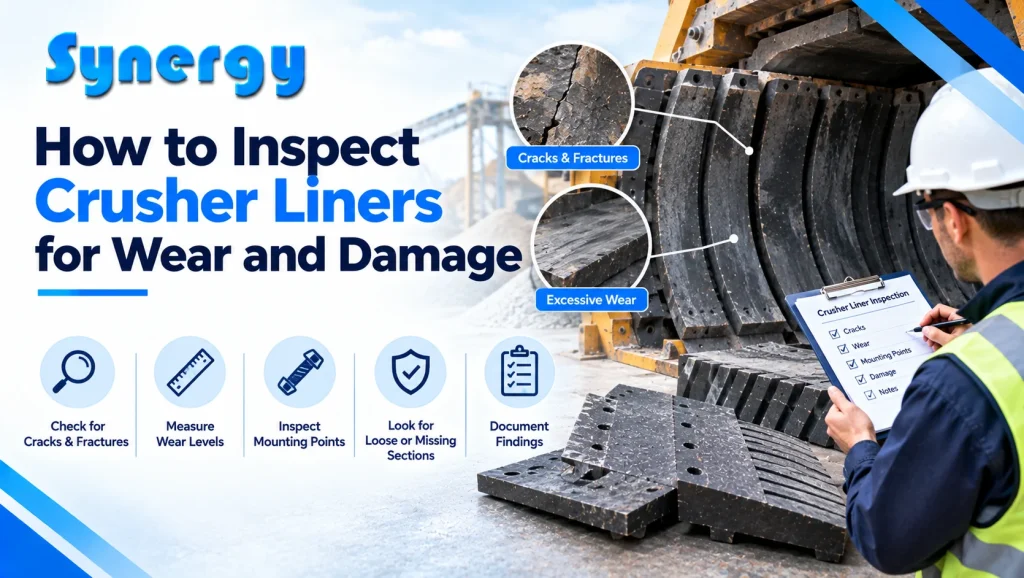
Crusher liners are essential wear components that protect crushing equipment from abrasion, impact, and material pressure. Regular inspection helps identify excessive wear, cracks, uneven material loss, and fitment issues before they cause unexpected equipment downtime. By following a structured inspection process, industrial operators can improve crusher reliability, plan replacement activities, and maintain consistent crushing performance.
For mining, quarrying, cement, and aggregate processing operations, crusher liner inspection should combine visual checks, dimensional measurements, wear pattern analysis, and maintenance history reviews.
Why Is Crusher Liner Inspection Important?
Crusher liners operate under demanding conditions where rocks, minerals, and other abrasive materials continuously contact their surfaces. Over time, this interaction gradually reduces liner thickness and changes the geometry of the crushing chamber.
Without regular inspection, worn or damaged liners may affect production efficiency, increase the risk of equipment damage, and create unplanned maintenance requirements.
The main benefits of routine crusher liner inspection include:
- Early wear detection: Identifies material loss before liners reach their operational limits.
- Reduced downtime: Helps maintenance teams plan replacement during scheduled shutdowns.
- Consistent crushing performance: Supports the required crushing chamber profile and product size.
- Improved equipment protection: Helps identify cracks, loose components, and abnormal contact.
- Better maintenance planning: Provides useful data for estimating remaining service life and replacement requirements.
1. Check the Crusher Liner Surface for Visible Damage
A visual inspection is an important first step in evaluating crusher liner condition. It helps identify damage that may not be apparent from production data alone.
Before beginning an inspection, follow the equipment manufacturer’s isolation, lockout, and confined-space procedures where applicable. Never enter or reach into crusher equipment while it is operating or could restart.
During the visual inspection, look for the following warning signs.
Cracks and Fractures
Cracks may develop due to repeated impact, material fatigue, unsuitable operating conditions, installation problems, or material defects. Cracks around mounting areas and highly loaded sections require particular attention.
Document the location, length, and apparent severity of each crack. Follow the manufacturer’s inspection criteria to determine whether the liner can remain in service or requires immediate replacement.
Chipping and Surface Breakage
Chipping occurs when pieces of the liner surface break away. It may indicate severe impact, localized stress, or an unsuitable liner material for the application.
Inspect areas exposed to large feed material and concentrated impact, especially when the damage is more pronounced than expected from normal abrasion.
Deformation and Distortion
Changes in liner shape can affect the crushing chamber profile and liner seating. Check for unusual deformation, damaged mounting areas, and signs that the liner has shifted from its intended position.
Record photographs and compare the observed condition with the original liner profile whenever suitable reference information is available.
2. Measure Liner Thickness and Material Loss
Visual checks alone cannot reliably establish how much usable liner material remains. Dimensional measurements provide a more objective way to evaluate wear.
Use an appropriate measurement method specified by the equipment manufacturer or maintenance procedure. Depending on the liner design, this may involve accessible thickness measurements, profile templates, dimensional gauges, or other approved inspection techniques.
Record measurements at consistent reference points, including areas expected to experience high and low wear.
A useful inspection record includes:
- Initial or reference liner dimensions.
- Current measurements at identified locations.
- Date and operating hours at inspection.
- Material processed since the previous inspection, where available.
- The manufacturer’s minimum allowable dimensions.
- Any changes in the liner profile or crushing performance.
Comparing successive measurements helps maintenance teams identify the rate of material loss.
For example, if a liner loses 8 mm of measurable thickness over 400 operating hours at a particular reference point, the observed average wear rate is 0.02 mm per operating hour at that point. This is a historical measurement, not a guarantee of future wear or a universal replacement threshold.
Actual wear rates can change with feed hardness, particle size, throughput, moisture, operating settings, and material distribution.
3. Identify Uneven Wear Patterns
Uneven wear is one of the most useful indicators of potential problems with crusher operation, feed distribution, or liner selection.
Inspect the entire accessible liner profile rather than checking only the most visibly worn area.
Common wear patterns include:
Localized wear: One section loses material much faster than the surrounding areas. Possible causes include concentrated material flow, uneven feeding, or localized impact.
Uneven left-to-right wear: One side of the liner wears more quickly than the other. This may indicate asymmetric loading, feed distribution issues, or installation-related differences.
Excessive wear near the feed zone: High material impact or abrasive feed conditions may accelerate wear near the point where material enters the crushing chamber.
Abnormal wear near the discharge zone: This can be associated with material flow, operating conditions, or changes in the crushing chamber geometry.
Wear patterns should be interpreted alongside equipment design, feed characteristics, and operating records. A pattern alone does not prove a specific mechanical fault.
4. Inspect Liner Fitment and Mounting Components
A liner may show acceptable surface condition but still present a maintenance risk if it is loose, incorrectly seated, or improperly supported.
Inspect the liner mounting arrangement according to the equipment manufacturer’s procedure. Look for:
- Loose or damaged fastening components.
- Signs of movement between the liner and its supporting surface.
- Damaged seating or contact areas.
- Abnormal gaps or evidence of poor fitment.
- Deterioration of approved backing or supporting materials, where used.
- Wear or damage around mounting points.
Correct fitment helps distribute operating loads as intended. Incorrect installation can contribute to localized stress, movement, premature damage, and difficulties during future replacement.
Any adjustment, tightening, or reinstallation should follow the specified procedure and torque requirements for the crusher model. Do not apply generic torque values or improvised repair methods.
5. Review Crusher Performance Alongside Liner Condition
Liner inspection becomes more effective when physical observations are compared with operating performance.
Changes in throughput, product size distribution, power consumption, vibration, or operating stability may indicate that the crushing system needs investigation. However, these changes can also result from feed conditions, other worn components, blockages, or equipment settings.
During an inspection, compare current operating data with the equipment’s normal baseline.
Important parameters include:
- Production rate and throughput consistency.
- Product size distribution.
- Crusher power draw, where monitored.
- Unusual noise or vibration reports.
- Feed size, material hardness, and moisture.
- Recent changes in crusher settings.
- Operating hours since the last liner replacement.
This combined approach helps maintenance teams distinguish normal liner wear from a broader operating problem.
6. Evaluate the Remaining Service Life of Crusher Liners
Estimating remaining liner life supports planned maintenance and procurement. However, the estimate should be based on measured wear trends and operating conditions rather than visual appearance alone.
A practical assessment involves four steps.
Step 1: Establish the Usable Wear Allowance
Determine the difference between the current liner measurement and the manufacturer’s specified minimum allowable dimension at the relevant reference point.
Step 2: Calculate the Historical Wear Rate
Compare measurements from two or more inspections and divide the dimensional loss by the operating hours between measurements.
Step 3: Estimate the Potential Remaining Operating Hours
If the wear rate has been reasonably stable, divide the remaining usable wear allowance by the observed wear rate.
Step 4: Apply an Appropriate Safety Margin
Treat the result as a planning estimate, not a guaranteed service-life figure. Account for changing feed material, operating intensity, safety requirements, and the manufacturer’s replacement criteria.
If the liner is cracked, loose, distorted, or otherwise damaged, a remaining-life calculation should not override the need for an immediate engineering assessment.
7. Maintain a Crusher Liner Inspection Checklist
A standardized checklist makes inspections more consistent across shifts, operators, and maintenance teams.
| Inspection item | What to check | Recommended record |
| Surface condition | Cracks, chips, fractures, and deformation | Photographs and damage notes |
| Liner dimensions | Thickness and profile at reference points | Measurement readings |
| Wear distribution | Localized or uneven material loss | Wear map or inspection diagram |
| Mounting and fitment | Fasteners, seating, gaps, and movement | Fitment observations |
| Operating performance | Throughput, power, and product size | Operating data comparison |
| Service-life estimate | Wear rate and remaining allowance | Estimated hours and assumptions |
| Replacement planning | Lead time and shutdown requirements | Maintenance action plan |
The inspection frequency should reflect the crusher manufacturer’s recommendations, operating severity, previous wear rates, and the consequences of component failure.
8. Choose Suitable Crusher Liners for the Application
Inspection results can reveal whether the current liner design and material are suitable for the operating environment.
For example, an application with highly abrasive feed may require a different material strategy from one dominated by severe impact. The correct selection depends on the crusher type, feed characteristics, operating conditions, required service life, and compatibility with the equipment.
When evaluating replacement liners, consider:
- Material composition and relevant mechanical properties.
- Liner geometry and compatibility with the crusher model.
- Manufacturing consistency and dimensional accuracy.
- Heat treatment or other material processing requirements, where applicable.
- Inspection records and quality documentation.
- Supplier capability and replacement lead times.
India Synergy supports industrial sourcing requirements for wear components. Explore its industrial wear parts solutions to understand the range of components available for demanding applications.
For equipment operators and procurement teams, selecting a suitable liner should involve both the purchase specification and the conditions under which the component will operate.
9. Common Crusher Liner Inspection Mistakes to Avoid
Even regular inspections can miss important issues when teams rely on inconsistent methods.
Avoid these common mistakes:
Inspecting only visible areas: Wear may be more severe in less accessible sections. Use a repeatable inspection plan covering the relevant liner profile.
Recording observations without measurements: Photographs are useful, but consistent dimensional readings provide better evidence of wear progression.
Using the same replacement interval for every application: Wear rates differ according to feed material, operating intensity, and crusher configuration.
Ignoring mounting components: A liner’s surface condition does not confirm that it is securely seated or correctly installed.
Replacing liners without reviewing the cause of premature wear: Repeated damage may indicate an unresolved issue with feeding, operating settings, fitment, or material selection.
Waiting until the liner fails: Replacement should be planned according to manufacturer limits, inspection findings, and operational risk—not solely after performance declines.
Conclusion
Effective crusher liner inspection combines visual assessment, dimensional measurements, wear pattern analysis, fitment checks, and operating data. This structured approach helps industrial teams identify damage early, estimate service life more realistically, and plan replacement activities before wear becomes a major operational issue.
For the best results, use consistent inspection points, document every assessment, and follow the equipment manufacturer’s safety and replacement requirements. Working with a suitable wear parts supplier can also help align liner specifications with the actual demands of the application.
Frequently Asked Questions
1. How often should crusher liners be inspected?
Inspection frequency depends on the crusher type, feed material, operating severity, manufacturer recommendations, and historical wear rates. High-impact or highly abrasive applications may require more frequent checks. Use operating hours and measured wear trends to establish an appropriate schedule.
2. What are the signs of worn crusher liners?
Common signs include excessive material loss, changes in the liner profile, uneven wear, cracking, chipping, reduced crushing performance, and changes in product size. These signs should be assessed alongside dimensional measurements and operating data.
3. How can crusher liner thickness be measured?
Use an approved measurement method appropriate to the liner design, such as dimensional gauges, profile templates, or other manufacturer-specified techniques. Measurements should be taken at consistent reference points and compared with the applicable wear limits.
4. What causes uneven crusher liner wear?
Uneven wear can result from inconsistent feed distribution, localized impact, variations in material hardness, incorrect fitment, or operating conditions. The wear pattern should be reviewed with equipment data before determining the root cause.
5. Can cracked crusher liners continue operating?
Not automatically. The severity, location, and extent of the crack must be assessed against the manufacturer’s requirements and site safety procedures. Significant cracking may require the equipment to be stopped and the liner replaced or assessed by a qualified professional.
6. How do you estimate the remaining life of crusher liners?
Estimate remaining life using the usable wear allowance and the historical wear rate measured over a known number of operating hours. Treat the result as a planning estimate and account for changes in feed material, operating conditions, and manufacturer-defined limits.
7. Why is liner fitment important?
Correct fitment helps the liner remain securely seated and distribute operating loads as designed. Poor fitment can contribute to movement, localized stress, premature wear, and damage to mounting or supporting components.
8. What information should buyers provide when sourcing replacement crusher liners?
Buyers should provide the crusher make and model, liner identification or drawings, required dimensions, material specifications, operating conditions, expected quantities, and relevant quality requirements. Accurate specifications help suppliers assess compatibility and manufacturing requirements.