




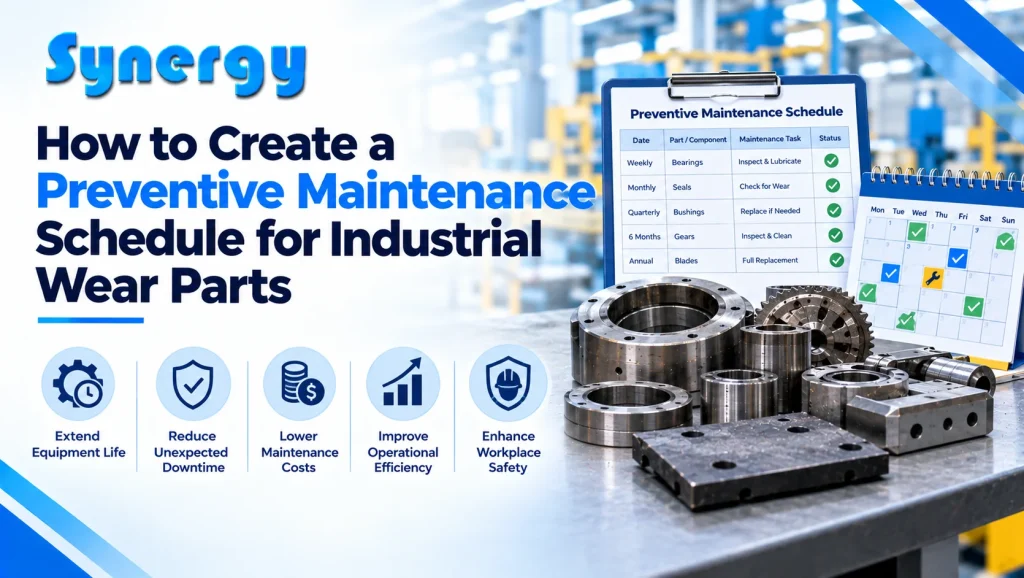
Industrial wear parts are essential for maintaining the performance and reliability of equipment used in mining, cement manufacturing, construction, crushing, and material handling. Components such as crusher liners, mill liners, wear plates, chute liners, and bucket teeth gradually deteriorate because of abrasion, impact, friction, and continuous operating loads.
Without a structured preventive maintenance schedule, businesses may replace components too early, continue using them beyond acceptable wear limits, or experience unexpected equipment failures. A well-planned schedule helps maintenance teams monitor component condition, organize replacement activities, manage spare parts, and reduce avoidable downtime.
To create an effective preventive maintenance schedule for industrial wear parts, businesses should identify critical components, establish inspection intervals, record wear measurements, estimate service life, define replacement limits, and coordinate maintenance with procurement and production teams.
This guide explains how industrial facilities can develop a practical wear-parts maintenance schedule and adapt it to their equipment, operating conditions, and production requirements.
What Is Preventive Maintenance for Industrial Wear Parts?
Preventive maintenance is a planned approach to inspecting, servicing, and replacing components before their deterioration leads to unacceptable equipment performance or failure.
For wear parts, preventive maintenance focuses on measuring wear, identifying damage, monitoring replacement intervals, and arranging components before they become unsuitable for continued use.
Common activities include:
- Visual inspections of wear surfaces.
- Measuring remaining thickness or component profiles.
- Checking mounting arrangements and fasteners.
- Recording operating hours and material throughput.
- Inspecting cracks, deformation, and uneven wear.
- Planning replacement during scheduled shutdowns.
- Maintaining appropriate replacement inventory.
Preventive maintenance does not mean replacing every component at a fixed interval regardless of condition. A good schedule combines manufacturer recommendations, historical performance data, operating conditions, and condition-based inspection findings.
Why Is a Preventive Maintenance Schedule Important?
1. Reduces Unplanned Equipment Downtime
Unexpected wear-part failure can interrupt production and require urgent maintenance work. A planned schedule helps teams identify deterioration earlier and arrange replacement activities in advance.
2. Helps Control Maintenance Costs
Unplanned replacements may involve overtime, expedited transportation, emergency purchasing, and additional repairs. Preventive maintenance gives businesses more opportunities to plan labor, stock, and procurement.
3. Improves Equipment Reliability
Worn or damaged components can affect clearances, material flow, processing performance, and the condition of connected equipment. Regular inspections help maintenance teams identify these issues before they escalate.
4. Supports Better Inventory Planning
Knowing which components are approaching their replacement limits helps procurement teams estimate future requirements and coordinate orders with supplier lead times.
5. Improves Maintenance Documentation
A consistent schedule creates records of component condition, wear rates, replacement dates, and failure patterns. These records help teams refine future maintenance intervals and make better purchasing decisions.
Step 1: Identify and List All Critical Wear Parts
Start by preparing a wear-parts register covering the components installed across your equipment and production lines.
Depending on the operation, this may include:
- Crusher liners and jaw plates.
- Mill liners and grinding components.
- Chute liners and wear plates.
- Bucket teeth and earthmoving wear components.
- High-chrome and manganese steel wear parts.
- Conveyor and material-transfer components.
- Custom abrasion-resistant parts.
For each component, record its part number, equipment model, location, material specification, dimensions, supplier, and replacement history.
Where possible, include drawings, photographs, installation instructions, and approved wear limits. Accurate identification reduces the risk of ordering incompatible components.
Classify Components by Criticality
Not every wear part needs the same inspection frequency.
Classify components according to their impact on production, equipment protection, safety, and maintenance requirements.
High-criticality components: Parts whose failure could stop an important production process or cause significant secondary damage.
Medium-criticality components: Parts that affect performance but may have some operational flexibility or backup arrangements.
Lower-criticality components: Parts that can usually be replaced without major production disruption, subject to the specific application.
Criticality should reflect the consequences of failure, not just the component’s purchase price.
Step 2: Establish Baseline Wear Measurements
Before creating replacement intervals, determine the condition of each critical component when it is new or first enters service.
Record the relevant baseline measurements, which may include:
- Original thickness.
- Working profile and dimensions.
- Critical clearances.
- Surface condition.
- Mounting and alignment measurements.
- Material specifications and hardness requirements, where applicable.
These measurements provide a reference for future inspections.
For example, if a wear plate begins with a specified thickness, subsequent measurements can show how much material has been lost during operation. Replacement limits should be based on manufacturer specifications, approved engineering requirements, and the component’s intended function.
Do not establish arbitrary wear limits without confirming that they are suitable for the equipment.
Step 3: Determine the Initial Inspection Frequency
Inspection intervals should reflect equipment criticality, operating intensity, expected wear rate, and the consequences of component failure.
A practical starting point is to review manufacturer guidance and existing maintenance records, then adjust intervals using actual inspection results.
The following table illustrates a planning framework rather than a universal schedule.
| Inspection Category | Example Starting Approach | Purpose |
| High-criticality components | Frequent checks based on risk and manufacturer guidance | Identify deterioration before it creates a major problem |
| Medium-criticality components | Scheduled inspections based on wear history | Track condition and plan replacement |
| Lower-criticality components | Routine checks during planned maintenance | Maintain reliable records and avoid excessive wear |
| Components with unexpected wear | Increase inspection frequency temporarily | Investigate the cause and establish a reliable trend |
Some components may need daily visual checks, while others may be assessed during weekly, monthly, or shutdown inspections. The appropriate interval depends on the operating environment and manufacturer requirements.
If a component begins wearing faster than expected, shorten the inspection interval until its behavior is understood.
Step 4: Monitor Operating Hours and Production Throughput
Calendar-based maintenance alone may not provide an accurate picture of wear-part condition.
A component used continuously in a high-throughput environment may deteriorate faster than an identical component operating for fewer hours or handling less abrasive material.
Track one or more relevant operating measures:
- Machine operating hours.
- Tonnes of material processed.
- Number of production cycles.
- Material hardness and abrasiveness.
- Equipment load and operating intensity.
- Changes in feed size or composition.
For crushing and mineral-processing equipment, throughput may be a useful measure of component usage. For other applications, operating hours or cycle counts may be more appropriate.
Compare wear measurements against these operating measures to estimate component service life under actual conditions.
Step 5: Calculate the Wear Rate
Wear-rate calculations help estimate how quickly a component is deteriorating and whether the existing inspection schedule is appropriate.
A simple thickness-based formula is:
Wear Rate = Material Thickness Lost ÷ Operating Hours
For example, suppose a wear plate loses 3 mm of thickness over 300 operating hours.
Wear Rate = 3 mm ÷ 300 hours = 0.01 mm per operating hour.
If the remaining usable thickness is known, this rate can help estimate when the component may approach its approved replacement limit.
However, wear rates are not always constant. Changes in feed material, impact, operating conditions, or contact patterns can accelerate deterioration. Use wear-rate estimates as planning aids, not as guarantees of remaining service life.
Where appropriate, calculate wear per tonne of material processed instead of wear per operating hour.
Step 6: Define Replacement Limits and Warning Conditions
Every critical wear part should have clear criteria for inspection findings that require monitoring, planned replacement, or urgent action.
Examples include:
- Remaining thickness reaching the approved minimum.
- Wear profile changing beyond the specified tolerance.
- Cracks, fractures, or severe chipping.
- Deformation affecting fitment or protection.
- Loose or displaced components.
- Exposure or damage to the supporting structure.
- Abnormal vibration or operating performance associated with component condition.
A component approaching its approved wear limit may be scheduled for replacement during the next suitable maintenance window. A component showing serious structural damage may require immediate assessment under site safety procedures.
Ensure that maintenance personnel understand how to record and escalate these findings.
Step 7: Build a Practical Maintenance Calendar
Once inspection frequencies and replacement criteria are established, organize activities into a maintenance calendar.
A sample framework could include:
Daily or Shift-Based Checks
Where appropriate, operators can monitor abnormal noise, vibration, visible displacement, material flow, or other changes identified in operating procedures.
These checks should not require personnel to approach moving machinery or bypass safety controls.
Weekly Inspections
Maintenance personnel can review accessible wear surfaces, component condition, fastening arrangements, and operating observations where the approved procedure permits.
Monthly Reviews
Review inspection records, wear measurements, replacement forecasts, spare-part availability, and recurring issues.
Adjust inspection frequency when measurements indicate faster-than-expected deterioration.
Planned Shutdown Inspections
Use scheduled shutdowns for detailed inspections, measurements, replacement of components approaching their limits, and repairs to supporting structures.
The actual calendar should be customized to equipment requirements. Daily, weekly, and monthly intervals are examples, not mandatory frequencies for every component.
Step 8: Coordinate Maintenance With Spare Parts Procurement
An inspection schedule is most useful when it triggers timely procurement decisions.
If a component is expected to reach its replacement limit within a known period, procurement teams should verify whether the correct replacement is available or needs to be ordered.
Include the following information in the maintenance plan:
- Component identification and approved specifications.
- Expected replacement date or operating threshold.
- Required quantity.
- Current stock availability.
- Supplier manufacturing lead time.
- Delivery and inspection requirements.
- Planned installation date.
Custom wear parts may require drawing approval, material sourcing, manufacturing, machining, or additional inspection. These activities should be considered when setting order dates.
Step 9: Track Maintenance Performance Using KPIs
Maintenance teams should measure whether the schedule is improving component reliability and controlling costs.
Useful indicators include:
Mean operating life: Average operating hours or production throughput achieved before replacement.
Wear-part replacement frequency: How often a particular component is replaced during a defined period.
Unplanned failure rate: The frequency of unexpected component failures.
Maintenance-related downtime: Time lost because of component inspection, failure, or replacement.
Emergency procurement rate: How often components must be purchased urgently.
Inventory accuracy: Whether recorded spare-part quantities match physical stock.
Maintenance schedule compliance: The proportion of planned maintenance activities completed as scheduled.
Review these indicators regularly. If a component repeatedly fails early, investigate the cause instead of simply shortening its replacement interval.
Step 10: Investigate Recurring Wear and Update the Schedule
A preventive maintenance schedule should evolve as the business learns more about equipment performance.
When wear parts deteriorate faster than expected, investigate possible causes such as:
- Incorrect material selection.
- Changes in feed material or abrasiveness.
- Higher operating loads.
- Incorrect installation or alignment.
- Poor component fitment.
- Manufacturing inconsistencies.
- Inadequate protection of supporting structures.
- Changes in equipment settings.
Document the findings and update inspection intervals, replacement criteria, or technical specifications where appropriate.
When introducing a new material or component design, compare its performance under reasonably similar operating conditions before changing the maintenance schedule across all equipment.
Common Mistakes in Wear Parts Preventive Maintenance
Replacing Components Only on a Fixed Calendar
A calendar-only approach may result in replacing usable components too early or continuing to use damaged parts for too long. Combine time-based planning with inspection findings and approved wear limits.
Ignoring Operating Conditions
Wear rates can change when throughput, feed composition, impact intensity, or operating settings change. Maintenance schedules should account for these variations.
Maintaining Incomplete Records
Without reliable measurements and replacement history, teams cannot accurately estimate service life or identify recurring failures. Use consistent recording methods and clearly identify each component.
Ordering Replacement Parts Too Late
Waiting until a component is at its replacement limit before contacting suppliers can create avoidable delays. Use forecasts and lead times to arrange procurement in advance.
Failing to Investigate Premature Failure
Repeated early replacement may indicate a material, design, installation, or operational issue. Investigating the cause can be more effective than continuing to replace the same component.
Overlooking Safety Procedures
Wear-part inspections and replacements can involve heavy components, stored energy, hot surfaces, and moving machinery. Follow approved isolation, lockout/tagout, lifting, access, and inspection procedures.
How India Synergy Can Support Wear Parts Maintenance Planning
Effective maintenance planning requires accurate component information, appropriate specifications, and coordination between technical teams and suppliers.
India Synergy works with industrial manufacturing and sourcing requirements across component categories. When planning replacement wear parts, buyers should provide equipment details, approved drawings, dimensions, material specifications, operating conditions, and available wear-history records.
This information helps establish the requirements for evaluating component suitability, manufacturing needs, inspection criteria, and replenishment timelines.
For information about the company’s broader industrial manufacturing and sourcing capabilities, visit India Synergy.
Conclusion
A preventive maintenance schedule for industrial wear parts helps businesses identify deterioration early, plan replacements, control inventory, and reduce unexpected equipment failures.
The process begins with identifying critical components and recording baseline measurements. Maintenance teams can then establish inspection intervals, monitor operating hours or throughput, calculate wear rates, define replacement limits, and coordinate procurement with planned maintenance.
The most effective schedule combines manufacturer guidance, condition monitoring, historical data, and site-specific operating requirements. Regular reviews help ensure that inspection intervals and replacement decisions remain appropriate as equipment and production conditions change.
With a structured approach, industrial businesses can improve equipment reliability, make better-informed purchasing decisions, and manage wear-part maintenance costs more effectively.
Frequently Asked Questions
1. What is a preventive maintenance schedule for wear parts?
It is a planned schedule of inspections, measurements, maintenance activities, and replacement decisions designed to identify wear before it causes unacceptable equipment performance or failure.
2. How often should industrial wear parts be inspected?
Inspection frequency depends on component criticality, operating conditions, manufacturer recommendations, and historical wear rates. Some components require frequent checks, while others may be inspected during scheduled maintenance.
3. How do you calculate wear-part service life?
Service life can be estimated using historical operating hours, throughput, wear measurements, and approved replacement limits. Estimates should be updated when operating conditions or wear rates change.
4. What is the difference between preventive and condition-based maintenance?
Preventive maintenance uses planned intervals or operating thresholds to schedule maintenance. Condition-based maintenance uses measured component condition to guide decisions. Combining both approaches can improve wear-part replacement planning.
5. Which KPIs should maintenance teams track?
Useful KPIs include component operating life, replacement frequency, unplanned failures, maintenance-related downtime, emergency procurement, inventory accuracy, and maintenance schedule compliance.
6. How does spare-parts inventory support preventive maintenance?
Maintaining appropriate stock of critical components helps ensure replacements are available when required. Inventory planning should consider expected consumption, supplier lead times, component criticality, and the consequences of stockouts.
7. What should be included in a wear-part maintenance record?
Record component identification, installation date, operating hours or throughput, inspection measurements, observed damage, maintenance activities, removal date, failure findings, and replacement details.
8. Can preventive maintenance eliminate wear-part failures?
No. Wear rates and operating conditions can change unexpectedly, and some failures cannot be predicted precisely. Preventive maintenance helps identify deterioration, improve planning, and reduce avoidable failures, but it cannot eliminate all risks.