





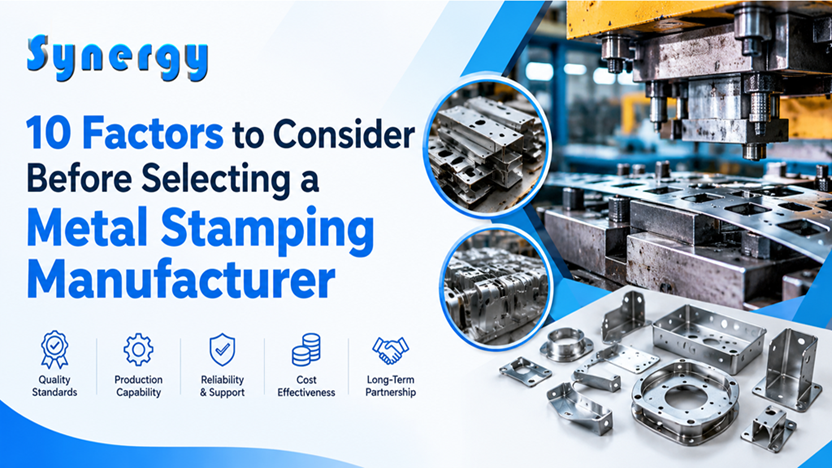
Selecting the right metal stamping manufacturer is an important decision for businesses that require consistent, accurate, and cost-effective metal components. The manufacturer you choose can influence product quality, tooling performance, production capacity, delivery schedules, and overall manufacturing costs.
Metal stamping is widely used to produce components such as brackets, clips, connectors, electrical parts, automotive components, appliance parts, industrial hardware, and custom sheet metal components. Depending on the application, manufacturers may use processes such as blanking, punching, bending, forming, embossing, deep drawing, compound stamping, or progressive die stamping.
However, choosing a supplier based only on the lowest quoted price can create problems later. Tooling limitations, inconsistent material quality, dimensional variation, production delays, poor communication, and inadequate quality control can increase the actual cost of a project.
This guide explains the 10 important factors to consider before selecting a metal stamping manufacturer, helping OEMs, procurement teams, engineers, importers, and businesses make a more informed supplier-selection decision.
What Is Metal Stamping?
Metal stamping is a manufacturing process used to cut, bend, form, or shape sheet metal or metal coil into specific components using a stamping press and specialized tooling.
Depending on the component design and production requirements, metal stamping can involve several operations, including:
- Blanking
- Punching
- Piercing
- Bending
- Forming
- Embossing
- Coining
- Deep drawing
- Progressive die stamping
- Compound stamping
The process is suitable for producing both relatively simple components and complex parts in repeatable quantities.
Metal stamping is commonly used in automotive, electrical, electronics, industrial equipment, appliances, construction, lighting, hardware, and other manufacturing applications.
For high-volume production, properly designed stamping tools can help manufacturers produce consistent components efficiently while reducing the per-piece production cost.
1. Manufacturing Experience and Technical Expertise
The first factor to evaluate is the manufacturer’s experience with metal stamping projects similar to yours.
Having stamping equipment alone does not guarantee that a supplier can successfully manufacture your component. Experience in engineering, tooling, material selection, process planning, and quality control is equally important.
A capable metal stamping manufacturer should understand how different materials behave during cutting and forming and how part geometry affects tooling and production.
Look for experience in areas such as:
- Custom metal stamping
- Precision stamping
- Sheet metal forming
- Progressive die stamping
- Deep drawing
- Tool and die manufacturing
- High-volume production
- Low- and medium-volume production
- OEM component manufacturing
It is also useful to ask whether the supplier has manufactured components with similar dimensions, materials, tolerances, and production volumes.
2. Evaluate Press Capacity and Manufacturing Equipment
The manufacturer’s equipment must match your component requirements.
Different parts require different press capacities depending on their:
- Material
- Thickness
- Size
- Shape
- Number of forming operations
- Required production volume
- Tool design
- Required forming force
When evaluating a supplier, ask about its available:
- Press tonnage
- Press bed dimensions
- Stroke length
- Mechanical presses
- Hydraulic presses
- Progressive stamping equipment
- Automatic feeding systems
- Coil handling equipment
- Transfer equipment
- Production automation
The manufacturer should be able to select an appropriate press based on the requirements of your component rather than simply using whichever machine is available.
Why Press Capacity Matters
If a press is not suitable for the material, tool, or component geometry, it can affect production efficiency, part quality, and tooling life.
For high-volume components, automated feeding and progressive stamping capabilities may also help improve production consistency and throughput.
Therefore, equipment capability should be evaluated together with engineering and tooling expertise.
3. Check Material Expertise and Raw Material Sourcing
Material selection plays an important role in metal stamping because different metals have different strength, hardness, ductility, and forming characteristics.
Common materials used for stamped components include:
- Mild steel
- Carbon steel
- Stainless steel
- Galvanized steel
- Aluminum
- Copper
- Brass
- Spring steel
- Specialty metal alloys
The appropriate material depends on the component’s intended application.
For example, electrical components may require materials with suitable electrical conductivity, while industrial or structural components may require specific strength and corrosion-resistance characteristics.
A reliable metal stamping supplier should understand important material properties such as:
- Tensile strength
- Yield strength
- Hardness
- Ductility
- Formability
- Thickness
- Corrosion resistance
Material Traceability
For many industrial applications, knowing where the material came from and whether it meets the specified grade is important.
Depending on your requirements, ask the manufacturer about:
- Material certificates
- Material grade verification
- Heat or batch identification
- Thickness verification
- Raw material supplier records
- Inspection documentation
Good material control can help maintain consistency between production batches.
4. Assess Tool and Die Design Capabilities
Tooling is one of the most critical parts of a metal stamping operation.
The die controls how the material is cut, punched, bent, drawn, or formed. Tooling quality can directly affect part accuracy, production efficiency, tool life, and maintenance requirements.
Before selecting a metal stamping manufacturer, determine whether the company has in-house tooling capabilities or relies on external toolmakers.
Ask about:
- Die design
- Tool material
- Tool manufacturing
- Tool testing
- Die maintenance
- Tool modifications
- Spare components
- Tool storage
- Tool life
- Preventive maintenance
For progressive stamping applications, tooling expertise is particularly important because several operations can be integrated into a single die.
Clarify Tool Ownership
Tool ownership should be clearly defined in the commercial agreement.
Ask:
Who owns the stamping die after the tooling cost has been paid?
Also clarify:
- Where the tool will be stored
- Who is responsible for maintenance
- Who pays for modifications
- What happens if the supplier relationship ends
- Whether the tool can be transferred
- How tooling changes are approved
Clear tooling terms can help avoid future misunderstandings.
5. Review Quality Control and Inspection Systems
Quality control should be evaluated before production begins.
A professional metal stamping manufacturer should have defined procedures for monitoring quality throughout the manufacturing process.
Quality checks may include:
- Incoming material inspection
- First-piece inspection
- In-process inspection
- Dimensional inspection
- Visual inspection
- Final inspection
- Functional inspection
- Tool inspection
- Sampling inspection
Depending on the component and tolerance requirements, manufacturers may use equipment such as:
- Vernier calipers
- Micrometers
- Height gauges
- Gauges
- Checking fixtures
- Optical inspection equipment
- Coordinate measuring machines (CMM)
The inspection method should be appropriate for the part’s critical dimensions and functional requirements.
Ask for Quality Documentation
Depending on the project, you may require:
- Inspection reports
- Dimensional reports
- Material certificates
- First Article Inspection reports
- Certificates of conformity
- Process documentation
- Corrective action reports
Before approving a supplier, understand exactly how the manufacturer will identify and control quality issues during production.
6. Confirm Tolerance and Precision Capabilities
Not every stamped component requires the same level of dimensional accuracy.
Before requesting quotations, clearly identify which dimensions are critical to the function or assembly of your component.
Your engineering drawing should clearly communicate:
- Overall dimensions
- Dimensional tolerances
- Material specification
- Material thickness
- Hole sizes
- Bend requirements
- Angular tolerances
- Surface finish
- Flatness requirements
- Burr requirements
- GD&T requirements, where applicable
Why Tolerance Matters
Metal stamping involves cutting, forming, bending, material movement, and springback. These factors can affect the final dimensions of a component.
A manufacturer should review your drawing and confirm that the required tolerances can be consistently achieved using the proposed material, tooling, and production process.
Avoid specifying unnecessarily tight tolerances where they are not required for functionality. Extremely tight tolerances can increase tooling complexity, inspection requirements, and manufacturing costs.
A good supplier should help distinguish between critical dimensions and general dimensions during the engineering review.
7. Evaluate Production Capacity and Scalability
Your supplier should be capable of meeting both current and future production requirements.
Before selecting a manufacturer, discuss:
- Prototype quantities
- Initial production volume
- Monthly requirements
- Annual requirements
- Seasonal demand
- Forecast changes
- Future production growth
- Emergency requirements
Metal stamping can be highly effective for large production volumes because dedicated tooling allows repeatable production of components.
However, a manufacturer’s production capacity is not determined only by the number of machines it owns.
Also consider:
- Available production hours
- Workforce
- Tooling capacity
- Material availability
- Maintenance planning
- Quality-control resources
- Production scheduling
- Backup equipment
- Supplier dependencies
Consider Future Demand
For example, if your current requirement is 20,000 components per month but your forecast indicates that demand could increase substantially, discuss this with the supplier before approving the tooling.
Understanding future requirements early can help the manufacturer plan equipment, tooling, raw materials, and production capacity.
8. Examine Lead Times and Delivery Reliability
Delivery performance is another important consideration when selecting a metal stamping manufacturer in India.
A custom stamping project can involve several stages:
Design review → DFM → Tool design → Tool manufacturing → Sampling → Inspection → Approval → Production → Finishing → Packaging → Shipment
The exact timeline depends on the complexity of the component, tooling, materials, quality requirements, and production volume.
Ask the manufacturer to provide separate lead times for:
- Initial quotation
- Engineering review
- Tool design
- Tool manufacturing
- First samples
- Sample approval
- Production
- Finishing
- Packaging
- Shipment
Discuss Potential Delays
Ask how the supplier handles:
- Raw material shortages
- Tool breakdowns
- Quality issues
- Engineering changes
- Urgent orders
- Demand increases
- Production delays
For international buyers, also discuss export documentation, packaging, logistics coordination, and shipment planning.
A clear production schedule helps both the manufacturer and buyer plan inventory and downstream assembly.
9. Check Secondary Operations and Value-Added Services
Metal stamping may be only one stage of your manufacturing process.
Depending on the final application, stamped components may require additional operations such as:
- Deburring
- Tapping
- Threading
- Welding
- Riveting
- Heat treatment
- Plating
- Powder coating
- Painting
- Anodizing
- Passivation
- Assembly
- Custom packaging
For example, a stamped metal bracket may require deburring, surface finishing, and assembly before it can be used in the final product.
Working with a supplier that can provide or coordinate secondary operations may simplify your supply chain.
Ask About Outsourced Processes
Not every manufacturer performs every secondary operation internally.
Ask:
- Which processes are performed in-house?
- Which processes are outsourced?
- How are external suppliers qualified?
- Who performs final inspection?
- Can multiple processes be coordinated under one project?
- Can finished or assembled components be supplied?
This information helps you understand the supplier’s actual manufacturing and sourcing capabilities.
10. Compare Total Cost, Communication, and Long-Term Support
Price is important, but the lowest quotation should not be the only deciding factor.
A better approach is to evaluate the total cost of manufacturing.
This can include:
Tooling + material + stamping + secondary operations + inspection + packaging + logistics + maintenance + quality-related costs
A supplier with a lower unit price may not necessarily result in a lower overall cost if it has higher rejection rates, inconsistent quality, poor tooling life, or unreliable delivery.
Review the Quotation Carefully
A professional quotation should clearly identify:
- Tooling cost
- Part price
- Material specification
- Material thickness
- Production quantity
- Minimum order quantity
- Finishing cost
- Inspection requirements
- Packaging
- Delivery terms
- Tool maintenance
- Tool ownership
Communication Is Also Important
Manufacturing projects require communication between engineering, procurement, quality, and production teams.
Evaluate how the supplier handles:
- Technical questions
- Drawing revisions
- Tooling updates
- Sample approvals
- Production schedules
- Quality concerns
- Corrective actions
- Shipment updates
For international sourcing, effective communication becomes even more important because technical and commercial information may need to be exchanged across different locations and time zones.
Metal Stamping Manufacturer Selection Checklist
Before finalizing a supplier, use the following checklist:
| Factor | What to Evaluate |
| Manufacturing Experience | Similar components, industries, and processes |
| Press Capacity | Tonnage, bed size, automation, and equipment |
| Material Capability | Material grades, thicknesses, sourcing, and traceability |
| Tooling | Die design, manufacturing, maintenance, and ownership |
| Quality Control | Inspection systems and quality documentation |
| Tolerances | Ability to consistently meet critical dimensions |
| Production Capacity | Current requirements and future scalability |
| Lead Time | Tooling, sampling, production, and delivery |
| Secondary Operations | Finishing, welding, assembly, and packaging |
| Total Cost | Tooling, material, production, quality, and logistics |
| Communication | Technical support and project management |
| Export Support | Packaging, documentation, and shipment coordination |
Using a structured evaluation process can make it easier to compare potential suppliers based on the complete manufacturing requirement rather than just the initial quotation.
Common Mistakes to Avoid When Selecting a Metal Stamping Manufacturer
Choosing Only the Lowest Price
The lowest quoted price may not represent the lowest total cost.
Unexpected tooling changes, rejected components, material problems, delays, and additional processing can increase the final manufacturing cost.
Ignoring Tooling Ownership
Always clarify who owns the stamping dies and who is responsible for maintenance, modifications, and storage.
Not Defining Critical Tolerances
If critical dimensions are not clearly identified, manufacturers may interpret the requirements differently.
Failing to Check Production Capacity
A supplier may be able to handle your current quantity but struggle when your production requirements increase.
Overlooking Material Traceability
For applications where material performance is important, ask about material certificates and traceability procedures.
Not Discussing Secondary Operations
If your component requires coating, plating, welding, or assembly, determine how those processes will be managed before production starts.
Ignoring Communication
Technical problems can become more difficult to resolve when communication is slow or unclear. Evaluate the supplier’s responsiveness during the quotation and engineering stages.
How to Evaluate a Metal Stamping Manufacturer Before Placing an Order
A structured supplier-evaluation process can reduce manufacturing risks.
Step 1: Prepare Your Technical Requirements
Provide the manufacturer with:
- 2D engineering drawings
- 3D CAD files
- Material specification
- Material thickness
- Annual production volume
- Monthly production volume
- Dimensional tolerances
- Surface finish requirements
- Packaging requirements
- Quality requirements
The more complete the technical information, the more accurately the supplier can evaluate your project.
Step 2: Request a DFM Review
Ask the manufacturer to review the component for manufacturability.
The review may identify:
- Difficult bends
- Tight tolerances
- Small holes
- Material-forming challenges
- Tooling limitations
- Burr risks
- Potential deformation
- Opportunities to reduce manufacturing complexity
Step 3: Evaluate the Tooling Proposal
Do not compare tooling proposals based only on price.
Review:
- Die construction
- Tool material
- Tool life
- Maintenance requirements
- Tool ownership
- Spare components
- Modification procedures
Step 4: Review Quality Capabilities
Ask how critical dimensions will be inspected and how production consistency will be monitored.
Step 5: Approve Production Samples
Before moving into mass production, evaluate the initial samples against the engineering drawing and agreed specifications.
Step 6: Confirm Production Capacity
Ensure the supplier has sufficient equipment, tooling, materials, manpower, and production capacity to meet your expected requirements.
Step 7: Finalize Commercial Terms
Before placing the production order, confirm:
- Unit pricing
- Tooling charges
- Payment terms
- Lead time
- Quality requirements
- Packaging
- Delivery terms
- Tool ownership
- Change-control procedures
This approach helps create a clear understanding between the buyer and manufacturer before production begins.
Why Choose India Synergy for Metal Stamping and Manufacturing Support?
For businesses sourcing components from India, selecting a manufacturing partner requires a combination of technical capability, quality management, production planning, and supply-chain coordination.
India Synergy provides manufacturing and sourcing support for businesses looking to develop and procure custom industrial components from India.
Its manufacturing and sourcing capabilities can support requirements involving:
- Custom metal stamping
- Precision sheet metal components
- Custom brackets
- Formed metal components
- Industrial metal parts
- OEM components
- High-volume manufacturing
- Custom manufacturing and sourcing
Every metal stamping project has different requirements. Material, component geometry, tolerances, production volume, tooling, finishing, and application should be evaluated before selecting the appropriate manufacturing process.
Businesses looking for metal stamping manufacturing and sourcing support from India can explore the capabilities of India Synergy at:
Final Takeaway
Choosing the right metal stamping manufacturer requires a comprehensive evaluation of more than price.
The key factors include:
Manufacturing experience → Equipment → Materials → Tooling → Quality → Tolerances → Capacity → Lead time → Secondary operations → Total cost and support
A suitable manufacturing partner should understand your engineering requirements, evaluate the design for manufacturability, develop appropriate tooling, maintain consistent production quality, and support your production requirements as they evolve.
For companies looking for custom metal stamping and manufacturing support from India, a structured supplier-evaluation process can help establish clearer technical, commercial, and production expectations from the beginning.
India Synergy supports businesses seeking manufacturing and sourcing solutions from India. To learn more about its capabilities, visit https://indiasynergy.com/.
Frequently Asked Questions About Metal Stamping Manufacturers
What should I look for in a metal stamping manufacturer?
Look for manufacturing experience, suitable press capacity, tooling expertise, material knowledge, quality-control systems, tolerance capabilities, production capacity, reliable lead times, secondary processing capabilities, and effective communication.
How do I choose the right metal stamping supplier?
Start by defining your component specifications, material, tolerances, production volume, quality requirements, and delivery expectations. Then evaluate suppliers based on their equipment, tooling capabilities, quality systems, production capacity, lead times, and total manufacturing cost.
What materials can be used for metal stamping?
Common stamping materials include mild steel, carbon steel, stainless steel, galvanized steel, aluminum, copper, brass, spring steel, and other metal alloys. The appropriate material depends on the component’s application and required mechanical, electrical, environmental, and forming characteristics.
Why is tooling important in metal stamping?
Tooling determines how the material is cut and formed. Properly designed tooling can improve part consistency, production efficiency, dimensional accuracy, and tool life. Poor tooling can contribute to defects, downtime, maintenance requirements, and additional costs.
What is progressive die stamping?
Progressive die stamping is a manufacturing process in which a metal strip moves through multiple stations within a stamping die. Different operations are performed at successive stations, allowing complex components to be manufactured efficiently, particularly in higher-volume applications.
Is metal stamping suitable for high-volume production?
Yes. Metal stamping is widely used for high-volume manufacturing because dedicated tooling can produce repeatable components efficiently. The suitability of the process depends on the component design, material, production volume, tolerances, and tooling requirements.
How important are tolerances when selecting a metal stamping manufacturer?
Tolerances are particularly important when dimensions affect component functionality, assembly, or performance. The manufacturer should review the required tolerances and confirm that they can be achieved consistently using the proposed material, tooling, equipment, and manufacturing process.
What is DFM in metal stamping?
DFM means Design for Manufacturing. In metal stamping, DFM involves reviewing a component design before production to identify potential manufacturing challenges related to geometry, bends, holes, material thickness, radii, tolerances, and forming requirements.
What questions should I ask a metal stamping supplier?
Ask about manufacturing experience, press capacity, materials, tooling, quality-control procedures, tolerances, production capacity, lead times, secondary operations, inspection documentation, tooling ownership, maintenance, packaging, and export capabilities.
How can I reduce metal stamping costs?
Manufacturing costs can potentially be controlled through efficient part design, appropriate material selection, practical tolerances, optimized tooling, suitable production volumes, efficient material utilization, and reduced unnecessary secondary operations. Cost reduction should always be balanced against the component’s functional and quality requirements.
What is the difference between metal stamping and sheet metal fabrication?
Metal stamping typically uses presses and specialized dies to cut or form sheet metal or coil material. Sheet metal fabrication is a broader category that can include cutting, bending, welding, forming, and assembly. The appropriate manufacturing method depends on the component design, production volume, material, and required characteristics.
Can a metal stamping manufacturer provide finishing and assembly?
Some manufacturers can provide or coordinate secondary processes such as deburring, plating, coating, welding, riveting, and assembly. Buyers should confirm which operations are performed in-house and which are handled through qualified external suppliers.
Can businesses source stamped components from India?
Yes. Businesses can source custom stamped components from Indian manufacturers for domestic and international applications. When sourcing internationally, buyers should evaluate technical capabilities, quality systems, production capacity, documentation, packaging, logistics, and communication in addition to price.