





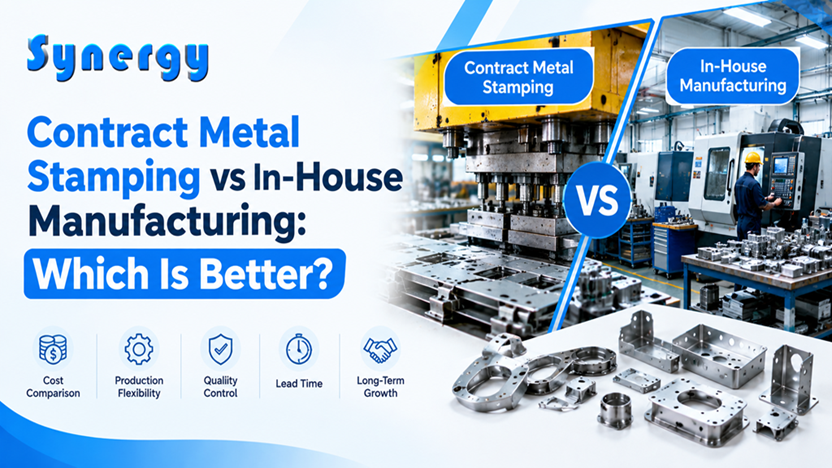
Businesses that use stamped metal components often face an important manufacturing decision: should metal stamping be handled in-house or outsourced to a contract metal stamping manufacturer?
Both approaches can work depending on the company’s production volume, technical requirements, available capital, workforce, tooling needs, quality requirements, and long-term manufacturing strategy.
Contract metal stamping allows a business to work with an external manufacturing partner that manages some or all of the stamping process. In-house manufacturing, on the other hand, requires the company to invest in its own stamping presses, tooling, facilities, employees, quality systems, maintenance, and production management.
There is no single solution that works for every business. The right approach depends on the specific component, production requirements, available resources, and desired level of manufacturing control.
This guide compares contract metal stamping vs. in-house manufacturing, including costs, equipment, tooling, quality control, production capacity, workforce, scalability, lead times, supply-chain considerations, and long-term business factors.
What Is Contract Metal Stamping?
Contract metal stamping is a manufacturing arrangement in which a business hires an external metal stamping manufacturer to produce components according to agreed technical, quality, quantity, and delivery requirements.
The contract manufacturer may manage some or all stages of production, including:
- Design review
- Design for Manufacturing (DFM)
- Tool and die development
- Raw material sourcing
- Metal stamping
- In-process inspection
- Finishing
- Secondary operations
- Assembly
- Packaging
- Production management
- Shipment coordination
The buyer typically provides engineering drawings, CAD files, specifications, quality requirements, production forecasts, or other technical information.
The external manufacturer then develops and executes the manufacturing process based on those requirements.
Contract manufacturing is commonly used when businesses want access to specialized production capabilities without investing heavily in their own manufacturing infrastructure.
What Is In-House Metal Stamping?
In-house metal stamping means that a company owns and operates its own stamping equipment and manages the manufacturing process internally.
An in-house operation may require investment in:
- Stamping presses
- Dies and tooling
- Coil feeders
- Material-handling equipment
- Tool storage
- Inspection equipment
- Manufacturing space
- Electrical infrastructure
- Maintenance systems
- Safety systems
- Skilled operators
- Toolmakers
- Engineers
- Quality personnel
The company is responsible for managing production from raw material through finished components.
This approach provides a high level of direct control, but it also requires significant investment and ongoing operational management.
Contract Metal Stamping vs. In-House Manufacturing: Quick Comparison
| Factor | Contract Metal Stamping | In-House Manufacturing |
| Initial Investment | Generally lower | Generally higher |
| Equipment Ownership | External manufacturer | Company |
| Tooling Management | Often managed by supplier | Managed internally |
| Skilled Workforce | Supplier provides expertise | Company must hire/train |
| Production Control | Shared with supplier | Direct internal control |
| Scalability | Can use supplier capacity | Requires internal expansion |
| Maintenance | Usually supplier responsibility | Company responsibility |
| Quality Control | Supplier + buyer requirements | Internal quality team |
| Capital Requirements | Lower infrastructure investment | Higher infrastructure investment |
| Manufacturing Expertise | Access to specialist | Must develop internally |
| Capacity Expansion | Potentially easier | Requires additional investment |
| Supply Chain | Depends on supplier | More internally controlled |
| Operational Responsibility | Shared | Primarily internal |
Neither model is universally appropriate. The decision should be based on the company’s production strategy and technical requirements.
1. Initial Investment and Capital Requirements
One of the biggest differences between contract and in-house metal stamping is the initial investment.
Contract Metal Stamping
With contract manufacturing, the business generally does not need to purchase its own stamping press, production facility, feeding equipment, or many of the supporting systems required for manufacturing.
Instead, the manufacturer already has the infrastructure needed to produce the components.
The buyer may still have to pay for:
- Tooling
- Engineering
- Samples
- Production
- Material
- Finishing
- Packaging
- Logistics
However, the capital investment can be significantly different from building an entire stamping operation.
In-House Manufacturing
An in-house operation may require substantial capital expenditure for:
- Presses
- Dies
- Automation
- Material handling
- Facility modifications
- Electrical systems
- Safety equipment
- Inspection equipment
- Tooling equipment
- Maintenance infrastructure
The company also has to account for ongoing operating costs.
Which Model Requires More Upfront Investment?
In general, in-house manufacturing requires more upfront infrastructure investment, while contract metal stamping can allow a company to access existing manufacturing capacity without owning the entire production setup.
2. Equipment and Technology
Metal stamping equipment can vary considerably depending on the application.
A manufacturer may use:
- Mechanical presses
- Hydraulic presses
- Progressive stamping presses
- Transfer presses
- Automatic feeders
- Coil lines
- Servo feeding systems
- Specialized stamping equipment
Contract Manufacturing Advantage
A contract metal stamping manufacturer may already have multiple machines with different capacities.
This can give a buyer access to equipment without purchasing each machine itself.
For example, one component may require a specific press capacity while another product may require a different setup.
Working with a capable contract manufacturer can provide access to a broader equipment base.
In-House Manufacturing
An in-house operation must select and purchase equipment based on its production requirements.
If requirements change significantly, the company may need additional equipment.
Therefore, equipment utilization becomes an important consideration.
A press that operates consistently at an appropriate production load may provide better asset utilization than equipment that sits idle for long periods.
3. Tooling and Die Development
Tooling is a central part of metal stamping.
Depending on the component, a manufacturer may require:
- Blanking dies
- Punching dies
- Forming dies
- Progressive dies
- Compound dies
- Deep drawing dies
- Specialized fixtures
Contract Metal Stamping
A contract manufacturer can often manage:
- Tool design
- Tool engineering
- Tool manufacturing
- Tool testing
- Tool maintenance
- Tool modification
- Production tooling
This can reduce the need for the buyer to develop a complete internal tooling department.
In-House Manufacturing
An in-house operation must manage tooling internally or work with external toolmakers.
This can require:
- Tool designers
- Toolmakers
- Tool maintenance personnel
- Tool storage
- Tool inspection equipment
- Spare tooling components
Why Tooling Strategy Matters
The right choice depends on how frequently your tools are used.
If a company produces large volumes of the same component for many years, owning and managing the tooling internally may be strategically useful.
If production requirements change frequently, outsourcing tooling and stamping may provide greater flexibility.
4. Production Volume
Production volume is one of the most important factors in deciding between contract and in-house manufacturing.
High-Volume Production
High-volume production can make dedicated tooling and stamping equipment more economical because fixed costs can be distributed across a larger number of components.
However, high volume alone does not automatically mean that in-house manufacturing is the right choice.
A business should consider:
- Annual demand
- Monthly demand
- Production stability
- Product lifecycle
- Forecast accuracy
- Equipment utilization
- Tooling investment
- Labor requirements
Variable or Lower Production Volumes
Contract manufacturing may be useful when demand is:
- Variable
- Seasonal
- Growing
- Uncertain
- Spread across multiple components
A contract supplier may be able to combine your production requirements with its existing equipment and manufacturing infrastructure.
5. Cost Comparison
Cost is often the first factor businesses consider, but it should not be the only one.
Contract Metal Stamping Costs
Contract manufacturing costs may include:
Tooling + material + stamping + secondary operations + inspection + packaging + logistics
The supplier may include its manufacturing overhead and profit margin in the quoted price.
The advantage is that many fixed infrastructure costs are already incorporated into the supplier’s operation.
In-House Manufacturing Costs
An in-house operation may involve:
Equipment + tooling + facility + labor + electricity + maintenance + quality + material + production management + depreciation + safety + overhead
The per-part manufacturing cost may become competitive at sufficiently high and stable production volumes, but this depends heavily on equipment utilization and operational efficiency.
Look at Total Cost of Ownership
A better comparison is:
Total annual in-house manufacturing cost vs. total annual contract manufacturing cost
Do not compare only the supplier’s piece price with raw material cost.
Include:
- Equipment depreciation
- Financing
- Labor
- Maintenance
- Electricity
- Factory space
- Quality inspection
- Tooling
- Waste
- Downtime
- Management
- Inventory
- Logistics
This gives a more realistic picture of the economics.
6. Skilled Workforce and Technical Expertise
Metal stamping requires specialized knowledge.
Depending on the operation, expertise may be needed in:
- Tool design
- Press operation
- Material selection
- Process engineering
- Die maintenance
- Quality inspection
- Production planning
- Automation
- Troubleshooting
Contract Metal Stamping
With a contract manufacturer, many of these skills already exist within the supplier’s organization.
This can give businesses access to experienced manufacturing professionals without building an entire team internally.
In-House Manufacturing
An organization operating its own stamping facility must recruit, train, and retain skilled personnel.
This can include:
- Production engineers
- Toolmakers
- Press operators
- Maintenance technicians
- Quality engineers
- Production managers
Workforce availability should therefore be considered when evaluating the long-term feasibility of an in-house operation.
7. Quality Control and Manufacturing Standards
Quality requirements are especially important for precision stamped components.
Contract Manufacturing
A contract manufacturer should have documented quality-control procedures covering:
- Raw material inspection
- First-piece inspection
- In-process inspection
- Dimensional inspection
- Final inspection
- Non-conformance management
- Corrective actions
- Traceability
The buyer should clearly define its quality requirements in the supplier agreement and technical documentation.
Depending on the project, customers may request:
- Inspection reports
- Material certificates
- First Article Inspection
- Certificates of conformity
- Dimensional reports
- Process documentation
In-House Manufacturing
With internal production, the company has direct control over the quality system.
It can establish its own:
- Inspection procedures
- Sampling plans
- Quality standards
- Process controls
- Traceability systems
However, maintaining an effective internal quality system requires personnel, equipment, documentation, training, and continuous monitoring.
8. Production Control and Visibility
One potential advantage of in-house manufacturing is direct visibility into production.
The company can directly monitor:
- Production schedules
- Machine utilization
- Tool condition
- Material availability
- Quality
- Work-in-progress
- Finished inventory
However, contract manufacturing can also provide strong production visibility when the supplier has effective communication and reporting systems.
Businesses can establish requirements for:
- Production updates
- Forecasts
- Inventory reports
- Quality reports
- Tooling status
- Shipment schedules
The level of visibility therefore depends not only on the manufacturing model but also on how the supplier relationship is managed.
9. Scalability and Capacity
Demand can change over time.
A company may initially require a small production quantity but later experience significant growth.
Contract Metal Stamping
Contract manufacturers may have multiple presses and production lines, allowing customers to access existing capacity.
This can make scaling easier in some situations.
However, capacity should always be confirmed with the supplier before committing to increased volumes.
Ask about:
- Available machine capacity
- Additional shifts
- Backup equipment
- Tooling capacity
- Raw material availability
- Production lead times
In-House Manufacturing
Scaling an internal operation may require:
- Additional presses
- More tooling
- More factory space
- Additional employees
- More inspection equipment
- Higher maintenance capacity
Expansion can therefore require significant additional capital investment.
10. Flexibility and Product Changes
Product designs can change due to:
- Customer requirements
- Engineering improvements
- Cost reduction
- Material changes
- Regulatory requirements
- Product upgrades
Contract manufacturing can provide flexibility when a business does not want to maintain a large fixed manufacturing infrastructure.
An external supplier may support different components, materials, and production volumes using its existing capabilities.
In-house manufacturing provides direct control over engineering and production changes, but the company must manage the associated tooling and process modifications itself.
11. Maintenance and Equipment Downtime
Stamping presses and tooling require maintenance.
Regular maintenance can include:
- Press inspections
- Die maintenance
- Lubrication
- Replacement of worn components
- Feeder maintenance
- Electrical maintenance
- Preventive maintenance
- Corrective repairs
Contract Manufacturing
The contract manufacturer generally manages its production equipment and maintenance systems.
This reduces the buyer’s direct responsibility for maintaining the manufacturing infrastructure.
However, the buyer should understand how the supplier manages equipment breakdowns and production interruptions.
In-House Manufacturing
The company is responsible for:
- Equipment maintenance
- Spare parts
- Maintenance personnel
- Tool repairs
- Downtime management
- Preventive maintenance schedules
The financial impact of downtime should be included in the in-house cost calculation.
12. Supply Chain and Logistics
Contract manufacturing introduces a supplier relationship into the production process.
This means the buyer must manage:
- Supplier communication
- Purchase orders
- Forecasts
- Inventory
- Transportation
- Delivery schedules
- Quality issues
For international sourcing, additional considerations may include:
- Export documentation
- International shipping
- Customs procedures
- Packaging
- Freight costs
- Transit time
In-house manufacturing reduces dependence on an external production supplier, but the company still needs to source raw materials and manage finished goods.
Therefore, neither model completely eliminates supply-chain management.
13. Business Risk and Supplier Dependency
Contract manufacturing can create dependency on an external supplier.
Potential risks may include:
- Supplier capacity constraints
- Production delays
- Quality problems
- Raw material shortages
- Tooling issues
- Communication problems
- Changes in commercial terms
These risks can be managed through:
- Supplier qualification
- Quality agreements
- Production forecasts
- Clear contracts
- Supplier audits
- Backup suppliers
- Tooling ownership agreements
- Performance monitoring
In-house manufacturing reduces dependence on an external stamping supplier but introduces other risks, such as:
- Equipment failure
- Skilled labor shortages
- Capital requirements
- Maintenance problems
- Internal production bottlenecks
The appropriate strategy depends on the company’s ability and willingness to manage these risks.
Contract Metal Stamping vs. In-House Manufacturing: Advantages and Considerations
Contract Metal Stamping
Potential Advantages
- Lower infrastructure investment
- Access to specialized expertise
- Access to existing equipment
- Reduced equipment maintenance responsibility
- Easier access to production scalability
- Potentially faster manufacturing setup
- Ability to focus internal resources on product development and core business activities
Considerations
- Dependence on supplier performance
- Less direct control over production
- Transportation requirements
- Supplier communication
- Potential minimum order quantities
- Need for supplier qualification
In-House Metal Stamping
Potential Advantages
- Direct production control
- Immediate access to manufacturing information
- Greater control over scheduling
- Direct management of quality
- Potentially greater control over proprietary processes
- No external stamping supplier dependency
Considerations
- Higher capital investment
- Equipment maintenance
- Skilled workforce requirements
- Tooling management
- Facility requirements
- Internal quality systems
- Equipment utilization risk
- Responsibility for production downtime
When Should You Consider Contract Metal Stamping?
Contract metal stamping may be worth considering when a business:
- Does not currently own stamping equipment
- Wants to avoid major capital investment
- Needs specialized stamping expertise
- Has variable production volumes
- Needs access to different press capacities
- Wants to scale production
- Has limited internal manufacturing resources
- Wants to focus on product development or other core operations
- Requires manufacturing support from an experienced supplier
For companies sourcing components internationally, working with an experienced metal stamping manufacturer in India can also provide access to established manufacturing and sourcing capabilities.
When Does In-House Metal Stamping Make Sense?
In-house manufacturing may be considered when a company:
- Has consistently high production volumes
- Has strong internal engineering capabilities
- Can justify equipment investment
- Has sufficient factory space
- Can hire and retain skilled workers
- Requires direct production control
- Has stable long-term product demand
- Can maintain equipment and tooling internally
The economics should be evaluated using realistic production volumes and complete operating costs.
How to Decide Between Contract and In-House Metal Stamping
A structured decision process can make the comparison easier.
Step 1: Calculate Your Production Volume
Determine:
- Monthly volume
- Annual volume
- Forecast growth
- Product lifecycle
- Seasonal requirements
Step 2: Calculate In-House Investment
Estimate the cost of:
- Presses
- Tooling
- Facility
- Installation
- Automation
- Inspection equipment
- Labor
- Maintenance
- Utilities
- Safety systems
Step 3: Obtain Contract Manufacturing Quotes
Request detailed quotations from qualified metal stamping manufacturers.
Compare:
- Tooling
- Unit price
- Material
- Quality
- Lead time
- Packaging
- Logistics
- Minimum order quantity
Step 4: Compare Total Annual Costs
Do not compare only per-piece pricing.
Calculate the estimated annual cost of both approaches.
Step 5: Evaluate Technical Requirements
Consider:
- Tolerances
- Materials
- Component complexity
- Tooling
- Secondary operations
- Inspection requirements
Step 6: Evaluate Risk
Consider what would happen if:
- Demand increases
- Demand decreases
- Equipment fails
- A tool requires modification
- Material becomes unavailable
- A supplier experiences delays
Step 7: Consider Your Core Business
Ask whether operating a stamping facility is a strategic part of your business or whether manufacturing can be handled more efficiently through a qualified external partner.
Why Businesses Work With Contract Metal Stamping Manufacturers
The biggest reason businesses consider contract manufacturing is the ability to access specialized manufacturing capabilities without building the complete production infrastructure themselves.
A qualified contract supplier can potentially provide:
Engineering + tooling + material sourcing + stamping + quality control + finishing + packaging + supply-chain coordination
This can simplify manufacturing for businesses that do not want to develop an internal stamping operation.
However, supplier selection remains critical. The buyer should evaluate manufacturing capabilities, quality systems, tooling expertise, capacity, communication, and total cost before entering into a long-term agreement.
Contract Metal Stamping From India
India has a broad manufacturing ecosystem supporting industrial components, engineering products, sheet metal components, and custom manufacturing.
Businesses considering sourcing stamped components from India should evaluate suppliers based on:
- Manufacturing capabilities
- Engineering support
- Tooling expertise
- Quality systems
- Material sourcing
- Production capacity
- Export experience
- Packaging
- Logistics
- Communication
- Documentation
For international buyers, the goal should be to establish a supplier relationship based on clearly defined technical and commercial requirements.
India Synergy supports businesses looking for manufacturing and sourcing solutions from India, including custom metal components and industrial manufacturing requirements.
To learn more about India Synergy’s capabilities, visit:
Contract Metal Stamping vs. In-House Manufacturing: Key Takeaway
The decision between contract metal stamping and in-house manufacturing depends on your production volume, capital availability, technical expertise, quality requirements, scalability needs, and desired level of manufacturing control.
Contract manufacturing can provide access to existing equipment, specialized expertise, tooling capabilities, and production capacity without requiring the buyer to build a complete stamping facility.
In-house manufacturing can provide greater direct control over equipment, production scheduling, quality, and manufacturing operations, but it requires significant investment and ongoing operational responsibility.
The most useful comparison is therefore not simply “Which option is cheaper?”
Instead, evaluate:
Total cost + production volume + equipment utilization + technical expertise + quality + scalability + risk + long-term business strategy
A detailed comparison based on these factors can help businesses determine which manufacturing model aligns with their specific requirements.
Final Conclusion
There is no universal answer to whether contract metal stamping or in-house manufacturing is the better approach.
The appropriate model depends on your company’s specific manufacturing requirements.
If you need access to specialized equipment and expertise without building your own stamping infrastructure, contract manufacturing can provide a practical sourcing model.
If you have stable, high-volume production, sufficient capital, internal technical expertise, and a strategic reason to control manufacturing directly, you may consider an in-house operation.
Before deciding, compare both options based on total cost, production volume, quality requirements, tooling, capacity, workforce, maintenance, scalability, supply-chain risk, and long-term business objectives.
For businesses evaluating contract manufacturing and sourcing opportunities from India, India Synergy can support custom manufacturing and industrial component sourcing requirements.
Learn more at https://indiasynergy.com/.
Frequently Asked Questions
Is contract metal stamping cheaper than in-house manufacturing?
The answer depends on production volume, equipment utilization, tooling costs, labor, facility costs, maintenance, material costs, and logistics. Contract stamping can reduce the need for major infrastructure investment, while high and stable production volumes may change the economics of an internal operation.
What is the main difference between contract and in-house metal stamping?
Contract metal stamping is performed by an external manufacturing supplier, while in-house stamping is managed using equipment, tooling, employees, and facilities owned or controlled directly by the company.
Why do companies outsource metal stamping?
Companies may outsource metal stamping to access specialized equipment and expertise, reduce infrastructure investment, increase production flexibility, manage variable volumes, or avoid developing a complete internal stamping operation.
Is in-house metal stamping better for high-volume production?
High production volumes can improve equipment utilization and help distribute fixed manufacturing costs across more components. However, whether in-house production is appropriate depends on total investment, demand stability, technical requirements, workforce, and operating costs.
What costs should be included when comparing contract and in-house stamping?
The comparison should include equipment, tooling, material, labor, facility costs, utilities, maintenance, inspection, quality management, depreciation, production management, packaging, logistics, and potential downtime.
Who owns the tooling in contract metal stamping?
Tool ownership depends on the commercial agreement between the buyer and manufacturer. The contract should clearly specify tooling ownership, storage, maintenance, modification costs, and transfer arrangements.
Can a contract metal stamping manufacturer handle high-volume production?
Many contract manufacturers support high-volume production, but capacity varies by supplier. Buyers should confirm press capacity, tooling capability, production schedules, material availability, and scalability before placing large orders.
What materials can be used in metal stamping?
Common stamping materials include mild steel, carbon steel, stainless steel, aluminum, copper, brass, galvanized steel, spring steel, and other metal alloys. Material selection depends on the application’s mechanical, environmental, electrical, and forming requirements.
What is progressive die stamping?
Progressive die stamping uses a specialized die containing multiple stations. A metal strip moves through the stations, where different operations are performed sequentially. It is commonly used for producing repeatable components in higher production volumes.
Can contract metal stamping include finishing and assembly?
Yes. Depending on the supplier, contract manufacturing programs can include secondary operations such as deburring, welding, riveting, plating, coating, heat treatment, assembly, and packaging. Buyers should confirm which services are performed internally and which are coordinated through external suppliers.
How do I choose a contract metal stamping manufacturer?
Evaluate manufacturing experience, equipment, press capacity, tooling expertise, materials, quality-control systems, production capacity, lead times, secondary operations, communication, total cost, and export capabilities.
Is metal stamping suitable for custom components?
Yes. Metal stamping can be used to manufacture a wide range of custom components. The appropriate process and tooling depend on the part’s geometry, material, thickness, tolerances, production volume, and functional requirements.
Can businesses source contract metal stamping from India?
Yes. Businesses can work with Indian manufacturers to source custom stamped components for domestic and international applications. Supplier evaluation should include technical capabilities, quality systems, tooling, capacity, documentation, packaging, logistics, and communication.