





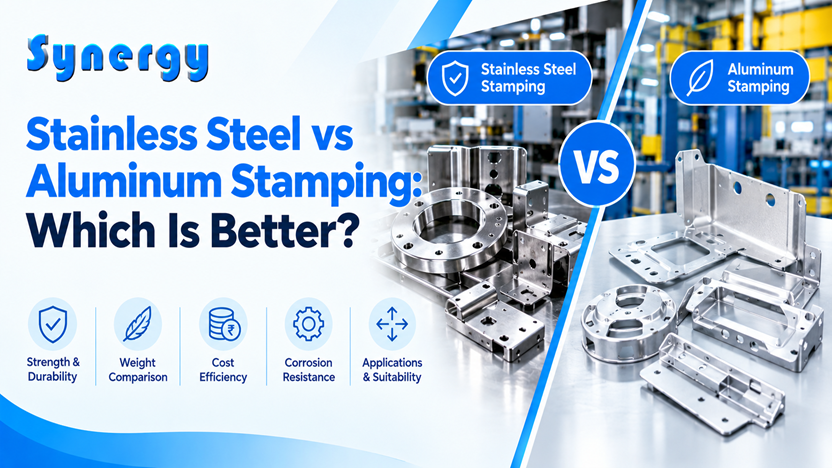
When choosing a metal for precision stamped components, stainless steel vs aluminum stamping is a common comparison for OEMs, manufacturers, engineers, and sourcing teams. Both materials offer distinct advantages, but the right choice depends on factors such as strength, weight, corrosion resistance, conductivity, forming requirements, production volume, application environment, and total manufacturing cost.
Stainless steel stamping is widely selected for applications requiring strength, durability, corrosion resistance, and dimensional stability. Aluminum stamping, on the other hand, is often preferred when lightweight construction, electrical conductivity, corrosion resistance, and efficient material handling are important.
At India Synergy, we provide custom metal stamping and manufacturing solutions designed around the material, component geometry, production volume, tolerance requirements, and end-use application. Understanding the differences between stainless steel and aluminum stamping can help OEMs make a more informed sourcing and manufacturing decision.
What Is Metal Stamping?
Metal stamping is a manufacturing process used to convert flat metal sheets, strips, or coils into specific shapes using stamping dies and presses. Depending on the component design, the process can include operations such as blanking, punching, bending, forming, drawing, and piercing.
The process can be used for both stainless steel and aluminum, but each material behaves differently during stamping.
Material selection affects:
- Component strength
- Part weight
- Formability
- Tooling requirements
- Surface finish
- Corrosion resistance
- Electrical and thermal conductivity
- Production speed
- Material cost
- Overall component performance
This is why comparing stainless steel vs aluminum stamping is important before finalizing a production material.
Stainless Steel Stamping vs Aluminum Stamping: Quick Comparison
| Factor | Stainless Steel Stamping | Aluminum Stamping |
| Strength | High | Moderate to high, depending on alloy |
| Weight | Heavier | Lightweight |
| Corrosion Resistance | Excellent | Excellent for many applications |
| Electrical Conductivity | Lower | High |
| Thermal Conductivity | Lower | High |
| Formability | Good, alloy-dependent | Generally good, alloy-dependent |
| Wear Resistance | High | Moderate |
| Temperature Resistance | Generally high | Alloy and application dependent |
| Surface Appearance | Excellent | Excellent |
| Typical Applications | Automotive, industrial, medical, appliances | Electronics, automotive, electrical, lightweight components |
| Lightweight Design | Limited | Excellent |
| Durability | Excellent | Good to excellent depending on alloy |
Neither material is universally better. The appropriate choice depends on the requirements of the finished component.
Stainless Steel Stamping
Stainless steel stamping uses stainless steel sheet or coil to manufacture precision components through controlled stamping operations. Stainless steel contains chromium, which provides its characteristic corrosion resistance.
Different stainless steel grades offer different combinations of strength, formability, corrosion resistance, and temperature performance.
Commonly used grades can include:
- 304 stainless steel
- 316 stainless steel
- 301 stainless steel
- 430 stainless steel
The appropriate grade depends on the application’s mechanical, environmental, and manufacturing requirements.
Advantages of Stainless Steel Stamping
1. High Strength
Stainless steel generally provides higher strength than aluminum, making it suitable for components that must withstand mechanical loads, pressure, vibration, or repeated use.
This makes stainless steel stamping suitable for structural brackets, industrial components, automotive parts, enclosures, clips, and other demanding applications.
2. Excellent Corrosion Resistance
Stainless steel offers strong resistance to corrosion and oxidation. This makes it suitable for environments where components may encounter moisture, chemicals, humidity, or other corrosive conditions.
For applications involving aggressive environments, the specific stainless steel grade should be selected carefully.
3. Good Durability
Stainless steel stamped components can provide long service life when the correct material grade, thickness, tooling, and manufacturing process are selected.
Its durability can be particularly valuable for industrial and automotive components that experience repeated mechanical stress.
4. Strong Temperature Performance
Many stainless steel grades maintain useful mechanical properties at temperatures where some aluminum applications may require additional consideration.
This makes stainless steel a potential option for components exposed to elevated operating temperatures.
5. Premium Surface Appearance
Stainless steel can provide a clean and professional appearance. Depending on the application, stamped stainless steel components may also undergo additional finishing processes such as polishing, brushing, passivation, or other surface treatments.
Limitations of Stainless Steel Stamping
Stainless steel also has certain manufacturing considerations.
- It is heavier than aluminum.
- Some stainless steel grades require greater forming force.
- Tooling can experience higher loads and wear.
- Material costs can vary significantly by grade and market conditions.
- Complex forming may require careful die and process engineering.
These factors should be considered during the product design and sourcing stage.
Aluminum Stamping
Aluminum stamping uses aluminum sheet or coil to produce lightweight components through operations such as blanking, bending, punching, and forming.
Different aluminum alloys offer different combinations of strength, formability, corrosion resistance, conductivity, and weight.
Common aluminum alloys used in manufacturing include various grades from the 1xxx, 3xxx, 5xxx, and 6xxx series, depending on the application and required properties.
Advantages of Aluminum Stamping
1. Lightweight Construction
One of the biggest advantages of aluminum is its low density.
For applications where reducing component weight is important, aluminum stamping can provide significant weight savings compared with stainless steel.
This can be valuable in:
- Automotive components
- Transportation equipment
- Electronics
- Electrical products
- Aerospace-related components
- Lightweight enclosures
- Consumer products
2. Excellent Electrical Conductivity
Aluminum provides substantially higher electrical conductivity than stainless steel.
This makes aluminum suitable for selected electrical and electronic components where conductivity and low weight are important.
3. High Thermal Conductivity
Aluminum transfers heat efficiently, which can be beneficial in components designed for thermal management.
It is therefore commonly considered for applications involving heat dissipation.
4. Corrosion Resistance
Aluminum naturally forms a thin oxide layer that helps protect the underlying metal from corrosion.
Its corrosion performance can be further enhanced through suitable finishing or coating processes where required.
5. Efficient Lightweight Design
Aluminum allows designers to reduce weight without necessarily eliminating the required functional characteristics of a component.
For OEMs focused on lightweight product development, aluminum stamping can therefore be an attractive manufacturing option.
Limitations of Aluminum Stamping
Aluminum also presents some manufacturing considerations:
- Some aluminum alloys are softer than stainless steel.
- Surface scratching can occur more easily.
- Springback may require careful process control.
- Certain alloys have different forming characteristics.
- Tooling and lubrication must be selected according to the alloy and stamping operation.
- High-strength aluminum grades may have different formability requirements.
Material grade selection is therefore important when developing a stamped aluminum component.
Stainless Steel vs Aluminum Stamping: Key Differences
1. Strength
When comparing stainless steel vs aluminum stamping, strength is often one of the first considerations.
Stainless steel generally offers higher strength and stiffness than standard aluminum alloys. This can make stainless steel suitable for components that must withstand higher mechanical loads.
However, high-strength aluminum alloys can provide significantly improved mechanical performance compared with softer aluminum grades.
Choose based on: required load capacity, thickness, design geometry, and selected alloy.
2. Weight
Aluminum has a major advantage when component weight is a critical factor.
A comparable aluminum component can weigh substantially less than a stainless steel component.
This makes aluminum attractive for applications where reducing overall product weight can improve handling, transportation efficiency, or energy consumption.
Choose aluminum when: lightweight construction is a major design objective.
3. Corrosion Resistance
Both materials can provide strong corrosion resistance, but their performance depends on the specific grade, environment, surface condition, and finishing process.
Stainless steel is widely used in demanding environments because of its corrosion-resistant properties.
Aluminum also provides natural corrosion protection through its oxide layer.
Choose based on: humidity, chemicals, salt exposure, temperature, and required service life.
4. Electrical Conductivity
Aluminum has significantly better electrical conductivity than stainless steel.
For electrical components where conductivity is important, aluminum may therefore offer a practical advantage.
Choose aluminum when: low weight and electrical conductivity are both important.
5. Thermal Conductivity
Aluminum transfers heat efficiently, making it suitable for applications requiring heat dissipation.
Stainless steel generally has much lower thermal conductivity.
Choose aluminum when: thermal management is a major component requirement.
6. Formability
Both materials can be stamped, but their forming behavior differs according to grade, thickness, temper, and component geometry.
Aluminum can offer good formability, but some high-strength aluminum alloys require careful process design.
Stainless steel grades also vary considerably in formability. Austenitic grades, for example, can offer good forming characteristics, while other grades may behave differently.
A professional stamping manufacturer evaluates material properties before selecting the stamping method and tooling approach.
7. Tooling and Production Considerations
Material hardness, thickness, strength, and friction characteristics affect die design, press requirements, tool wear, lubrication, and production parameters.
Stainless steel may require greater forming force, while aluminum can require additional attention to surface protection and material handling.
Therefore, comparing only the raw material price does not provide a complete picture of manufacturing cost.
8. Surface Finish
Both stainless steel and aluminum can provide attractive finished surfaces.
Stainless steel is often selected when a durable metallic appearance is required, while aluminum can provide a clean and modern finish with options such as anodizing, coating, or other surface treatments.
The required surface finish should be considered during the design stage rather than after stamping begins.
Stainless Steel vs Aluminum Stamping: Which Material Is Better?
There is no universal answer to which material is better.
The right material depends on the component’s technical requirements.
Stainless steel may be better when you need:
- Higher strength
- High durability
- Strong wear resistance
- Excellent corrosion resistance
- Good performance in demanding environments
- Higher resistance to mechanical loads
- A robust industrial component
Aluminum may be better when you need:
- Low component weight
- High electrical conductivity
- High thermal conductivity
- Lightweight product design
- Good corrosion resistance
- Easier handling
- Weight reduction across large production volumes
The final material decision should consider the complete application rather than a single material characteristic.
Stainless Steel vs Aluminum Stamping: Cost Considerations
Cost is another important factor when selecting a stamping material.
The total cost of a stamped component includes more than the price per kilogram of metal.
Important cost factors include:
- Raw material price
- Material thickness
- Component weight
- Scrap rate
- Die and tooling cost
- Press requirements
- Production volume
- Cycle time
- Finishing requirements
- Quality inspection
- Packaging
- Transportation
- Tool maintenance
- Part complexity
For example, aluminum may have a higher material price per kilogram in some market conditions, but its lower density can reduce the weight of each component.
Similarly, stainless steel may have a higher initial material weight but can provide durability and mechanical performance that reduces the need for thicker or reinforced components.
A proper cost comparison should therefore evaluate cost per finished component, not just cost per kilogram.
Which Is Better for High-Volume Metal Stamping?
Both stainless steel and aluminum can be used for high-volume stamping.
The better choice depends on:
- Material availability
- Component design
- Required tolerances
- Production volume
- Required press capacity
- Tooling requirements
- Material utilization
- Surface finish
- End-use environment
- Target component cost
For high-volume production, progressive dies, automated material feeding, and optimized stamping processes can improve productivity and consistency.
A manufacturing partner with strong tooling and production capabilities can also help identify opportunities to reduce scrap and improve overall production efficiency.
Applications of Stainless Steel Stamping
Stainless steel stamped components are commonly used across several industries, including:
Automotive
- Brackets
- Clips
- Mounting components
- Retainers
- Shields
- Structural parts
- Exhaust-related components
Industrial Equipment
- Machine components
- Brackets
- Fastening components
- Covers
- Enclosures
- Supports
Electrical and Electronics
- Contacts
- Shields
- Clips
- Mounting components
- Enclosures
Medical and Healthcare Equipment
- Precision brackets
- Clips
- Small formed components
- Equipment parts
Appliances
- Internal brackets
- Supports
- Retainers
- Structural components
Applications of Aluminum Stamping
Aluminum stamping is commonly used for:
Automotive
- Lightweight brackets
- Shields
- Structural components
- Electrical components
- Battery-related components
Electrical and Electronics
- Enclosures
- Conductive components
- Heat management components
- Mounting parts
Industrial Products
- Lightweight brackets
- Covers
- Panels
- Supports
- Formed components
Consumer Products
- Housings
- Decorative components
- Lightweight structural parts
Aerospace and Transportation
Where specifications permit, aluminum can be considered for lightweight components requiring a favorable strength-to-weight ratio.
How to Choose Between Stainless Steel and Aluminum Stamping
Before selecting a material, manufacturers and OEMs should evaluate the following questions:
1. What load will the component experience?
If the component must withstand substantial mechanical loads, stainless steel may be considered because of its strength characteristics.
2. Is weight reduction important?
If reducing component weight is a major objective, aluminum may be more suitable.
3. Will the component be exposed to corrosion?
Evaluate the exact environmental conditions and select a suitable alloy and surface treatment.
4. Does the component carry electrical current?
If electrical conductivity is important, aluminum may offer an advantage over stainless steel.
5. Will the component experience high temperatures?
Evaluate the actual operating temperature and required mechanical properties before selecting the material.
6. What is the required production volume?
High-volume projects may benefit from automated stamping and progressive die solutions.
7. What tolerances are required?
Tight tolerances require careful consideration of material behavior, tooling design, press capability, and process control.
8. What surface finish is required?
Determine whether the component requires a specific appearance, coating, anodizing, polishing, brushing, or other finishing process.
Why Choose India Synergy for Custom Metal Stamping?
India Synergy provides custom metal manufacturing and stamping solutions for OEMs, industrial companies, and global sourcing teams.
Our approach focuses on matching the manufacturing process with the component’s design, material, volume, quality requirements, and application.
Depending on project requirements, metal stamping solutions can include:
- Custom metal stamping
- Precision metal stamping
- Sheet metal stamping
- Progressive die stamping
- Deep draw stamping
- Custom sheet metal forming
- Precision components
- High-volume stamped components
- OEM manufacturing support
- Custom tooling and dies
- Quality inspection and production control
Whether the requirement involves stainless steel, aluminum, or another suitable metal, material selection should be evaluated together with tooling, production volume, tolerances, surface finish, and application requirements.
For international OEMs looking for a reliable metal stamping manufacturer in India, India Synergy can support the sourcing and manufacturing process from component development through production.
Conclusion
The choice between stainless steel vs aluminum stamping depends on the specific requirements of the finished component.
Stainless steel is generally suitable when strength, durability, corrosion resistance, and robust performance are priorities. Aluminum is often preferred when lightweight construction, electrical conductivity, thermal conductivity, and weight reduction are more important.
For OEMs and sourcing teams, the best approach is to evaluate material properties alongside component design, production volume, tooling, tolerances, surface finish, environmental conditions, and total manufacturing cost.
India Synergy supports custom metal stamping and manufacturing requirements with solutions designed around the technical and production needs of each project. By selecting the right material and stamping process at the design stage, manufacturers can achieve the required combination of performance, quality, production efficiency, and cost control.
Read More: Industrial Metal Stamping Solutions for High-Volume Production
Frequently Asked Questions
Is stainless steel better than aluminum for stamping?
Neither material is universally better. Stainless steel generally provides higher strength and durability, while aluminum offers lower weight and higher electrical and thermal conductivity. The appropriate choice depends on the component’s application and design requirements.
Which is cheaper, stainless steel or aluminum stamping?
The total cost depends on material grade, thickness, component weight, tooling, production volume, scrap rate, finishing, and manufacturing requirements. Comparing only raw material prices does not provide a complete cost assessment.
Is aluminum easier to stamp than stainless steel?
Stampability depends on the specific alloy, thickness, temper, geometry, and tooling. Aluminum can provide good formability, while different stainless steel grades also offer different forming characteristics.
Which material is stronger for stamped parts?
Stainless steel generally provides higher strength than common aluminum alloys. However, certain high-strength aluminum alloys can provide substantial mechanical performance with a significantly lower component weight.
Which is better for lightweight stamped components?
Aluminum is generally preferred when lightweight construction is a primary requirement because it has substantially lower density than stainless steel.
Can stainless steel and aluminum both be used for high-volume stamping?
Yes. Both materials can be used for high-volume production when the material, tooling, press capacity, die design, feeding system, and production parameters are appropriately selected.
Can India Synergy manufacture both stainless steel and aluminum stamped components?
India Synergy provides custom metal stamping and manufacturing solutions for different materials and component requirements. Material selection, tooling, production volume, tolerances, and finishing requirements can be evaluated as part of the project.