





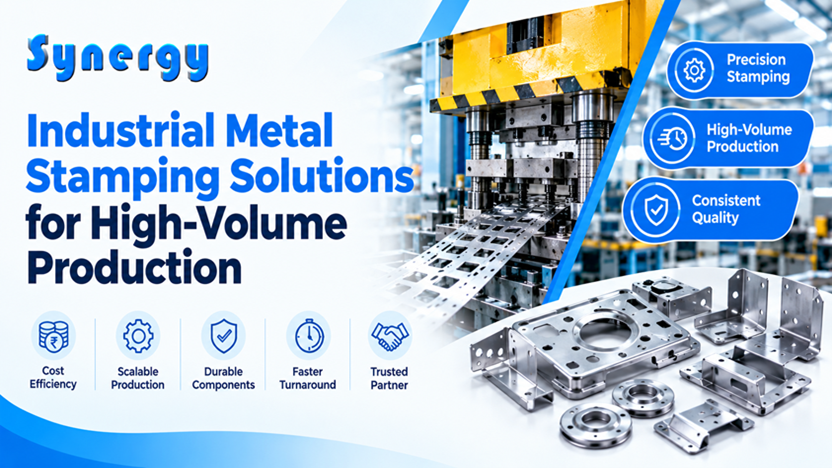
High-volume manufacturing requires more than simply producing large quantities of metal components. OEMs and industrial manufacturers need a production process that can deliver consistent dimensions, repeatable quality, efficient cycle times, reliable tooling, and predictable delivery schedules. This is where industrial metal stamping solutions play an important role.
Metal stamping is widely used to manufacture large quantities of brackets, clips, housings, panels, structural components, automotive parts, electrical components, and other precision metal products. By using specialized dies and stamping presses, manufacturers can produce thousands or even millions of components with repeatable results.
For companies looking for industrial metal stamping solutions for high-volume production, selecting the right manufacturing partner is critical. The supplier must have appropriate press capacity, tooling expertise, material knowledge, quality-control systems, production planning capabilities, and the ability to scale output according to demand.
India Synergy provides custom metal manufacturing and sourcing solutions for industrial and OEM applications, supporting businesses that require reliable production of precision metal components.
What Is Industrial Metal Stamping?
Industrial metal stamping is a manufacturing process that uses presses, dies, and forming tools to convert sheet metal or metal strip into specific shapes and components.
Depending on the application, the stamping process can include operations such as:
- Blanking
- Punching
- Bending
- Forming
- Drawing
- Embossing
- Coining
- Piercing
- Flanging
- Progressive stamping
- Deep draw stamping
The metal sheet is positioned within a stamping die, and controlled force is applied through a press to create the required shape.
For high-volume production, stamping is particularly valuable because the same tooling can repeatedly produce components with consistent dimensions and geometry.
Why Metal Stamping Is Suitable for High-Volume Production
When production quantities are high, manufacturers need to minimize the cost and time associated with producing each individual component.
Metal stamping can provide several advantages for high-volume manufacturing.
1. High Production Speed
Stamping presses can perform manufacturing operations rapidly compared with many manual or conventional fabrication processes.
Once the tooling has been properly developed and production parameters have been established, components can be produced repeatedly with relatively short cycle times.
This makes industrial metal stamping suitable for applications where thousands or large quantities of components are required.
2. Repeatable Production
High-volume production requires consistency.
A stamping die provides a defined geometry that can be repeated across production batches. With appropriate process controls, manufacturers can maintain consistent dimensions, hole locations, bends, and other critical features.
This repeatability is particularly important for components that must fit into larger assemblies.
3. Lower Per-Part Manufacturing Cost at Volume
Metal stamping often involves an initial investment in tooling and dies. However, when the same tooling is used to manufacture a large number of components, the tooling cost can be distributed across the production quantity.
As production volume increases, the cost per individual component can become more competitive.
This is one reason contract metal stamping is frequently considered for high-volume OEM manufacturing.
4. Reduced Manual Processing
Automated or semi-automated stamping operations can reduce the amount of manual intervention required during production.
Depending on the component and manufacturing setup, processes can incorporate automated feeding, progressive dies, material handling, and inspection systems.
Reduced manual handling can also help improve process consistency.
Key Industrial Metal Stamping Solutions for High-Volume Production
Different products require different stamping methods. A capable metal stamping manufacturer should be able to select the appropriate process based on material, geometry, thickness, tolerance, production volume, and application.
1. Progressive Die Stamping
Progressive die stamping is widely used for high-volume production.
In this process, a strip of metal moves through multiple stations within a single die. Each station performs a specific operation, such as punching, bending, forming, or cutting.
The component gradually takes its final shape as the material moves through the die.
Benefits of progressive stamping include:
- High production rates
- Repeatable component dimensions
- Reduced manual handling
- Multiple operations in one production cycle
- Efficient material movement
- Suitability for large production quantities
Progressive die stamping can be particularly useful for small and medium-sized components that require multiple operations.
2. Deep Draw Stamping
Deep drawing is used to manufacture components with significant depth compared with their diameter or width.
The process forms a flat sheet or blank into a deeper three-dimensional shape using a punch and die.
Typical applications can include:
- Housings
- Containers
- Covers
- Industrial enclosures
- Automotive components
- Electrical components
- Cylindrical and formed metal parts
For high-volume production, deep draw stamping can provide repeatable geometry when the tooling and process parameters are properly designed.
3. Precision Metal Stamping
Precision metal stamping focuses on producing components with controlled dimensions and tighter tolerances.
This can be important for industries where stamped parts must interface accurately with other components.
Applications may include:
- Electrical components
- Industrial machinery
- Automotive components
- Electronic hardware
- Precision brackets
- Connectors
- Mechanical assemblies
The required level of precision depends on the component design, material, tooling, press capabilities, and inspection process.
4. Custom Metal Stamping
Not every industrial application can be addressed with standard stamped components.
Custom metal stamping allows manufacturers to develop components according to customer-specific drawings, CAD files, specifications, and production requirements.
Custom stamping may involve:
- Custom dies
- Specialized forming operations
- Multiple stamping stages
- Secondary machining
- Deburring
- Surface finishing
- Assembly
For OEMs, this approach allows the stamped component to be designed around the requirements of the final product.
5. Sheet Metal Stamping
Sheet metal stamping is used to transform flat metal sheets into functional industrial components.
Materials can include different grades of:
- Carbon steel
- Stainless steel
- Aluminum
- Copper
- Brass
- Other engineering metals
The appropriate material depends on factors such as strength, corrosion resistance, conductivity, weight, formability, operating environment, and final application.
Important Factors in High-Volume Metal Stamping
High production volume changes the priorities of a manufacturing project. A process that works for a few hundred parts may not necessarily be optimized for hundreds of thousands of parts.
Tool and Die Design
Tooling is one of the most important elements of a high-volume stamping operation.
A well-designed die can support:
- Repeatable production
- Efficient material utilization
- Consistent component geometry
- Controlled cycle times
- Reduced downtime
- Long production runs
Poorly designed tooling can result in excessive wear, dimensional variation, material waste, frequent maintenance, and production interruptions.
For this reason, OEMs should evaluate a supplier’s tool and die engineering capabilities before beginning a large production program.
Press Capacity
The stamping press must be suitable for the component and material being processed.
Important considerations include:
- Required tonnage
- Bed size
- Stroke length
- Operating speed
- Feed system
- Material thickness
- Die dimensions
- Production cycle requirements
Choosing an unsuitable press can affect productivity, quality, and tooling performance.
Material Selection
Material selection directly influences stamping performance.
Factors such as tensile strength, hardness, ductility, thickness, grain direction, and surface condition can affect forming behavior.
For example, some components may require high-strength steel, while others may benefit from stainless steel, aluminum, copper, or brass.
A capable manufacturing partner should review the material specification along with the component design before production begins.
Quality Control
High-volume manufacturing requires a quality system capable of identifying process variation before it results in large quantities of non-conforming parts.
Quality controls may include:
- Incoming material inspection
- First-piece inspection
- In-process inspection
- Dimensional inspection
- Visual inspection
- Gauge inspection
- Statistical process monitoring
- Final inspection
- Batch traceability
The exact inspection process should be established according to the component’s critical characteristics and customer requirements.
Designing Stamped Components for High-Volume Manufacturing
Design decisions made before production can significantly influence manufacturing efficiency.
This is why Design for Manufacturability, or DFM, is an important part of industrial metal stamping.
During a DFM review, manufacturers may evaluate:
Material Thickness
The thickness should be appropriate for the required strength, forming operation, and stamping process.
Bend Geometry
Bends that are too tight or poorly positioned may increase the risk of cracking or distortion.
Hole Locations
Hole size and placement should be evaluated in relation to material thickness and tooling requirements.
Forming Requirements
Complex shapes may require multiple stamping stages rather than a single operation.
Tolerances
Not every feature needs extremely tight tolerances. Specifying realistic tolerances can help control manufacturing costs while maintaining functional requirements.
Material Utilization
The component layout on the sheet or coil can influence scrap generation and overall material efficiency.
A DFM review before tooling development can therefore help identify potential production issues early.
High-Volume Metal Stamping and Material Efficiency
Material represents a significant part of the cost of many stamped components.
High-volume production can involve substantial quantities of sheet metal or coil stock, making material utilization an important consideration.
Manufacturers can evaluate:
- Blank layout
- Strip progression
- Nesting
- Scrap percentage
- Coil width
- Part orientation
- Secondary material usage
Progressive die designs can sometimes optimize material movement by efficiently arranging multiple operations along a strip.
Improving material utilization does not only reduce waste. It can also improve overall manufacturing economics.
Secondary Operations After Metal Stamping
Metal stamping does not always represent the final manufacturing step.
Depending on the component, additional processes may be required.
These can include:
- Deburring
- Tapping
- Threading
- Machining
- Welding
- Riveting
- Heat treatment
- Surface finishing
- Plating
- Powder coating
- Painting
- Assembly
A supplier capable of coordinating multiple manufacturing stages can simplify the supply chain for OEMs.
For example, a stamped bracket may require deburring, coating, and assembly before it can be delivered as a finished component.
Industries That Use High-Volume Metal Stamping
Industrial metal stamping is used across many manufacturing sectors.
Automotive
Automotive manufacturers and suppliers use stamped components for brackets, structural parts, clips, shields, housings, and other assemblies.
Electrical and Electronics
Stamped metal components can be used for terminals, connectors, brackets, shields, housings, and conductive components.
Industrial Equipment
Machinery manufacturers may require stamped brackets, covers, mounting components, supports, and structural parts.
HVAC
Metal stamping can support the production of brackets, panels, supports, mounting components, and other HVAC-related parts.
Appliances
Stamped components are commonly incorporated into appliance housings, brackets, internal supports, and mechanical assemblies.
Energy and Power Equipment
Industrial stamping can be used to manufacture various brackets, electrical components, structural parts, and formed metal components.
Hardware and General Engineering
High-volume stamped parts can also be used in industrial hardware, fastener-related components, mechanical assemblies, and general engineering applications.
Contract Metal Stamping for High-Volume OEM Production
OEMs do not always need to establish their own stamping facility.
Contract metal stamping allows companies to outsource component manufacturing to a specialized supplier.
This approach can help OEMs avoid directly managing every aspect of:
- Press equipment
- Tooling infrastructure
- Production staffing
- Maintenance
- Material processing
- Quality inspection
- Manufacturing scheduling
Instead, the OEM can work with a manufacturing partner according to defined drawings, specifications, quality requirements, and delivery schedules.
The suitability of outsourcing depends on production volume, component complexity, internal capabilities, supply-chain requirements, and total manufacturing cost.
Why India Is Considered for Industrial Metal Stamping
India has become an important sourcing destination for businesses looking to develop international manufacturing supply chains.
For OEMs considering metal stamping manufacturing in India, the evaluation should focus on the individual supplier rather than relying only on country-level assumptions.
Important supplier capabilities include:
- Engineering expertise
- Tool and die development
- Press capacity
- Material sourcing
- Quality systems
- Production scalability
- Export experience
- Packaging capabilities
- Documentation
- Communication
- Delivery management
The right manufacturing partner can help integrate stamping production into a broader global sourcing strategy.
How to Select an Industrial Metal Stamping Manufacturer
Choosing a supplier for high-volume production requires more than comparing unit prices.
Consider the following areas before finalizing a manufacturing partner.
1. Review Manufacturing Capability
Check whether the supplier has the equipment and processes required for your component.
2. Evaluate Tooling Expertise
Ask about die design, tooling development, maintenance, and replacement procedures.
3. Verify Production Capacity
Make sure the manufacturer can support both current requirements and potential future volume increases.
4. Understand Quality Processes
Review inspection methods, documentation, traceability, and quality-control procedures.
5. Evaluate Material Sourcing
Confirm that the supplier can source the required material grades consistently.
6. Review Samples
Prototype or initial production samples can help identify dimensional, functional, and finishing issues before mass production.
7. Discuss Lead Times
Clarify tooling lead time, production lead time, shipping schedules, and replenishment requirements.
8. Consider Total Cost
Evaluate tooling, material, processing, inspection, packaging, logistics, and other relevant costs rather than focusing only on the quoted part price.
9. Review Communication
Clear communication is particularly important when production is outsourced internationally.
10. Assess Long-Term Scalability
A supplier should ideally be capable of supporting increased demand without compromising quality or delivery performance.
Industrial Metal Stamping: Cost Considerations
The cost of a stamped component depends on several variables.
These may include:
- Raw material cost
- Material thickness
- Component size
- Production volume
- Tooling complexity
- Number of operations
- Press requirements
- Secondary processing
- Surface treatment
- Quality requirements
- Packaging
- Transportation
- Production schedule
High-volume production can make tooling investments more economical because the tooling cost is distributed across a larger number of components.
However, the lowest initial quotation does not necessarily represent the lowest total manufacturing cost.
OEMs should consider the complete cost structure and the supplier’s ability to maintain quality and delivery over the entire production program.
Common Challenges in High-Volume Metal Stamping
Even an established stamping process can encounter manufacturing challenges.
Tool Wear
Long production runs can gradually wear stamping dies. Regular inspection and maintenance can help identify wear before it affects component quality.
Material Variation
Changes in material thickness, hardness, or mechanical properties can affect forming performance.
Dimensional Variation
Process conditions, tooling wear, material characteristics, and machine settings can contribute to dimensional variation.
Burr Formation
Cutting and punching operations can produce burrs. Appropriate tooling and secondary processes may be required depending on the application.
Production Downtime
Equipment maintenance, tooling issues, material shortages, or process adjustments can interrupt production.
Scrap
Poor material utilization or process instability can increase scrap rates and affect manufacturing economics.
Effective process planning and preventive quality control can help manage these risks.
How India Synergy Supports Industrial Metal Stamping Requirements
India Synergy provides manufacturing and sourcing support for businesses requiring custom metal components and industrial production solutions.
For OEMs and industrial buyers, the focus can extend beyond simply producing a stamped component. Manufacturing requirements can involve engineering coordination, material sourcing, tooling, production, quality inspection, secondary processing, and delivery management.
India Synergy can support requirements involving custom metal manufacturing and related processes based on project specifications.
The appropriate manufacturing approach depends on factors such as:
- Component design
- Material
- Production volume
- Tolerance requirements
- Tooling requirements
- Finishing specifications
- Quality standards
- Delivery requirements
For high-volume projects, these requirements should be reviewed during the initial engineering and sourcing stage so that the production process can be developed around the final application.
Industrial Metal Stamping Production Checklist
Before starting a high-volume stamping project, OEMs can use the following checklist:
Product Requirements
- Complete 2D drawings available
- 3D CAD model available where required
- Material specification confirmed
- Component dimensions defined
- Critical tolerances identified
- Surface finish requirements specified
Tooling Requirements
- Die design reviewed
- Tooling material selected
- Tool life expectations discussed
- Maintenance plan established
- Tooling ownership clarified
Production Requirements
- Annual volume estimated
- Monthly or weekly demand established
- Press capacity confirmed
- Production cycle evaluated
- Scalability requirements discussed
Quality Requirements
- Inspection plan established
- Critical dimensions identified
- Sample approval process defined
- Traceability requirements confirmed
- Final inspection requirements documented
Supply Chain Requirements
- Packaging requirements defined
- Delivery schedule agreed
- Shipping method established
- Replenishment process planned
- Communication process confirmed
Final Takeaway
Industrial metal stamping solutions for high-volume production can provide an efficient way to manufacture large quantities of consistent metal components. However, successful high-volume stamping depends on more than press speed.
Tooling design, material selection, press capacity, process engineering, quality control, production planning, secondary operations, and supply-chain management all contribute to the final result.
For OEMs evaluating contract metal stamping, the right approach is to assess the complete manufacturing capability of the supplier and ensure that the production process is designed around the component’s volume, specifications, quality requirements, and long-term demand.
India Synergy supports custom manufacturing and sourcing requirements for businesses looking for reliable metal component production and broader industrial manufacturing solutions. For project-specific requirements, buyers can discuss component drawings, materials, production volumes, tolerances, tooling, and delivery expectations with the manufacturing team.
Looking for industrial metal stamping solutions for high-volume production? Explore the manufacturing capabilities of India Synergy and discuss your custom metal component requirements.
Read more: Why OEMs Are Outsourcing Metal Stamping to India
Frequently Asked Questions About Industrial Metal Stamping
What is industrial metal stamping?
Industrial metal stamping is a manufacturing process that uses presses and dies to cut, form, bend, punch, draw, or shape metal into specific components. It is particularly suitable for repeat production and high-volume manufacturing.
Is metal stamping suitable for high-volume production?
Yes. Metal stamping is widely used for high-volume production because properly designed tooling can produce large quantities of components with repeatable dimensions and efficient cycle times.
What types of metal can be stamped?
Depending on the application and process, materials can include carbon steel, stainless steel, aluminum, copper, brass, and other suitable metal alloys. Material selection depends on strength, formability, thickness, corrosion resistance, conductivity, and other requirements.
What is progressive die stamping?
Progressive die stamping uses a continuous strip of material that moves through multiple stations within a die. Each station performs a specific operation, allowing multiple manufacturing steps to be completed during the stamping process.
What is the difference between metal stamping and sheet metal fabrication?
Metal stamping uses dies and presses to perform repeatable cutting and forming operations, while sheet metal fabrication can involve processes such as laser cutting, bending, welding, and other fabrication methods. The appropriate process depends on component geometry, volume, material, and production requirements.
How does tooling affect high-volume stamping?
Tooling directly influences production speed, dimensional consistency, material utilization, and process reliability. Properly engineered tooling is especially important when a component will be produced in large quantities.
Can stamped components require secondary operations?
Yes. Depending on the application, stamped components may require deburring, machining, threading, welding, coating, plating, heat treatment, or assembly after stamping.
How do OEMs choose a metal stamping manufacturer?
OEMs should evaluate manufacturing capability, press capacity, tooling expertise, quality systems, material sourcing, production scalability, lead times, communication, and total cost before selecting a supplier.
Can metal stamping manufacturers in India support global OEMs?
Yes, Indian manufacturing suppliers can be evaluated for international OEM sourcing programs. Buyers should assess the individual manufacturer’s engineering capabilities, quality processes, production capacity, export support, documentation, and ability to meet project-specific requirements.
What information should I provide when requesting a metal stamping quotation?
A quotation request should ideally include component drawings, CAD files where available, material grade and thickness, annual or monthly volume, tolerances, surface finish requirements, secondary operations, packaging requirements, and expected delivery schedule