




Industrial wear parts are exposed to continuous friction, abrasion, impact, and heavy operating loads. Over time, these conditions gradually reduce component thickness, alter equipment clearances, and affect machine performance. If worn components are not replaced at the right time, they can cause production interruptions, damage surrounding equipment, and increase maintenance costs.
Recognizing the warning signs of wear-part deterioration helps maintenance teams plan inspections, arrange replacement components, and reduce the risk of unexpected failures.
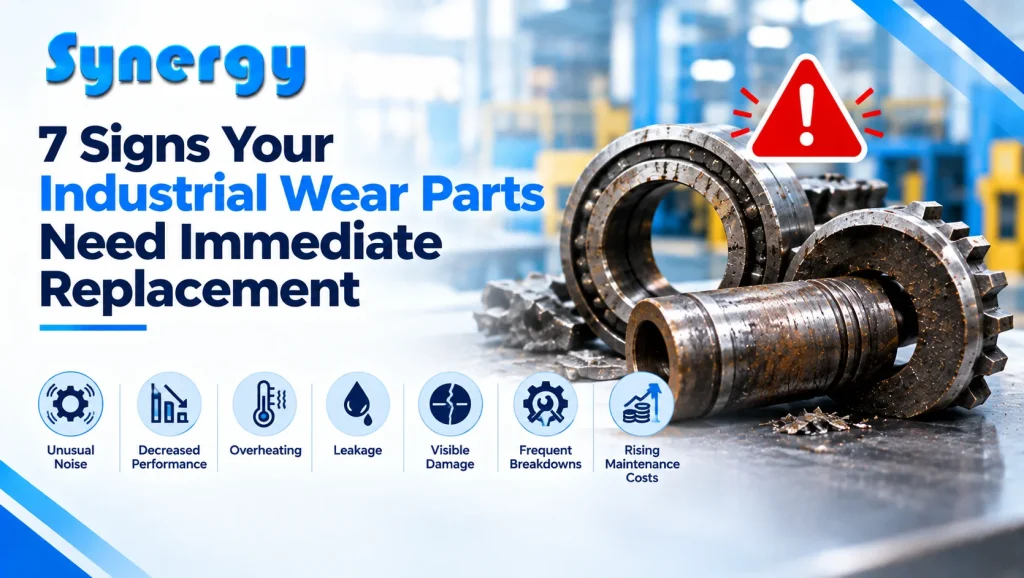
The seven major signs that industrial wear parts may need immediate replacement are excessive material loss, cracks or fractures, deformation, declining equipment performance, unusual vibration or noise, repeated maintenance issues, and visible damage to connected components. The urgency depends on the component’s function, the severity of the damage, and the manufacturer’s inspection criteria.
For industrial buyers and maintenance managers, understanding these warning signs is an important step toward improving equipment reliability and controlling operating costs.
Why Is Timely Wear Part Replacement Important?
Wear parts protect industrial equipment from direct contact with abrasive materials, heavy loads, and repeated impact. Components such as crusher liners, mill liners, chute liners, wear plates, and bucket teeth are designed to experience wear so that the underlying equipment remains protected.
However, when a component reaches the end of its usable service life, its ability to protect equipment may decline.
Timely replacement helps businesses:
- Reduce the risk of unplanned equipment downtime.
- Protect adjacent machine components from excessive damage.
- Maintain more consistent production performance.
- Improve maintenance and spare-parts planning.
- Reduce emergency procurement and repair costs.
- Support safer equipment operation.
Replacement decisions should follow equipment manuals, approved wear limits, inspection procedures, and site-specific safety requirements rather than relying on visual appearance alone.
1. Excessive Wear or Material Loss
One of the clearest signs that a wear part may need replacement is excessive loss of material from its working surface.
Abrasive particles, sliding contact, and repeated impact gradually remove material from components. As the surface becomes thinner, the component may no longer provide adequate protection or maintain its intended geometry.
What to Look For
Inspect components for:
- Significant reduction in thickness.
- Deep grooves or uneven wear patterns.
- Exposed underlying layers or base materials.
- Rounded edges where sharp working profiles are required.
- Wear beyond the manufacturer’s specified limit.
- Uneven material loss across the component.
For example, a worn chute liner may become too thin to protect the supporting structure. A crusher liner may lose its intended profile, affecting the crushing chamber and material processing performance.
What Should You Do?
Measure remaining thickness or other relevant wear dimensions using an approved inspection method. Compare the readings with manufacturer specifications and previous inspection records.
Where the component has reached its defined wear limit, arrange replacement according to the approved maintenance procedure.
Do not wait for a component to wear through completely. Excessive wear can transfer damage to more expensive equipment structures.
2. Visible Cracks, Fractures, or Chipping
Cracks and fractures can indicate that a component is experiencing excessive stress, unsuitable impact loading, material defects, fatigue, or installation-related problems.
A cracked component may lose structural integrity even when much of its original thickness remains.
Common Warning Signs
Look for:
- Visible cracks across the working surface.
- Cracks near mounting holes or fasteners.
- Chipped edges or broken sections.
- Pieces missing from the component.
- Damage around corners and stress-concentration points.
- Repeated cracking in the same location after replacement.
These signs can be particularly important in heavy-duty applications where a component is exposed to repeated impact and high loads.
What Should You Do?
Treat significant cracks or fractures as a potential safety and equipment-integrity concern. Follow the site’s isolation and inspection procedures, and have qualified personnel assess whether the component must be removed from service.
Do not assume that a crack can be safely repaired through welding or another method. Repair suitability depends on the material grade, component design, operating conditions, and approved engineering procedures.
Recurring cracks should also trigger a review of material selection, installation, loading conditions, and manufacturing quality.
3. Deformation or Changes in Component Shape
Wear parts are designed with specific dimensions and profiles to withstand operating loads and maintain equipment performance. Excessive force, heat, impact, or unsuitable material properties can cause deformation.
A component may become bent, distorted, stretched, or permanently compressed.
Signs of Deformation
Check for:
- Bent edges or mounting sections.
- Distorted holes or fastening points.
- Uneven contact with adjacent components.
- Changes in clearances or alignment.
- Buckling, warping, or permanent surface indentation.
- Difficulty fitting replacement components into the intended position.
For instance, a distorted wear plate may leave gaps that allow abrasive material to reach the underlying structure. A deformed bucket tooth or cutting component may no longer perform as intended.
What Should You Do?
Compare the component’s current dimensions and alignment with its approved drawings or installation specifications.
If deformation affects fitment, protection, or structural integrity, arrange an engineering assessment and replacement where required. Investigate whether operating loads, support arrangements, fasteners, or material properties contributed to the damage.
4. Declining Equipment Performance
Wear-part deterioration can affect equipment performance before the damage becomes visually obvious.
Changes in component geometry may influence material flow, crushing efficiency, grinding performance, loading behavior, or product consistency.
Performance Changes to Monitor
Depending on the equipment, warning signs may include:
- Reduced processing capacity.
- Changes in output particle size.
- Increased power consumption under comparable operating conditions.
- Uneven material flow.
- Reduced digging or material-handling effectiveness.
- More frequent process adjustments.
- Lower production efficiency without an obvious external cause.
For example, worn crusher liners can change the effective crushing profile. Worn grinding components may also affect operating conditions and processing efficiency.
However, performance changes are not always caused by wear parts. Feed characteristics, equipment settings, lubrication, drive systems, and other factors may produce similar symptoms.
What Should You Do?
Compare current performance with historical operating data under similar production conditions. Review inspection records, wear measurements, equipment settings, and maintenance history.
If component deterioration is confirmed, plan replacement based on the manufacturer’s limits and the operational risk of continued use.
5. Unusual Noise or Increased Vibration
Unexpected noise or vibration may indicate loose components, damaged mounting points, uneven wear, misalignment, or other mechanical problems.
In some applications, deteriorating wear parts can contribute to changes in contact patterns or operating loads.
Warning Signs
Pay attention to:
- New knocking or metallic impact sounds.
- Increased vibration compared with normal operation.
- Repeated movement or loosening around mounted components.
- Changes in operating sound during loading.
- Abnormal vibration readings from monitoring equipment.
These symptoms should not automatically be attributed to wear parts. Bearings, shafts, fasteners, drive systems, and foundations can also cause abnormal noise or vibration.
What Should You Do?
Follow the site’s condition-monitoring and isolation procedures. Qualified maintenance personnel should identify the source before restarting or continuing operation where a significant fault is suspected.
Inspect wear parts, mounting arrangements, adjacent components, and relevant mechanical systems. Replace damaged parts when inspection confirms that they no longer meet service requirements.
6. Frequent Repairs or Shorter Replacement Intervals
A wear part that requires replacement much sooner than expected may indicate a material mismatch, changing operating conditions, incorrect installation, or an underlying equipment problem.
Repeated replacement also increases labor requirements, purchasing activity, and production interruptions.
What to Review
Analyze the following information:
- Actual operating hours between replacements.
- Quantity of material processed.
- Material hardness and abrasiveness.
- Impact intensity and feed characteristics.
- Installation methods and component fitment.
- Supplier quality and manufacturing consistency.
- Changes in production volume or equipment settings.
If a component’s service life decreases over several replacement cycles, investigate the reason rather than repeatedly purchasing the same specification without review.
What Should You Do?
Maintain a replacement history for critical wear parts. Record installation dates, removal dates, operating hours, observed failure modes, and relevant process conditions.
Use these records to determine whether the component is reaching its expected service life or failing prematurely.
Where necessary, review the material grade, component design, supplier specifications, and operating conditions with qualified technical personnel.
7. Damage to Adjacent Components or Supporting Structures
Wear parts are often installed to protect more expensive machine components. When the protective layer becomes excessively worn, damaged, or detached, the underlying structure may begin to deteriorate.
This can turn a relatively straightforward replacement into a more complex repair.
Signs of Secondary Damage
Inspect for:
- Wear marks on the supporting structure.
- Damage around mounting points.
- Exposed base metal beneath a protective liner.
- Gaps that allow abrasive material to pass behind a component.
- Damage to nearby fasteners or connected parts.
- Uneven wear on adjacent surfaces.
For example, a damaged chute liner may expose the chute body to abrasive material. In crushing equipment, a worn or displaced liner may also affect nearby surfaces or mounting arrangements.
What Should You Do?
Assess both the wear part and the protected structure. Replacing the component alone may not resolve the problem if the underlying surface has already been damaged.
Identify the cause of the secondary damage, verify the condition of mounting points, and complete the necessary repairs before installing the replacement component.
How to Determine Whether a Wear Part Needs Immediate Replacement
Not every sign of wear requires an immediate shutdown, but some conditions require urgent action.
Use the following general approach:
| Condition | Recommended Response |
| Wear remains within approved limits | Continue scheduled monitoring |
| Wear is approaching the replacement limit | Plan procurement and replacement |
| Cracks or fractures are detected | Assess promptly under approved safety procedures |
| Component is loose or displaced | Follow site isolation and inspection procedures |
| Severe deformation affects fitment or protection | Arrange urgent technical assessment |
| Supporting equipment is exposed or damaged | Assess the full assembly before further operation |
| Unusual noise or vibration occurs | Investigate the cause before assuming wear-part failure |
This table is general guidance, not a substitute for equipment-specific instructions. Where there is a risk of component failure, injury, or equipment damage, follow the site’s emergency procedures and the manufacturer’s requirements.
How to Extend the Service Life of Industrial Wear Parts
Although wear parts are designed to deteriorate over time, appropriate operating and maintenance practices can help control wear rates.
Conduct Regular Inspections
Establish inspection intervals based on equipment criticality, operating hours, historical wear rates, and manufacturer guidance.
Inspect high-risk components more frequently when operating conditions change or when previous inspections reveal rapid deterioration.
Maintain Accurate Wear Measurements
Use repeatable measurement methods to track remaining thickness, profile changes, and other relevant dimensions.
Consistent records help teams estimate replacement timing and avoid relying only on visual judgment.
Match Materials to Operating Conditions
Material selection should account for abrasion, impact, temperature, corrosion, and loading conditions. The hardest available material is not necessarily the best choice for every application.
Follow Correct Installation Procedures
Incorrect fitment, inadequate support, poor alignment, and unsuitable fastening can shorten service life. Use approved installation instructions and verify compatibility before returning equipment to operation.
Monitor Operating Conditions
Changes in feed material, throughput, particle size, and equipment settings can affect wear rates. Record major process changes and investigate unexpected increases in material loss.
Plan Replacement Components in Advance
Maintain appropriate stock of critical wear parts based on consumption, lead times, and the consequences of a stockout. Early procurement helps reduce delays when replacement becomes necessary.
How to Choose Suitable Replacement Wear Parts
Choosing replacement components involves more than matching the part name or dimensions. Buyers should confirm that the replacement meets the equipment’s technical and operating requirements.
Before ordering, verify:
- Equipment model and compatible part number.
- Approved drawings and dimensional tolerances.
- Material grade and relevant hardness requirements.
- Expected abrasion and impact conditions.
- Manufacturing and inspection requirements.
- Installation and fastening arrangements.
- Supplier lead time and delivery schedule.
- Required technical documentation.
For custom components, share available drawings, photographs, operating details, and information about previous failures with the supplier. This can help clarify the intended requirements and reduce the risk of incorrect fitment.
Explore the India Synergy Wear Parts range for industrial wear-component categories relevant to demanding operating environments.
Why Maintenance Teams Should Work With Procurement Teams
Wear-part replacement becomes more predictable when maintenance and procurement teams coordinate their activities.
Maintenance personnel can provide information about component condition, expected replacement dates, and operating requirements. Procurement teams can use this information to evaluate supplier availability, manufacturing lead times, and order quantities.
Regular coordination helps businesses:
- Reduce emergency purchasing.
- Align deliveries with planned shutdowns.
- Maintain appropriate stock of critical components.
- Improve communication about technical specifications.
- Identify recurring quality or service-life issues.
- Support more consistent production planning.
A shared wear-parts register can make this process easier by recording component specifications, inspection history, replacement dates, and pending purchase orders.
How India Synergy Supports Industrial Wear Parts Requirements
Selecting appropriate wear parts requires clear technical specifications and an understanding of the component’s operating environment.
India Synergy works with industrial manufacturing and sourcing requirements across component categories. When evaluating replacement wear parts, buyers should communicate equipment details, approved drawings, material requirements, operating conditions, and relevant failure history.
This information helps establish the requirements for evaluating component suitability, manufacturing processes, inspection expectations, and replenishment planning.
Conclusion
Recognizing wear-part deterioration early helps industrial businesses plan maintenance, reduce unexpected failures, and protect expensive equipment.
Excessive material loss, cracks, deformation, declining performance, abnormal vibration, repeated repairs, and damage to supporting structures are all important warning signs. The appropriate response depends on the severity of the condition, approved wear limits, and the risks associated with continued operation.
By combining regular inspections, accurate wear measurements, appropriate material selection, correct installation, and advance replacement planning, maintenance teams can make better-informed decisions about component replacement.
A structured approach helps businesses improve equipment reliability, manage procurement costs, and maintain more predictable industrial operations.
Frequently Asked Questions
1. What are the most common signs that industrial wear parts need replacement?
Common signs include excessive material loss, cracks, deformation, reduced equipment performance, unusual noise or vibration, frequent repairs, and damage to adjacent components. Inspection results should be compared with approved replacement limits.
2. How often should industrial wear parts be inspected?
Inspection frequency depends on the component, equipment criticality, operating conditions, and historical wear rates. Follow manufacturer recommendations and increase inspection frequency when components wear rapidly or operating conditions change.
3. Can worn wear parts damage other equipment components?
Yes. When protective components become too thin, damaged, or displaced, abrasive material and impact may reach supporting structures or nearby parts. This can increase repair complexity and equipment downtime.
4. Should a cracked wear part always be replaced immediately?
A crack can indicate a serious loss of component integrity, but the required response depends on the component and operating conditions. Significant cracks should be assessed promptly under approved safety and maintenance procedures. Do not continue operating equipment against applicable safety requirements.
5. How can companies estimate when wear parts need replacement?
Companies can track remaining thickness, wear profiles, operating hours, throughput, and historical replacement intervals. These measurements help estimate replacement timing, provided the operating conditions and equipment requirements are considered.
6. Why do some wear parts fail earlier than expected?
Premature failure may result from unsuitable material selection, severe impact, changing feed conditions, incorrect installation, manufacturing defects, or excessive operating loads. Reviewing inspection and failure records can help identify the cause.
7. How can businesses reduce unexpected wear-part failures?
Businesses can conduct regular inspections, monitor wear rates, use appropriate materials, follow installation procedures, coordinate maintenance with procurement, and maintain critical replacement components according to operational risk.
8. What information should buyers provide when ordering replacement wear parts?
Buyers should provide equipment details, part numbers, drawings, dimensions, material specifications, operating conditions, and relevant failure history. They should also confirm inspection requirements, delivery lead times, and compatibility before approving an order.