




Industrial buyers often face an important decision when replacing worn components: should they purchase standard replacement parts or invest in custom wear parts designed for a specific application? The right choice depends on equipment compatibility, operating conditions, wear resistance, production requirements, and total cost of ownership.
For mining companies, cement plants, material handling facilities, heavy equipment manufacturers, and industrial OEMs, selecting the right replacement components can directly affect equipment reliability and maintenance costs.
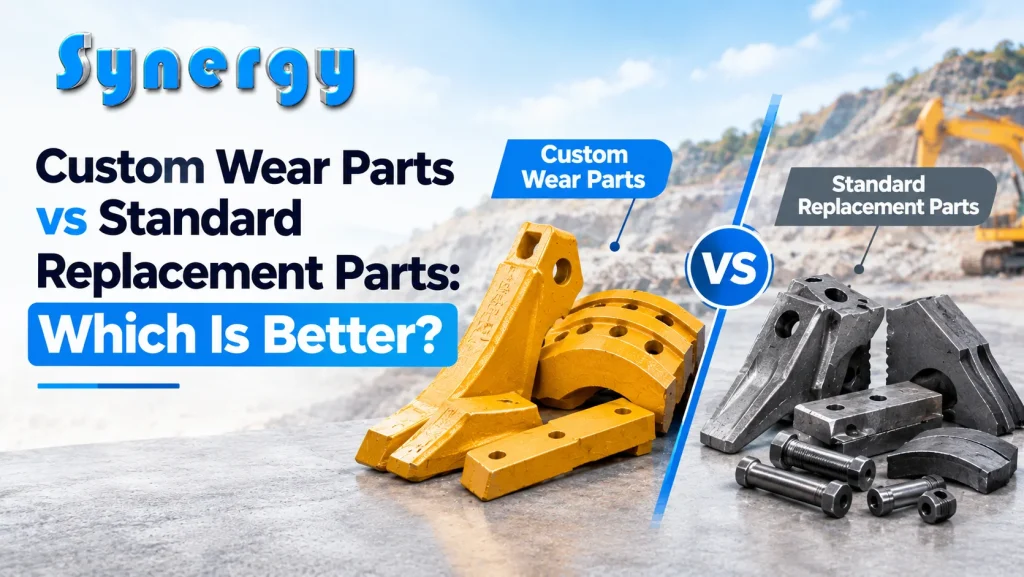
Custom wear parts are designed around specific equipment requirements, while standard replacement parts follow established sizes or specifications. Standard parts can be suitable when compatibility and availability are priorities. Custom wear parts may be a better option when equipment has unique dimensions, demanding operating conditions, or specialized performance requirements.
India Synergy provides industrial manufacturing and wear parts solutions for businesses seeking components suited to their operational needs. This guide compares custom and standard wear parts, explains their advantages and limitations, and helps procurement teams determine which option best fits their requirements.
What Are Standard Replacement Wear Parts?
Standard replacement wear parts are components manufactured according to established specifications, common dimensions, or existing equipment designs. They are generally used to replace worn or damaged components without requiring substantial design changes.
These parts are commonly considered for equipment such as crushers, conveyors, chutes, hoppers, mills, and material handling systems.
Key Characteristics of Standard Wear Parts
- Manufactured using established specifications or designs.
- Often available for common equipment models.
- May offer shorter procurement lead times when stocked.
- Can simplify replacement planning and inventory management.
- Usually require less design development when specifications are already established.
- May be available from multiple suppliers, depending on the component.
Advantages of Standard Replacement Parts
- Faster procurement when available
Standard components may be easier to source when the required specification is widely used and suppliers maintain inventory. This can be particularly valuable when equipment needs urgent maintenance.
- Simpler replacement process
When the replacement part matches the original specification, installation may require fewer engineering changes. Buyers must still verify dimensions, material grade, and compatibility.
- Predictable purchasing requirements
Established part numbers and specifications can simplify purchase orders, inventory planning, and repeat procurement.
- Potentially lower initial cost
Standard parts may avoid custom tooling, engineering, or prototype expenses. However, actual costs depend on material, quantity, availability, and supplier pricing.
Limitations of Standard Wear Parts
Standard components are not always suitable for every industrial application. Limitations may include restricted design choices, material options, or dimensions.
If the operating environment has unusually high abrasion, heavy impact, elevated temperatures, or unique equipment interfaces, a standard component may not meet the required performance specifications.
Buyers should also avoid assuming that parts described as interchangeable will fit every equipment variant. Drawing revisions, manufacturing tolerances, and material differences can affect compatibility.
What Are Custom Wear Parts?
Custom wear parts are components manufactured or adapted to meet specific equipment, dimensional, material, or operational requirements.
They may be developed from engineering drawings, CAD models, physical samples, approved designs, or jointly reviewed technical specifications.
Custom wear parts are particularly relevant when standard components do not provide the required fit, geometry, material properties, or service performance.
Key Characteristics of Custom Wear Parts
- Designed around specific equipment requirements.
- Can accommodate non-standard dimensions and mounting arrangements.
- May use application-specific materials or wear-resistant surfaces.
- Can support specialized operating conditions.
- May require engineering review, tooling, sampling, or first-article approval.
- Require clear technical specifications and quality acceptance criteria.
Advantages of Custom Wear Parts
- Better application-specific fit
Custom components can be manufactured to approved drawings and tolerances, helping address unique mounting arrangements and equipment interfaces.
- Greater material flexibility
Depending on manufacturing capabilities and application requirements, buyers can specify suitable materials, hardness ranges, coatings, overlays, or heat treatment requirements.
- Design optimization opportunities
Engineering teams can assess component geometry, wear zones, thickness, and replaceable sections to determine whether design improvements are technically feasible.
Any design modification should be reviewed for equipment compatibility, structural integrity, and operational safety before production.
- Potential to improve service life
When a custom component addresses a known failure mechanism and uses an appropriate material and design, it may improve service life under comparable operating conditions. Performance should be verified through relevant testing or field data rather than assumed.
- Support for specialized machinery
Custom manufacturing can be useful for legacy equipment, modified production lines, specialized OEM assemblies, and machinery with limited standard replacement options.
Limitations of Custom Wear Parts
Custom components may require additional engineering time, sample approval, tooling, or production setup. Initial procurement can therefore take longer than purchasing an available standard part.
Buyers should also account for minimum order quantities, design approval, inspection requirements, and the time needed to qualify a new component.
For repeat orders, retaining approved drawings, revisions, material specifications, and inspection records helps improve consistency and simplify future procurement.
Custom Wear Parts vs Standard Replacement Parts: Key Differences
| Evaluation factor | Standard replacement parts | Custom wear parts |
| Design | Established or commonly used specifications | Tailored to approved requirements |
| Dimensions | Available standard sizes or existing designs | Can accommodate specified dimensions |
| Equipment compatibility | Suitable when specifications match | Can address unique interfaces |
| Material selection | Depends on available specifications | Can offer application-specific options |
| Initial procurement | Often faster when stocked | May require development and approval |
| Engineering requirements | Usually lower for established replacements | May require drawings, reviews, or samples |
| Initial cost | May be lower when readily available | May include development or tooling costs |
| Design flexibility | Generally limited to available designs | Greater flexibility within manufacturing capabilities |
| Quality verification | Requires specification and batch checks | Requires specification, design, and batch checks |
| Best suited for | Common, established replacement requirements | Specialized or non-standard applications |
The most appropriate choice depends on the application, supplier capabilities, production requirements, and total cost of ownership.
1. Compare the Operating Conditions
Before selecting custom or standard wear parts, identify the conditions under which the component operates.
Important factors include:
- Type and hardness of the processed material.
- Particle size and material flow.
- Impact intensity and abrasion level.
- Operating temperature.
- Moisture and corrosion exposure.
- Equipment speed and loading conditions.
- Average operating hours.
- Existing component failure patterns.
For example, a conveyor chute handling highly abrasive material may require different wear protection from a component exposed to repeated high-impact loading.
If a standard replacement part performs adequately under the existing conditions, customization may not provide sufficient additional value. If repeated failures indicate a mismatch between the component and its application, an engineering review may help determine whether a custom solution is justified.
2. Evaluate Material Requirements
Material selection affects wear resistance, toughness, manufacturing feasibility, and cost.
Depending on the application, industrial wear components may use manganese steel, high-chrome iron, Ni-Hard alloys, chromium carbide overlay plates, or other wear-resistant materials.
The appropriate material should be selected according to the dominant wear mechanism and operating environment.
For example:
- Manganese steel: Often considered for applications involving impact and work hardening.
- High-chrome iron: Used in selected applications involving substantial abrasion.
- Ni-Hard alloys: Used for certain abrasive applications where the specified properties are suitable.
- Chromium carbide overlay plates: Considered for applications requiring a wear-resistant surface.
- Other engineered wear-resistant materials: Selected according to application requirements and component design.
Standard parts may already be available in a suitable material. Custom manufacturing may offer more flexibility when the required material specification, geometry, or wear protection is not available in an existing component.
However, customization does not automatically mean better performance. The material specification, manufacturing process, and component design must all be appropriate.
3. Assess Dimensional Accuracy and Equipment Compatibility
A replacement component must fit the intended equipment and meet the required engineering tolerances.
Incorrect dimensions may cause installation problems, misalignment, uneven loading, excessive vibration, or accelerated wear.
When evaluating a standard part, confirm that the part number, equipment model, drawing revision, and material specification match the original requirement.
When evaluating a custom part, provide the manufacturer with the latest approved drawing, CAD model, or suitable reference sample.
Critical dimensions may include:
- Overall length, width, and thickness.
- Mounting holes and bolt patterns.
- Angles, profiles, and radii.
- Clearances and mating surfaces.
- Flatness and alignment requirements.
- Coating or overlay thickness, where specified.
For new custom components, first-article inspection can help verify that the manufactured part matches the approved design before bulk production begins.
4. Compare Manufacturing Lead Times
Lead time can be a decisive factor when equipment downtime affects production.
Standard replacement parts may offer an advantage when the required components are already available from a reliable supplier. Custom parts may require additional time for drawing review, material procurement, tooling, production, inspection, and approval.
However, standard parts are not necessarily faster if they are out of stock or need to be imported. Similarly, repeat custom orders may become more predictable once the design and manufacturing process have been established.
Before ordering, ask the supplier to confirm:
- Material availability.
- Production capacity.
- Tooling or development requirements.
- Sample approval timelines.
- Inspection and testing schedules.
- Packaging and dispatch dates.
- Expected lead time for repeat orders.
If the component is critical to operations, evaluate whether maintaining a suitable safety stock can reduce the risk of production interruptions.
5. Calculate the Total Cost of Ownership
Comparing purchase prices alone can produce misleading results.
The total cost of a wear part includes more than its initial price. Installation, maintenance, replacement frequency, downtime, shipping, and inspection can all affect the overall expenditure.
A simplified calculation is:
Total cost of ownership = Purchase cost + Installation cost + Maintenance cost + Replacement cost + Downtime cost + Relevant logistics costs
Consider two options:
- A standard wear part with a lower initial purchase price but frequent replacements.
- A custom wear part with a higher initial purchase price that may provide a better fit or longer service life under verified operating conditions.
The custom option may offer better value if the reduction in replacement and downtime costs exceeds its additional purchase and development costs. If the standard part performs reliably and is readily available, it may remain the more economical choice.
Use actual operating data wherever possible. Avoid assuming that a custom component will last longer without supporting test results or comparable service records.
6. Consider Production Volume and Repeat Orders
Order quantity influences manufacturing economics.
For low-volume requirements, an available standard part may be more practical because it can avoid development costs and additional setup.
For recurring requirements, custom wear parts may become more attractive when the design is stable and the manufacturing process is established. Development costs can be evaluated across the expected order volume and component life cycle.
Before placing a bulk order, review:
- Required quantity and annual demand.
- Expected frequency of repeat purchases.
- Minimum order quantity.
- Tooling and setup charges.
- Storage and inventory costs.
- Shelf-life or storage considerations, where applicable.
- Requirements for consistent specifications across batches.
Procurement teams should compare quotations using equivalent quantities, specifications, testing requirements, packaging, and delivery terms.
7. Verify Quality Control and Supplier Capability
Whether purchasing standard or custom wear parts, buyers should evaluate the supplier’s ability to manufacture and inspect components consistently.
Ask about the quality controls relevant to the component, including:
- Material verification.
- Hardness testing.
- Dimensional inspection.
- Manufacturing defect checks.
- Heat treatment records, where applicable.
- Batch traceability.
- Final inspection reports.
- Handling of non-conforming products.
For custom components, confirm that the supplier can work with the approved drawings and control design revisions.
For standard components, verify that the supplied product matches the required specification rather than relying on a similar appearance or a general product description.
When necessary, request samples, inspection reports, or a first-article approval process before releasing the full production order.
8. When Should You Choose Standard Replacement Parts?
Standard wear parts may be the better option when:
- The equipment uses an established, readily available component.
- The existing part meets service-life and performance requirements.
- Replacement speed is a priority and stock is available.
- The component’s design does not require modification.
- Procurement needs are frequent but technically straightforward.
- Custom development would add cost without a demonstrated benefit.
In these circumstances, standard components can simplify purchasing, reduce engineering work, and support straightforward maintenance planning.
9. When Should You Choose Custom Wear Parts?
Custom wear parts may be worth evaluating when:
- Standard components do not fit the equipment correctly.
- The equipment uses a unique or legacy design.
- Repeated wear or failure suggests an application-specific problem.
- The required material or surface protection is not available in a suitable standard part.
- A component needs specific mounting features or geometry.
- The OEM requires parts manufactured to approved drawings.
- A documented engineering improvement could reduce operating costs.
Customization should begin with a clear technical requirement. Buyers should identify the existing problem, define the expected improvement, and establish how the proposed component will be evaluated.
10. Questions to Ask a Wear Parts Manufacturer Before Ordering
Before choosing a supplier, ask the following questions:
- Can you manufacture the component to our approved drawing or sample?
- Which material grades are suitable for our operating conditions?
- What manufacturing and inspection processes will be used?
- Can you provide material and dimensional inspection reports?
- How do you ensure consistency across bulk production batches?
- Can we review and approve a sample before mass production?
- What are the minimum order quantity and expected lead time?
- Which tooling, development, or testing costs apply?
- How are design changes and drawing revisions controlled?
- What procedures apply if delivered parts fail to meet the agreed specifications?
The answers help procurement and engineering teams compare suppliers on technical capability, quality assurance, and commercial suitability.
How India Synergy Supports Industrial Wear Parts Requirements
India Synergy offers industrial manufacturing and wear parts solutions for businesses seeking components for demanding applications.
Its Wear Parts product provides a starting point for exploring relevant wear-resistant component categories, including wear liners, chromium carbide overlay plates, bimetallic wear components, and other industrial wear solutions.
When assessing a potential requirement, buyers should prepare equipment details, operating conditions, material specifications, component drawings or samples, expected quantities, and delivery requirements.
These details help establish whether an existing component or a custom manufacturing approach is more appropriate for the application.
The right solution depends on the technical specification and the actual conditions in which the component will operate. Material selection, dimensional accuracy, manufacturing quality, and agreed inspection criteria should remain central to the evaluation.
Conclusion
Choosing between custom wear parts and standard replacement parts requires a balanced assessment of compatibility, material requirements, operating conditions, lead times, manufacturing quality, and total cost of ownership.
Standard wear parts are often suitable for established applications where the required specification is readily available and performance is satisfactory. Custom wear parts may provide advantages when equipment requires specific dimensions, specialized materials, or application-specific design features.
Neither option is universally better. The most effective purchasing decision is the one supported by technical requirements, reliable quality checks, and realistic cost comparisons.
For businesses evaluating industrial wear-resistant components, India Synergy’s Wear Parts solutions provide a starting point for discussing component requirements and potential manufacturing options.
Frequently Asked Questions
1. What is the difference between custom wear parts and standard replacement parts?
Standard replacement parts follow established specifications or existing designs. Custom wear parts are manufactured or adapted to meet specific requirements for dimensions, materials, geometry, or equipment compatibility.
2. Are custom wear parts better than standard wear parts?
Not always. Custom wear parts may be more suitable for specialized equipment or applications that require unique specifications. Standard parts may be more economical and faster to source when they already meet the required performance and compatibility criteria.
3. Are custom wear parts more expensive?
Custom parts may involve additional engineering, tooling, sampling, or setup costs. However, the overall cost depends on order volume, material, manufacturing complexity, and expected operating performance. Total cost of ownership is more useful than purchase price alone.
4. When should a company switch from standard to custom wear parts?
Consider customization when standard parts repeatedly fail to meet service requirements, do not fit correctly, or cannot meet the required material or design specifications. Review the cause of the problem before approving a redesign.
5. Which materials are commonly used for industrial wear parts?
Common options include manganese steel, high-chrome iron, Ni-Hard alloys, chromium carbide overlay plates, and other wear-resistant materials. Selection depends on abrasion, impact, temperature, and the specific equipment application.
6. What information is required to manufacture custom wear parts?
Manufacturers generally need component drawings or CAD files, material requirements, critical dimensions and tolerances, operating conditions, quantity, inspection requirements, and the delivery schedule.
7. How can buyers ensure the quality of bulk wear parts?
Buyers should establish clear specifications, verify material and dimensional requirements, review inspection reports, define batch traceability, and agree on sampling and acceptance criteria. Sample or first-article approval can be useful for new or critical components.
8. Can custom wear parts reduce maintenance costs?
They may reduce maintenance costs if the design addresses a verified fitment, wear, or failure problem. Actual savings depend on service conditions, component performance, replacement labour, and downtime. Results should be evaluated using operational data.