




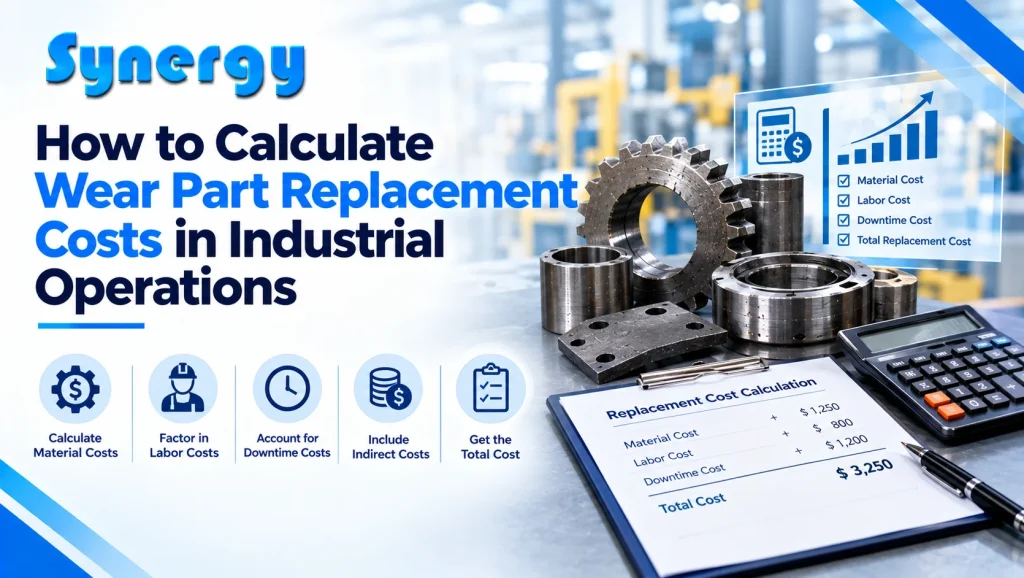
Wear parts play a critical role in mining, cement manufacturing, construction, crushing, and material handling operations. Components such as crusher liners, mill liners, wear plates, chute liners, and bucket teeth gradually deteriorate under abrasion, impact, friction, and heavy operating loads. Replacing these components is a necessary part of maintenance, but the total cost can extend far beyond the purchase price.
For industrial businesses, calculating wear part replacement costs accurately helps improve maintenance budgeting, compare suppliers, reduce unplanned downtime, and make better purchasing decisions.
The actual cost of replacing a wear part includes the component price, transportation, installation labor, equipment downtime, inspection, disposal, and any additional repairs caused by excessive wear or component failure. Businesses should evaluate these expenses together rather than choosing a replacement based only on the lowest quotation.
This guide explains how to calculate wear part replacement costs, which factors influence the total expense, and how industrial buyers can identify opportunities to reduce long-term operating costs.
What Are Wear Part Replacement Costs?
Wear part replacement costs are the total expenses associated with purchasing, removing, installing, and managing a component that has reached the end of its useful service life.
These expenses vary depending on the equipment, component design, material specification, operating environment, and replacement procedure.
For example, replacing a wear plate during a planned maintenance shutdown may require relatively little additional downtime. Replacing the same component after an unexpected failure could involve emergency procurement, unplanned labor, production losses, and repairs to surrounding equipment.
A complete cost calculation should therefore consider both direct and indirect expenses.
Why Is It Important to Calculate Wear Part Replacement Costs?
Understanding replacement costs helps industrial businesses evaluate equipment maintenance from a financial and operational perspective.
1. Improve Maintenance Budgeting
A clear replacement cost estimate helps maintenance managers forecast future expenses and allocate budgets more accurately.
Instead of reacting to unexpected component failures, businesses can use historical wear rates and replacement intervals to estimate upcoming maintenance requirements.
2. Compare Suppliers More Effectively
Two suppliers may quote different prices for components that appear similar. However, differences in material properties, manufacturing quality, service life, inspection requirements, and delivery reliability can influence the actual cost of ownership.
Comparing total replacement costs provides a more meaningful basis for supplier selection.
3. Reduce Unplanned Downtime
When replacement parts are unavailable, equipment may remain idle while procurement teams arrange emergency delivery.
Calculating the cost of downtime helps businesses understand why maintaining critical components and planning replacements in advance can be financially beneficial.
4. Evaluate Material and Design Improvements
A higher-priced wear part may provide better value if it lasts significantly longer or reduces the frequency of maintenance interventions.
Cost analysis helps businesses determine whether a different material, component design, or supplier offers measurable operational benefits.
What Factors Affect Wear Part Replacement Costs?
Several direct and indirect factors contribute to the overall expense of replacing an industrial wear component.
1. Purchase Price of the Wear Part
The purchase price is usually the most visible cost. It depends on material grade, dimensions, manufacturing process, component complexity, order quantity, and supplier requirements.
Custom components may require specialized tooling, casting patterns, machining, or additional engineering work.
When comparing quotations, ensure that the components meet equivalent technical specifications. Comparing prices without confirming material grade, dimensions, and quality requirements can lead to misleading conclusions.
2. Transportation and Logistics
Transportation costs may include packaging, freight, insurance, handling, and applicable import-related charges.
Internationally sourced components may also involve customs clearance and additional delivery time. Urgent orders can increase freight expenses if expedited transportation is required.
For accurate calculations, include the logistics expenses necessary to deliver the component to the actual point of use.
3. Removal and Installation Labor
Replacing a wear part may require technicians, fitters, operators, lifting equipment, tools, and safety procedures.
Labor costs depend on the component’s size, accessibility, mounting method, and the complexity of the replacement task.
A component that requires extensive disassembly or precise alignment may cost more to replace than a readily accessible part, even if its purchase price is lower.
4. Equipment Downtime
Downtime can be one of the most significant costs associated with wear part replacement.
When equipment is unavailable, a facility may lose production capacity, delay deliveries, or incur additional operating expenses.
The financial impact depends on the production process, available backup equipment, inventory buffers, and whether the replacement occurs during planned maintenance.
5. Secondary Repairs
If a wear part deteriorates beyond its intended service limit, the underlying structure or adjacent components may become damaged.
Additional costs may include structural repairs, machining, replacement fasteners, alignment work, and extra inspection.
Timely replacement and accurate condition monitoring can help reduce the likelihood of these avoidable expenses.
6. Inspection and Quality Verification
Depending on the component and its criticality, inspection may involve dimensional checks, hardness testing, material verification, or other application-specific assessments.
These checks contribute to maintenance and procurement costs but can help confirm that replacement components meet the required specifications.
7. Disposal and Inventory Handling
Removing and managing used components may involve handling, storage, transport, recycling, or disposal expenses.
Businesses should also consider inventory carrying costs, including storage space, working capital, insurance where applicable, and the risk of obsolete stock.
How to Calculate the Total Cost of Wear Part Replacement
A practical cost model begins by identifying all expenses associated with one replacement event.
Total Replacement Cost = Purchase Cost + Logistics Cost + Installation Cost + Downtime Cost + Inspection Cost + Disposal Cost + Additional Repair Cost
This formula can be adapted to the accounting practices and operating conditions of each facility.
Step 1: Calculate the Component Purchase Cost
Multiply the number of components required by the price per component.
Purchase Cost = Quantity Required × Unit Price
For example, if a maintenance team needs four wear plates priced at ₹12,000 each:
Purchase Cost = 4 × ₹12,000 = ₹48,000.
Include any applicable tooling, engineering, or setup charges separately if they are not already included in the unit price.
Step 2: Add Transportation and Handling Expenses
Include the cost of delivering the components to the facility.
For example:
- Freight and handling: ₹5,000.
- Packaging and other applicable logistics expenses: ₹2,000.
Total logistics cost = ₹7,000.
These figures are illustrative. Actual charges depend on the supplier, delivery location, shipment size, and transport method.
Step 3: Calculate Installation Labor
Estimate the total labor hours required and multiply them by the applicable hourly labor rate.
Installation Cost = Total Labor Hours × Labor Cost per Hour
If a replacement requires 12 labor hours at ₹500 per hour:
Installation Cost = 12 × ₹500 = ₹6,000.
Where relevant, include equipment rental, lifting arrangements, and other installation-related expenses.
Step 4: Estimate Downtime Cost
Downtime should be calculated using the production or financial measure most appropriate for the facility.
A simplified approach is:
Downtime Cost = Downtime Hours × Estimated Cost per Downtime Hour
Suppose a replacement causes three hours of downtime and the estimated operational impact is ₹10,000 per hour.
Downtime Cost = 3 × ₹10,000 = ₹30,000.
The hourly figure should reflect the actual business impact. Depending on the accounting approach, it may represent lost contribution margin, additional operating expenses, or another approved measure. Avoid counting the same production loss twice.
Step 5: Add Inspection, Disposal, and Repair Costs
Suppose the additional costs are:
- Inspection: ₹2,000.
- Disposal and handling: ₹1,000.
- Additional repairs: ₹4,000.
Total additional cost = ₹7,000.
If no additional repair is required, enter zero rather than assuming that every replacement involves repair expenses.
Step 6: Calculate the Total Replacement Cost
Using the illustrative figures:
| Cost Component | Example Cost |
| Purchase of four wear plates | ₹48,000 |
| Transportation and handling | ₹7,000 |
| Installation labor | ₹6,000 |
| Downtime impact | ₹30,000 |
| Inspection | ₹2,000 |
| Disposal and handling | ₹1,000 |
| Additional repairs | ₹4,000 |
| Total replacement cost | ₹98,000 |
In this example, the total replacement cost is ₹98,000, even though the wear plates themselves cost ₹48,000.
This illustrates why purchase price alone does not provide a complete picture of the financial impact of maintenance.
How to Calculate Wear Part Cost per Operating Hour
Cost per operating hour helps businesses compare components with different service lives.
Cost per Operating Hour = Total Replacement Cost ÷ Operating Hours Before Replacement
Suppose a wear component has a total replacement cost of ₹60,000 and operates for 1,500 hours before replacement.
Cost per Operating Hour = ₹60,000 ÷ 1,500 = ₹40 per operating hour.
If another suitable component costs ₹75,000 to replace but lasts 2,500 hours:
Cost per Operating Hour = ₹75,000 ÷ 2,500 = ₹30 per operating hour.
In this illustrative comparison, the second component has a lower replacement cost per operating hour, despite its higher initial replacement expense.
For a fair comparison, use equivalent operating conditions and include comparable cost categories for both options.
How to Calculate Wear Part Cost per Tonne of Material Processed
For mining, crushing, cement, and bulk material handling operations, cost per tonne can be more useful than cost per operating hour.
Wear Part Cost per Tonne = Total Replacement Cost ÷ Tonnes Processed Before Replacement
For example, if a component costs ₹80,000 to replace and processes 20,000 tonnes before reaching its replacement limit:
Cost per Tonne = ₹80,000 ÷ 20,000 = ₹4 per tonne.
This metric helps procurement and maintenance teams compare component performance in relation to production output.
However, production rate, material characteristics, machine settings, and operating conditions should be considered when comparing results from different periods or facilities.
Planned Replacement vs Emergency Replacement Costs
The timing of replacement can substantially affect the overall expense.
Planned Replacement
A planned replacement is arranged before the component reaches a critical failure point. Maintenance teams can order the component, schedule labor, prepare tools, and coordinate the work with a shutdown.
Potential advantages include:
- Better control over purchasing and delivery.
- Improved labor and equipment scheduling.
- Reduced need for emergency transportation.
- Lower risk of secondary equipment damage.
- More predictable maintenance budgets.
Emergency Replacement
An emergency replacement occurs when a component fails unexpectedly or becomes unsuitable for continued operation.
Potential additional costs include:
- Expedited freight.
- Unplanned overtime.
- Production interruptions.
- Urgent supplier coordination.
- Secondary component damage.
- Disruption to downstream production schedules.
Not every emergency replacement can be prevented, but accurate wear monitoring and realistic replenishment planning can reduce avoidable events.
How to Compare Wear Part Suppliers Using Total Cost of Ownership
Total cost of ownership evaluates the expenses associated with acquiring, operating, maintaining, and replacing a component over a defined period.
When comparing wear-part suppliers, consider the following factors.
Component Price and Technical Compliance
Confirm that the quoted component meets the required dimensions, material specifications, operating conditions, and quality criteria.
A lower-priced component may not provide equivalent performance if the specifications differ.
Expected Service Life
Review verified operating history, inspection records, and comparable application data.
Avoid assuming that a component will last longer simply because it has a higher price or nominal hardness.
Delivery Reliability
Assess manufacturing lead times, order fulfillment, delivery consistency, and the supplier’s ability to support planned replenishment.
Delivery reliability can be particularly important for custom components and critical machinery.
Quality and Documentation
Review the supplier’s inspection processes and ability to provide relevant technical documentation. Depending on the application, this may include material certificates, dimensional reports, or other required quality records.
Maintenance and Replacement Requirements
Consider how frequently the component must be replaced, the labor required, and the impact on production.
The most economical option is generally the one that meets the technical requirements at an acceptable total lifecycle cost—not necessarily the one with the lowest quotation.
Strategies to Reduce Wear Part Replacement Costs
1. Use Condition-Based Inspection
Monitor component condition through measurements, visual inspections, and appropriate equipment-monitoring methods.
Replacing parts based on verified wear limits can help avoid both premature replacement and continued operation beyond acceptable limits.
2. Improve Material Selection
Match the material to the dominant wear mechanism, impact level, and operating environment.
Depending on the application, an appropriate balance of hardness and toughness may improve service life and reduce replacement frequency.
3. Maintain Accurate Replacement Records
Record component installation dates, removal dates, operating hours, processed material, and failure observations.
Historical records help identify recurring issues and improve future cost estimates.
4. Coordinate Procurement With Maintenance
Share expected replacement dates and component specifications with procurement teams well in advance.
Advance planning can reduce emergency orders, improve delivery coordination, and support better purchasing decisions.
5. Maintain Appropriate Critical Spares
Identify components whose unavailability could significantly affect production.
Maintain suitable inventory based on consumption, manufacturing lead times, and the consequences of a stockout. Avoid excessive stock of components with low demand or a high risk of becoming obsolete.
6. Investigate Premature Failures
If a component repeatedly fails earlier than expected, examine the material, design, installation, operating conditions, and manufacturing quality.
Addressing the root cause may deliver greater savings than simply negotiating a lower unit price.
7. Compare Performance Using Consistent Metrics
Use cost per operating hour, cost per tonne, replacement frequency, and downtime impact to evaluate performance.
Consistent metrics help teams distinguish genuine improvements from differences caused by changing production conditions.
How India Synergy Can Support Industrial Wear Parts Sourcing
Wear part replacement planning requires accurate technical information, suitable component specifications, and dependable sourcing arrangements.
India Synergy works with industrial manufacturing and sourcing requirements across component categories. Buyers evaluating replacement wear parts should share equipment details, drawings, dimensions, material requirements, operating conditions, and relevant service-life information.
These details help establish a clearer basis for assessing manufacturing requirements, component suitability, inspection expectations, and procurement planning.
Conclusion
Calculating wear part replacement costs accurately requires more than reviewing the component purchase price. Transportation, installation labor, downtime, inspection, disposal, and additional repairs can all contribute to the total expense.
By using a consistent cost model, industrial businesses can compare replacement options, estimate cost per operating hour or tonne, evaluate suppliers, and identify opportunities to improve maintenance planning.
The most effective strategy combines suitable material selection, accurate wear monitoring, reliable sourcing, and planned replacement schedules. These practices can help reduce avoidable costs while supporting equipment reliability and consistent production.
Frequently Asked Questions
1. How do you calculate industrial wear part replacement costs?
Add the component purchase price, transportation, installation labor, downtime impact, inspection, disposal, and any additional repair expenses. Use consistent cost categories when comparing different components or suppliers.
2. What is the difference between purchase price and total replacement cost?
Purchase price is the amount paid for the component itself. Total replacement cost includes the additional expenses required to deliver, install, inspect, and manage the replacement, along with applicable downtime and repair costs.
3. How do you calculate wear part cost per operating hour?
Divide the total replacement cost by the operating hours achieved before replacement. This helps compare components with different service lives, provided the cost categories and operating conditions are reasonably comparable.
4. How can businesses calculate wear part cost per tonne?
Divide the total replacement cost by the amount of material processed before replacement. This metric is useful for operations where production throughput is a meaningful measure of component performance.
5. Why are emergency wear part replacements more expensive?
Emergency replacements may involve expedited transportation, unplanned labor, production interruptions, and damage to surrounding equipment. The additional costs depend on the severity of the failure and the facility’s operating conditions.
6. Is a more expensive wear part always more economical?
No. A higher-priced component may offer better value if it lasts longer or reduces downtime, but performance should be verified. Compare total replacement cost, service life, maintenance requirements, and operational impact.
7. How can companies reduce wear part replacement expenses?
Companies can improve inspections, select suitable materials, plan replacements in advance, maintain critical spares, coordinate maintenance with procurement, and investigate premature component failures.
8. What information is needed to estimate wear part replacement costs?
Useful information includes the component price, required quantity, logistics expenses, installation hours, downtime impact, inspection costs, disposal expenses, repair costs, and expected service life. Operating hours or tonnes processed can then be used to calculate performance-based cost metrics.