





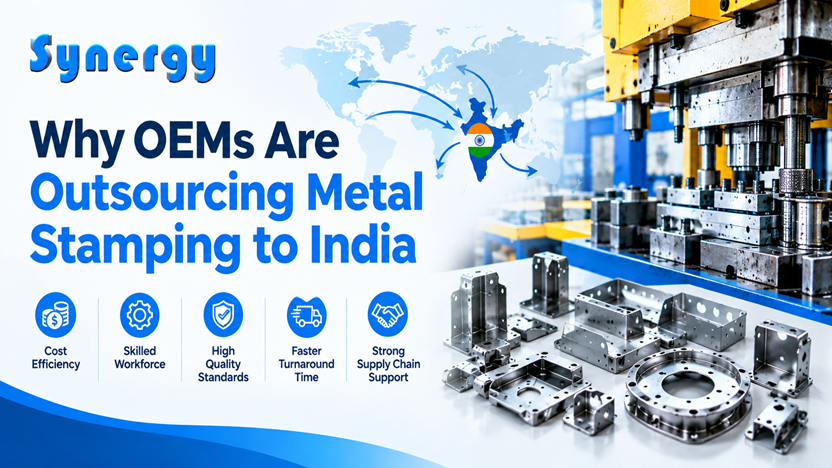
Original Equipment Manufacturers (OEMs) across automotive, industrial equipment, electrical, electronics, appliances, construction, and other sectors increasingly evaluate global sourcing options for custom metal components. One area receiving particular attention is metal stamping outsourcing to India.
Metal stamping is used to manufacture a wide range of components, including brackets, clips, connectors, mounting plates, housings, structural parts, electrical components, and other precision sheet metal products. For OEMs, selecting the right manufacturing location is not simply about reducing the price per component. It involves evaluating manufacturing expertise, tooling capabilities, quality control, production capacity, material availability, delivery performance, engineering support, and supply-chain requirements.
India has developed a broad engineering and manufacturing ecosystem that supports custom metal components and contract manufacturing for domestic and international customers. As a result, some OEMs are considering Indian suppliers as part of their global sourcing strategies.
This article explains why OEMs are outsourcing metal stamping to India, what benefits and considerations are involved, and how international buyers can evaluate an Indian metal stamping manufacturer.
What Is Metal Stamping Outsourcing?
Metal stamping outsourcing is the practice of hiring an external manufacturing company to produce stamped metal components instead of manufacturing those components internally.
The external supplier may handle some or all of the following:
- Engineering review
- Design for Manufacturing (DFM)
- Tool and die design
- Tool manufacturing
- Raw material sourcing
- Metal stamping
- Progressive die stamping
- Deep drawing
- Quality inspection
- Surface finishing
- Secondary operations
- Assembly
- Packaging
- Export documentation
- Shipment coordination
For an OEM, outsourcing can provide access to manufacturing infrastructure and specialized expertise without requiring the company to build and maintain an additional stamping facility.
Why Are OEMs Looking at India for Metal Stamping?
OEM sourcing decisions are generally influenced by a combination of cost, capability, capacity, quality, supply-chain resilience, and long-term supplier relationships.
India offers an established engineering and manufacturing base, making it a potential sourcing location for companies looking for custom metal components.
Some of the factors that can influence an OEM’s decision include:
- Manufacturing and engineering capabilities
- Competitive manufacturing economics
- Tooling and die-making expertise
- Availability of engineering talent
- Customization capabilities
- Production scalability
- Material and component sourcing
- Quality-control requirements
- Global export opportunities
- Supply-chain diversification
These factors should be evaluated on a supplier-by-supplier basis because capabilities can vary significantly between manufacturers.
1. Competitive Manufacturing Economics
Cost is one of the factors OEMs consider when evaluating international manufacturing locations.
Metal stamping costs can include:
- Raw material
- Tooling
- Press operation
- Labor
- Quality inspection
- Secondary processing
- Packaging
- Transportation
- Manufacturing overhead
India’s manufacturing ecosystem can provide cost-competitive options for certain metal components and production programs.
However, OEMs should avoid evaluating suppliers based only on the quoted piece price.
A more useful approach is to calculate the total landed cost.
Total Landed Cost Can Include:
Part cost + tooling + finishing + packaging + freight + duties/taxes where applicable + inspection + inventory costs
A supplier offering a competitive piece price may still have a higher total cost if logistics, quality problems, or additional processing are not considered.
2. Access to Metal Stamping and Engineering Expertise
Modern metal stamping involves much more than operating a press.
A successful production program may require expertise in:
- Die design
- Material selection
- Forming
- Progressive stamping
- Deep drawing
- Press selection
- Tolerance management
- DFM
- Quality control
- Process optimization
India has a large engineering and manufacturing ecosystem that supports a variety of industrial production activities.
For OEMs, access to experienced engineers and manufacturing teams can be useful when developing complex stamped components.
A capable supplier should be able to review the design and discuss potential manufacturing challenges before tooling begins.
3. Tool and Die Manufacturing Capabilities
Tooling is one of the most important investments in a custom metal stamping project.
Depending on the component, OEMs may require:
- Progressive dies
- Compound dies
- Blanking dies
- Forming dies
- Piercing dies
- Deep drawing dies
- Custom fixtures
Indian manufacturers with integrated tooling capabilities can potentially manage several stages of the production process through a single supply relationship.
This can simplify communication between:
Engineering → Tooling → Sampling → Production → Quality
Why Tooling Expertise Matters
Good tooling can influence:
- Dimensional consistency
- Production speed
- Tool life
- Material utilization
- Part quality
- Production downtime
OEMs should therefore evaluate the manufacturer’s tooling experience instead of comparing only the stamping price.
4. Ability to Support Custom Metal Components
OEMs rarely require generic components.
Many projects involve custom parts developed specifically for:
- A particular machine
- An automotive platform
- An electrical product
- An industrial assembly
- A consumer appliance
- A construction product
- A specialized equipment application
A capable metal stamping manufacturer in India should be able to work from engineering drawings, CAD files, specifications, and samples.
The manufacturer may also provide DFM feedback to help identify potential issues involving:
- Bend radii
- Material thickness
- Hole locations
- Forming operations
- Tolerances
- Tooling complexity
- Material utilization
This engineering collaboration can be particularly useful before the production tooling is finalized.
5. Production Capacity and Scalability
OEM production requirements can change over time.
A product may start with:
- Prototype quantities
- Pilot production
- Initial commercial production
and later move to significantly higher volumes.
A suitable supplier should therefore be evaluated for both current and future capacity.
Important questions include:
- What press capacities are available?
- How many production lines are available?
- What monthly production volume can be supported?
- Can additional shifts be added?
- Is there backup equipment?
- Can tooling support the forecasted volume?
- Can raw materials be sourced consistently?
For OEMs, scalability can be particularly important because supplier changes can be expensive after a component has entered regular production.
6. Access to Different Materials
Metal stamping can involve a variety of materials depending on the component’s requirements.
Common materials include:
- Mild steel
- Carbon steel
- Stainless steel
- Galvanized steel
- Aluminum
- Copper
- Brass
- Spring steel
- Specialty alloys
The selected material can affect:
- Strength
- Formability
- Corrosion resistance
- Electrical conductivity
- Weight
- Surface finish
- Tooling requirements
- Production cost
OEMs should confirm that the supplier can source and process the required material grade and thickness.
Material traceability should also be considered when documentation is important for the application.
7. Quality Control and Process Consistency
OEMs typically require consistent component quality across production batches.
A qualified stamping supplier should have defined processes for:
- Incoming material inspection
- Tool inspection
- First-piece inspection
- In-process inspection
- Final inspection
- Dimensional verification
- Non-conformance management
- Corrective actions
Depending on the component, quality documentation may include:
- Material certificates
- Dimensional inspection reports
- First Article Inspection reports
- Certificates of conformity
- Process records
- Corrective action documentation
What OEMs Should Evaluate
Instead of simply asking whether a supplier has a quality system, ask how the system is applied to your specific component.
For example:
- How are critical dimensions identified?
- How frequently are dimensions checked?
- How are tooling-related variations monitored?
- How are rejected components controlled?
- How are corrective actions documented?
These questions provide a better understanding of actual production controls.
8. Ability to Handle High-Volume Production
Metal stamping is commonly used for repeatable component production.
Once the appropriate tooling has been developed and validated, the process can support large production quantities.
This can be useful for OEMs that require:
- Thousands of components
- Tens of thousands of components
- Large annual production volumes
- Recurring production schedules
However, high-volume production requires more than a suitable press.
The supplier must also have:
- Tooling capacity
- Material availability
- Production planning
- Quality resources
- Maintenance systems
- Workforce
- Packaging capability
- Logistics coordination
OEMs should evaluate the complete production system rather than a single machine.
9. Availability of Secondary Manufacturing Services
Many OEM components require additional operations after stamping.
These may include:
- Deburring
- Tapping
- Threading
- Welding
- Riveting
- Plating
- Powder coating
- Painting
- Heat treatment
- Anodizing
- Passivation
- Assembly
- Custom packaging
A supplier that can provide or coordinate multiple operations can potentially simplify the OEM’s supply chain.
For example, instead of managing separate suppliers for:
Stamping → Deburring → Coating → Assembly → Packaging
an OEM may be able to coordinate these requirements through a manufacturing partner that provides integrated sourcing support.
The buyer should always confirm which operations are performed internally and which are handled through qualified external suppliers.
10. Global Sourcing and Export Support
For an OEM located outside India, manufacturing capability is only one part of supplier selection.
The supplier should also understand international order requirements.
These can include:
- Export packaging
- Commercial documentation
- Shipping coordination
- Product labeling
- Quality documentation
- Purchase-order requirements
- Delivery schedules
- International communication
A manufacturer that regularly works with international customers may already have processes for coordinating these activities.
OEMs should confirm export and logistics capabilities during supplier qualification rather than assuming that they are included automatically.
11. Engineering Support and Design for Manufacturing
OEMs often involve manufacturing partners during the design stage.
A supplier with DFM expertise can review the component and identify opportunities or potential issues before tooling is manufactured.
The review may consider:
- Material thickness
- Bend radius
- Hole size
- Hole-to-edge distance
- Part geometry
- Forming sequence
- Tolerances
- Tooling requirements
- Material utilization
Why DFM Matters
Making changes during the design stage is generally easier than modifying production tooling after manufacturing has started.
Early engineering collaboration can therefore help reduce avoidable tooling changes and production challenges.
12. Supply-Chain Diversification
Global supply chains can face disruptions caused by:
- Transportation problems
- Material shortages
- Capacity constraints
- Regional disruptions
- Supplier-specific issues
OEMs may therefore consider multiple geographic sourcing locations as part of their supply-chain strategy.
Adding an Indian manufacturing supplier can potentially provide another source for selected components.
However, diversification should be based on proper supplier qualification, quality validation, logistics planning, and commercial evaluation.
13. Flexible Production Support
OEM demand does not always remain constant.
Orders may increase because of:
- New customers
- Product launches
- Seasonal demand
- Market expansion
- New applications
Demand may also decline due to:
- Product changes
- Inventory adjustments
- Market conditions
- End-of-life products
A contract metal stamping supplier should therefore be evaluated on how it handles changing requirements.
Ask about:
- Forecast changes
- Production scheduling
- Minimum order quantities
- Safety stock
- Capacity increases
- Urgent production
- Tooling availability
A supplier that can communicate clearly about capacity and lead times can make demand planning easier.
14. Better Focus on Core OEM Activities
Manufacturing every component internally can require significant management resources.
An OEM may prefer to focus internal teams on:
- Product development
- Engineering
- Research
- Customer requirements
- Assembly
- Sales
- Product improvement
Outsourcing selected components can allow the company to use external manufacturing expertise while maintaining control over its product specifications and quality requirements.
This does not mean outsourcing eliminates manufacturing management. OEMs still need effective supplier qualification, quality control, forecasting, and relationship management.
Read More: 10 Factors to Consider Before Selecting a Metal Stamping Manufacturer
What Should OEMs Check Before Outsourcing Metal Stamping to India?
Selecting an Indian supplier should involve a structured evaluation.
Manufacturing Capability
Check:
- Press capacity
- Equipment
- Automation
- Material capability
- Stamping processes
- Production capacity
Tooling Capability
Evaluate:
- Die design
- Die manufacturing
- Tool maintenance
- Tool life
- Tool ownership
- Tool modification process
Quality Capability
Review:
- Inspection equipment
- Quality-control procedures
- Material traceability
- Inspection documentation
- Non-conformance management
Commercial Capability
Discuss:
- Unit price
- Tooling cost
- Minimum order quantity
- Payment terms
- Lead times
- Packaging
- Logistics
Export Capability
Confirm:
- International shipment experience
- Export documentation
- Packaging
- Freight coordination
- Communication
- Delivery planning
How to Start Outsourcing Metal Stamping to India
OEMs can follow a structured process when evaluating Indian suppliers.
Step 1: Prepare Your Technical Package
Provide:
- Engineering drawings
- CAD models
- Material specifications
- Material thickness
- Tolerances
- Surface finish requirements
- Annual volume
- Monthly forecast
- Quality requirements
Step 2: Request a DFM Review
Ask suppliers to review the component before tooling.
Step 3: Request a Detailed Quotation
The quotation should clearly identify:
- Tooling
- Part price
- Material
- Secondary operations
- Packaging
- Lead time
- Delivery terms
Step 4: Evaluate Tooling
Review the proposed die design, tool life, maintenance requirements, and ownership terms.
Step 5: Approve Samples
Production samples should be inspected against the agreed engineering specifications.
Step 6: Conduct Supplier Qualification
Evaluate the manufacturer’s:
- Factory
- Equipment
- Quality systems
- Engineering capabilities
- Production capacity
- Supply-chain processes
Step 7: Begin Controlled Production
After sample approval and supplier qualification, move into production according to an agreed manufacturing and quality plan.
Why Choose India Synergy for Metal Stamping Sourcing?
India Synergy provides manufacturing and sourcing support for businesses looking to source custom industrial components from India.
For OEMs evaluating a metal stamping manufacturer in India, supplier capability should be considered across the entire manufacturing process—from engineering and tooling through production, quality control, finishing, packaging, and delivery.
India Synergy can support manufacturing requirements involving:
- Custom metal stamping
- Precision sheet metal components
- Custom brackets
- Formed metal components
- Industrial components
- OEM manufacturing
- High-volume component sourcing
- Custom manufacturing solutions
Each OEM project has its own technical and commercial requirements. Material, component geometry, tolerance, production volume, tooling, finishing, packaging, and delivery requirements should be reviewed before selecting the appropriate manufacturing approach.
To explore India Synergy’s manufacturing and sourcing capabilities, visit: https://indiasynergy.com/
Key Benefits and Considerations of Outsourcing Metal Stamping to India
| Factor | What OEMs Should Evaluate |
| Manufacturing Cost | Complete landed cost, not only piece price |
| Engineering | DFM, tooling and process expertise |
| Equipment | Press capacity and automation |
| Tooling | Design, manufacturing, life and ownership |
| Quality | Inspection, documentation and traceability |
| Materials | Grades, thickness and sourcing |
| Capacity | Current and future production requirements |
| Secondary Operations | Finishing, welding and assembly |
| Logistics | Packaging, export and transportation |
| Communication | Technical and production coordination |
| Scalability | Ability to support changing volumes |
| Supplier Risk | Backup planning and supplier qualification |
Final Takeaway
Outsourcing metal stamping to India can provide OEMs with access to manufacturing infrastructure, engineering expertise, tooling capabilities, production capacity, and potentially competitive manufacturing economics.
However, choosing a supplier should involve more than comparing quotations.
OEMs should evaluate:
Engineering capability + tooling + materials + quality + production capacity + scalability + secondary operations + logistics + communication + total landed cost
A structured supplier-qualification process can help OEMs understand whether an Indian metal stamping manufacturer is appropriate for their specific component and production requirements.
For businesses looking for custom metal stamping and manufacturing sourcing support from India, India Synergy offers manufacturing and sourcing capabilities for industrial and OEM component requirements.
Explore the company’s manufacturing capabilities at:
Frequently Asked Questions About Outsourcing Metal Stamping to India
Why are OEMs outsourcing metal stamping to India?
OEMs may consider India for metal stamping because of its manufacturing ecosystem, engineering capabilities, tooling expertise, production capacity, and potential cost advantages. The suitability of an Indian supplier depends on the specific component and supplier’s capabilities.
Is metal stamping in India cost-effective?
Metal stamping in India can be cost-competitive for certain components and production volumes. OEMs should compare total landed cost, including tooling, material, production, finishing, packaging, logistics, and other applicable costs rather than comparing only the per-piece quotation.
Can Indian manufacturers produce precision stamped components?
Yes. Indian manufacturers can produce custom and precision stamped components, but capabilities vary by supplier. OEMs should evaluate equipment, tooling, quality systems, inspection capabilities, and demonstrated experience with similar components.
What materials can Indian metal stamping manufacturers process?
Depending on the supplier, materials can include mild steel, carbon steel, stainless steel, aluminum, copper, brass, galvanized steel, spring steel, and specialty alloys.
Can OEMs outsource tooling and die manufacturing to India?
Yes. Some Indian manufacturing suppliers provide or coordinate tool and die development along with metal stamping. OEMs should clarify tool design responsibility, ownership, maintenance, expected tool life, and modification procedures.
Can metal stamping suppliers in India support high-volume production?
Many suppliers support high-volume production, but capacity varies. OEMs should confirm press capacity, tooling capability, raw material availability, production scheduling, quality resources, and scalability.
Can an Indian metal stamping manufacturer provide secondary operations?
Depending on the supplier, secondary services may include deburring, tapping, welding, riveting, plating, coating, heat treatment, assembly, and packaging. Always confirm which services are performed internally and which are outsourced.
How should OEMs evaluate a metal stamping manufacturer in India?
Evaluate the supplier’s manufacturing experience, equipment, tooling, materials, quality-control systems, production capacity, engineering support, lead times, secondary operations, export capabilities, communication, and total cost.
What information should an OEM provide when requesting a metal stamping quotation?
An OEM should ideally provide engineering drawings, CAD files, material grade, material thickness, tolerances, surface finish requirements, production volumes, quality requirements, packaging requirements, and delivery expectations.
What is DFM in metal stamping?
DFM stands for Design for Manufacturing. It is the process of reviewing a component design to identify manufacturing challenges and opportunities before production tooling is developed.
How does outsourcing metal stamping affect the OEM supply chain?
Outsourcing introduces an external manufacturing partner into the supply chain. This can provide access to specialized production capabilities but also requires supplier qualification, production planning, quality management, logistics coordination, and ongoing supplier communication.
Is outsourcing metal stamping suitable for small OEMs?
It can be suitable when a small or growing OEM does not want to invest in its own stamping equipment, tooling infrastructure, manufacturing facility, and specialized workforce. The decision depends on production volume, component complexity, and total manufacturing economics.
Can OEMs source stamped components from India for international markets?
Yes. OEMs can source components from Indian manufacturers for international applications, provided the supplier can meet the required technical, quality, documentation, packaging, and logistics requirements.