





Introduction
The manufacturing industry is rapidly evolving, and businesses across the automotive, construction, electrical, aerospace, agricultural, mining, and heavy engineering sectors require components that are stronger, lighter, more precise, and more cost-effective than ever before. Standard manufacturing solutions often fail to meet specialized product requirements, creating a growing demand for custom sheet metal fabrication.
Custom sheet metal fabrication allows manufacturers to design and produce components according to specific dimensions, performance requirements, material specifications, and application needs. Unlike standardized manufacturing processes, custom fabrication provides complete flexibility throughout product development.
India has become one of the world’s leading manufacturing destinations for precision sheet metal fabrication. Modern manufacturing facilities, advanced production technologies, engineering expertise, and competitive production costs have made Indian manufacturers preferred partners for global businesses.
India Synergy is a trusted custom sheet metal fabrication company in India, delivering high-quality fabrication solutions for domestic and international customers. The company provides end-to-end manufacturing services, including design support, laser cutting, CNC punching, metal forming, welding, machining, surface finishing, assembly, and quality testing.
This comprehensive guide explains everything businesses need to know about custom sheet metal fabrication, including manufacturing processes, materials, applications, benefits, quality standards, and supplier selection.
What Is Custom Sheet Metal Fabrication?
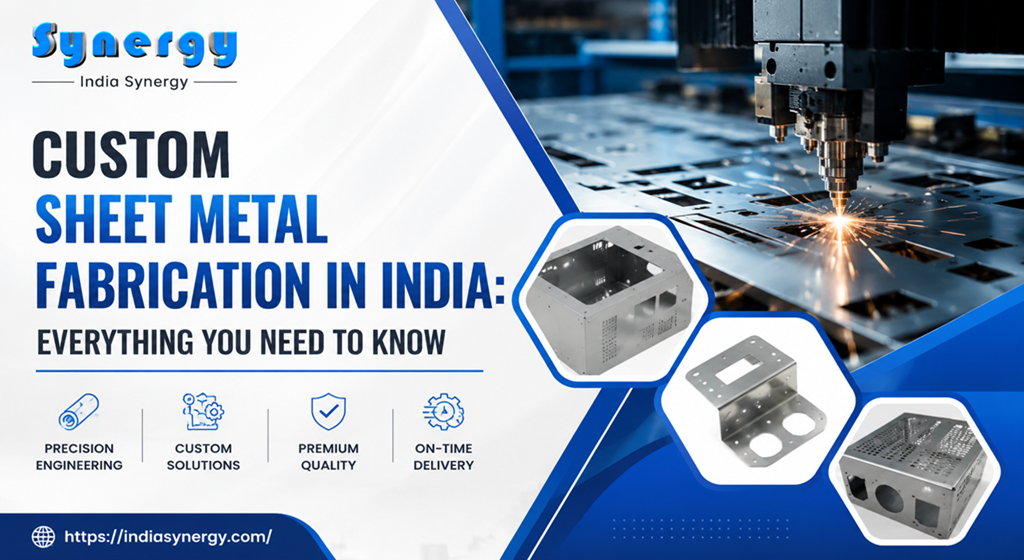
Custom sheet metal fabrication is a manufacturing process that transforms flat metal sheets into finished products based on specific customer requirements.
Unlike standard manufacturing, custom fabrication focuses on producing components according to:
- Technical drawings
- Engineering specifications
- Industry standards
- Product functionality
- Performance requirements
The fabrication process involves multiple manufacturing operations that convert raw materials into precision-engineered components.
Common products manufactured through custom sheet metal fabrication include:
- Brackets
- Enclosures
- Cabinets
- Frames
- Panels
- Housings
- Structural assemblies
Modern fabrication techniques allow manufacturers to create highly complex components while maintaining exceptional dimensional accuracy.
How Does the Custom Sheet Metal Fabrication Process Work?
The sheet metal fabrication process follows a structured manufacturing workflow.
Product Design and Engineering
Every fabrication project begins with product design.
Engineers create detailed models using Computer-Aided Design (CAD) software.
During this stage, manufacturers define:
- Product dimensions
- Material specifications
- Tolerances
- Assembly requirements
- Surface finishing requirements
Design optimization improves both manufacturing efficiency and product performance.
Material Selection
Choosing the correct material is one of the most important decisions in custom fabrication.
Several factors influence material selection, including:
- Mechanical strength
- Corrosion resistance
- Weight
- Environmental conditions
- Production costs
Material selection directly affects durability, performance, and manufacturing efficiency.
Cutting Operations
After material selection, the metal sheets are cut according to design specifications.
Common cutting technologies include:
Laser Cutting
Laser cutting uses a focused beam of light to create highly precise cuts.
Benefits include:
- Superior accuracy
- Clean edges
- Reduced material waste
CNC Punching
CNC punching creates holes, slots, and customized patterns in sheet metal.
This process improves manufacturing speed and consistency.
Plasma Cutting
Plasma cutting is commonly used for processing thicker metal sheets.
The technology provides excellent cutting speeds for heavy industrial applications.
Forming and Bending
Forming operations reshape flat metal sheets into three-dimensional components.
Common forming processes include:
Press Brake Bending
Press brakes create precise angles and bends.
Applications include:
- Brackets
- Cabinets
- Structural components
Rolling
Rolling forms cylindrical and curved components.
Industries frequently use rolled products in structural applications.
Stamping
Stamping reshapes metal through controlled pressure.
The process supports high-volume manufacturing.
Welding and Assembly
Individual components are assembled after cutting and forming operations.
Common welding techniques include:
- MIG welding
- TIG welding
- Arc welding
- Robotic welding
Proper welding ensures structural strength and product durability.
Surface Finishing
Surface treatments improve product appearance and resistance to environmental conditions.
Common finishing methods include:
- Powder coating
- Painting
- Electroplating
- Galvanizing
- Sandblasting
Surface finishing increases product lifespan.
Quality Inspection
Finished products undergo comprehensive testing before shipment.
Manufacturers evaluate:
- Dimensional accuracy
- Surface quality
- Structural integrity
- Material properties
Quality assurance ensures compliance with customer requirements.
Materials Used in Custom Sheet Metal Fabrication
Different applications require different materials.
Stainless Steel
Stainless steel offers exceptional corrosion resistance and durability.
Advantages include:
- High strength
- Long service life
- Excellent heat resistance
Common applications include:
- Food processing equipment
- Medical equipment
- Industrial machinery
Carbon Steel
Carbon steel is widely used because of its affordability and strength.
Applications include:
- Construction equipment
- Structural components
- Heavy machinery
Aluminum
Aluminum provides several important advantages.
These include:
- Lightweight properties
- Corrosion resistance
- Excellent thermal conductivity
The automotive and aerospace industries frequently use aluminum.
Copper
Copper offers exceptional electrical conductivity.
Applications include:
- Electrical systems
- Electronic components
- Power distribution equipment
Brass
Brass combines durability with corrosion resistance.
Common applications include:
- Decorative products
- Precision components
- Electrical equipment
Galvanized Steel
Galvanized steel provides additional protection against corrosion.
Manufacturers commonly use it in outdoor environments.
Benefits of Custom Sheet Metal Fabrication
Complete Design Flexibility
Custom fabrication allows businesses to manufacture products according to their exact requirements.
Manufacturers can easily modify:
- Dimensions
- Shapes
- Material specifications
- Functional features
Superior Precision
Modern manufacturing technologies ensure exceptional dimensional accuracy.
Advanced CNC systems minimize human error.
Faster Production
Automation significantly reduces production time.
Manufacturers can deliver components more efficiently.
Reduced Material Waste
Precision manufacturing optimizes material utilization.
Lower waste reduces production costs.
Improved Product Performance
Customized products are designed specifically for their intended applications.
This improves:
- Durability
- Reliability
- Operational efficiency
Applications of Custom Sheet Metal Fabrication
Automotive Industry
Automotive manufacturers use fabricated components in:
- Chassis systems
- Engine components
- Body panels
- Structural assemblies
Construction Industry
Construction companies rely on fabricated components for:
- Structural frameworks
- Support systems
- Architectural structures
Electrical and Electronics Industry
Sheet metal fabrication supports the production of:
- Electrical cabinets
- Control panels
- Server enclosures
- Switchgear systems
Agricultural Equipment Industry
Agricultural machinery manufacturers use fabricated components in:
- Tractors
- Harvesters
- Cultivation equipment
Aerospace Industry
Aerospace manufacturers require lightweight and highly accurate components.
Applications include:
- Aircraft structures
- Equipment housings
- Precision assemblies
Industrial Machinery Manufacturing
Industrial manufacturers use fabricated products in:
- Conveyor systems
- Machine enclosures
- Equipment frames
Quality Control in Custom Sheet Metal Fabrication
Quality assurance is critical in precision manufacturing.
Raw Material Inspection
Manufacturers verify the physical and chemical properties of raw materials.
Dimensional Verification
Advanced measuring systems ensure compliance with engineering specifications.
Welding Inspection
Welded components undergo detailed inspections to identify defects.
Surface Quality Evaluation
Manufacturers inspect products for:
- Scratches
- Burrs
- Cracks
- Surface imperfections
Final Product Testing
Every product undergoes a final inspection before shipment.
Common Challenges in Sheet Metal Fabrication
Manufacturers must overcome several technical challenges.
Material Distortion
Excessive heat can cause metal deformation.
Advanced manufacturing controls minimize distortion.
Surface Defects
Improper handling can damage finished products.
Quality control procedures reduce these risks.
Dimensional Variations
Maintaining tight tolerances requires precision equipment.
Modern CNC technologies improve manufacturing accuracy.
Tool Wear
Continuous production can affect tooling performance.
Regular maintenance improves manufacturing consistency.
Why Choose India for Custom Sheet Metal Fabrication?
India has become a preferred global manufacturing destination because of several advantages.
Cost-Effective Manufacturing
Indian manufacturers offer competitive pricing without compromising quality.
Advanced Manufacturing Infrastructure
Modern production facilities use:
- CNC machines
- Laser cutting systems
- Robotic welding
- Automated inspection equipment
Skilled Engineering Workforce
India has a large network of engineers, fabricators, and manufacturing specialists.
Strong Export Capabilities
Indian manufacturers supply products to customers across:
- North America
- Europe
- Australia
- Africa
- The Middle East
How to Choose the Right Sheet Metal Fabrication Company in India
Several factors should be considered when selecting a manufacturing partner.
Evaluate Manufacturing Experience
Choose a company with proven industry expertise.
Review Technical Capabilities
Ensure the manufacturer offers:
- Cutting
- Forming
- Welding
- Machining
- Surface finishing
Verify Quality Standards
Manufacturers should maintain comprehensive quality control procedures.
Assess Production Capacity
Evaluate whether the supplier can support:
- Prototype development
- Low-volume production
- High-volume manufacturing
Examine Delivery Performance
Reliable delivery schedules are essential for supply chain efficiency.
Why Choose India Synergy?
India Synergy provides complete custom sheet metal fabrication solutions for businesses worldwide.
End-to-End Manufacturing Services
The company offers:
- Product design
- Laser cutting
- CNC punching
- Metal forming
- Welding
- Machining
- Assembly
Engineering Expertise
Experienced engineers optimize product designs to improve manufacturing efficiency.
Advanced Manufacturing Technologies
Modern equipment ensures exceptional accuracy and consistency.
Strict Quality Control
Every product undergoes comprehensive inspection and testing.
Global Manufacturing Support
India Synergy serves customers across multiple international markets while maintaining consistent quality and timely delivery.
Future Trends in Custom Sheet Metal Fabrication
Manufacturing technologies continue to evolve.
Emerging trends include:
- Artificial intelligence
- Smart factories
- Robotic manufacturing
- Industry 4.0 integration
- Digital production monitoring
- Sustainable manufacturing
These technologies will continue to transform the fabrication industry.
Conclusion
Custom sheet metal fabrication has become an essential manufacturing solution for industries that require high-quality, application-specific metal components. Modern fabrication technologies provide exceptional design flexibility, improved precision, reduced material waste, and lower production costs.
As global demand for precision-engineered products continues to increase, India remains a leading destination for custom fabrication services.
India Synergy combines advanced manufacturing technologies, engineering expertise, and strict quality standards to deliver reliable, cost-effective, and customized sheet metal fabrication solutions for customers worldwide.
Frequently Asked Questions
What is custom sheet metal fabrication?
Custom sheet metal fabrication is a manufacturing process that transforms flat metal sheets into customized components based on specific design requirements.
Which materials are commonly used in sheet metal fabrication?
Common materials include stainless steel, carbon steel, aluminum, copper, brass, and galvanized steel.
Which industries use custom sheet metal fabrication?
Automotive, aerospace, construction, agriculture, electronics, and industrial manufacturing industries rely on fabricated metal components.
What are the advantages of custom sheet metal fabrication?
The process offers design flexibility, high precision, faster production, reduced material waste, and improved product performance.
How does laser cutting improve sheet metal fabrication?
Laser cutting improves accuracy, reduces waste, and creates clean, precise edges.
How do manufacturers ensure product quality?
Manufacturers use material inspection, dimensional verification, welding inspections, and final product testing.
Why should businesses choose India for sheet metal fabrication?
India offers competitive manufacturing costs, advanced technologies, skilled engineers, and strong export capabilities.
Why is India Synergy a trusted fabrication partner?
India Synergy provides end-to-end manufacturing services, advanced engineering support, strict quality control, and reliable global delivery.