





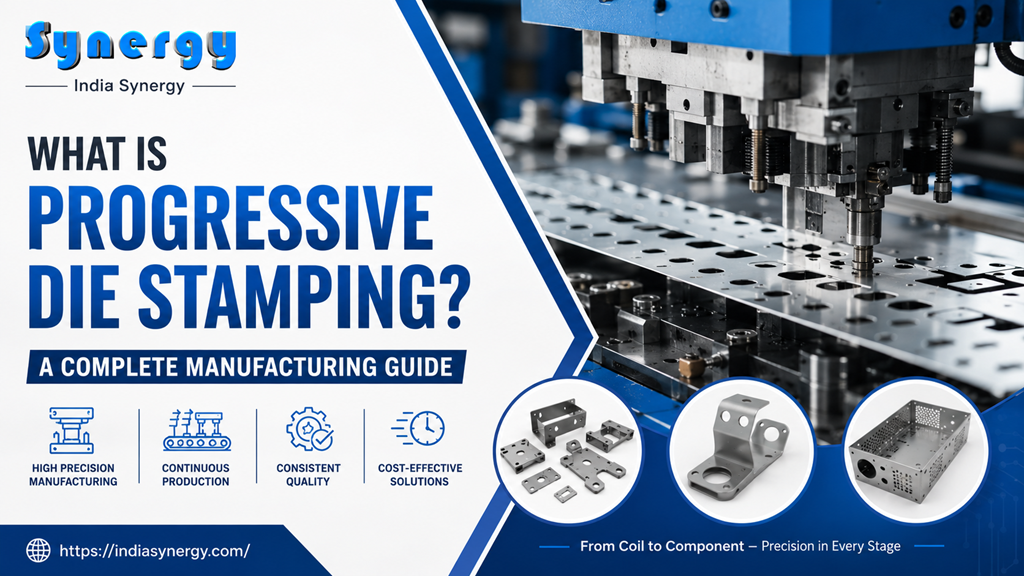
What Is Progressive Die Stamping? A Complete Manufacturing Guide
Introduction
Manufacturers across the automotive, electronics, aerospace, construction, electrical, and industrial sectors continuously seek production methods that deliver high precision, lower costs, faster production cycles, and consistent quality. Traditional manufacturing techniques often require multiple operations, increasing production time and material waste.
Progressive die stamping has emerged as one of the most efficient manufacturing processes for producing high-volume, precision-engineered metal components. The process combines multiple metal-forming operations into a single automated workflow, allowing manufacturers to create complex parts with exceptional accuracy and repeatability.
From electrical connectors and mounting brackets to automotive components and industrial equipment parts, progressive die stamping plays a critical role in modern manufacturing.
India has become a leading global manufacturing destination because of its advanced production capabilities, engineering expertise, cost-effective operations, and strong supply chain infrastructure.
India Synergy provides complete manufacturing solutions for businesses seeking precision-engineered metal components. The company specializes in progressive die stamping, sheet metal fabrication, laser cutting, welded assemblies, CNC machining, and custom manufacturing solutions for domestic and international markets.
This comprehensive guide explains the progressive die stamping process, materials, applications, benefits, challenges, and the factors businesses should consider when choosing a manufacturing partner.
What Is Progressive Die Stamping?
Progressive die stamping is a metal-forming process in which a continuous strip of metal moves through multiple stations within a single die. Each station performs a specific operation until the final component is completely manufactured.
Unlike conventional stamping, which typically performs one operation at a time, progressive die stamping combines several operations into one continuous production cycle.
Common operations include:
- Blanking
- Piercing
- Bending
- Coining
- Embossing
- Forming
Each operation occurs sequentially as the metal strip advances through the die.
This manufacturing technique is particularly suitable for high-volume production because it provides excellent consistency and production efficiency.
How Does Progressive Die Stamping Work?
The progressive die stamping process follows a systematic manufacturing sequence.
Step 1: Material Selection
The manufacturing process begins with selecting the appropriate material.
Engineers consider several factors, including:
- Strength requirements
- Corrosion resistance
- Material thickness
- Product specifications
- End-use applications
Step 2: Feeding the Metal Coil
Metal coils are loaded into the stamping press.
Automated feeding systems move the material through the progressive die at a controlled speed.
Continuous feeding improves manufacturing efficiency and reduces production delays.
Step 3: Sequential Die Operations
The metal strip passes through multiple stations.
Each station performs a specific operation.
Examples include:
| Station | Operation |
| Station 1 | Piercing |
| Station 2 | Blanking |
| Station 3 | Bending |
| Station 4 | Forming |
| Station 5 | Part Separation |
This sequential approach eliminates unnecessary handling and improves productivity.
Step 4: Component Separation
After completing all operations, the finished component is separated from the metal strip.
The component then moves to the inspection stage.
Step 5: Finishing and Quality Inspection
Manufacturers inspect every component to ensure compliance with dimensional and quality requirements.
Additional finishing operations may include:
- Deburring
- Surface treatment
- Coating
- Plating
- Polishing
Components of a Progressive Die Stamping System
Several components work together to ensure manufacturing accuracy.
Progressive Die
The die contains multiple stations that perform different manufacturing operations.
A properly designed die improves productivity and product consistency.
Punch
The punch applies pressure to the metal and performs cutting or forming operations.
Different punch designs create different component features.
Metal Strip
The metal strip serves as the raw material throughout the manufacturing process.
The strip remains connected until the final operation is completed.
Press Machine
The press machine generates the force necessary to perform stamping operations.
Common press types include:
- Mechanical presses
- Hydraulic presses
- Servo presses
Types of Operations Performed in Progressive Die Stamping
Blanking
Blanking removes the desired component shape from the metal sheet.
This operation creates the component’s external profile.
Piercing
Piercing creates holes, slots, and openings in the material.
Examples include:
- Mounting holes
- Ventilation openings
- Connector openings
Bending
Bending changes the angle of the metal to create three-dimensional features.
This operation is commonly used to manufacture brackets and support structures.
Coining
Coining applies significant pressure to create detailed surface features.
Manufacturers use this technique to improve dimensional accuracy.
Embossing
Embossing creates raised or recessed designs on the component’s surface.
Forming
Forming changes the shape of the material without removing it.
Complex geometries are often created through forming operations.
Materials Used in Progressive Die Stamping
Material selection significantly influences manufacturing performance.
Stainless Steel
Stainless steel offers several advantages:
- Excellent corrosion resistance
- High durability
- Long service life
Common applications include medical equipment and industrial machinery.
Carbon Steel
Carbon steel provides:
- High strength
- Excellent formability
- Affordable production costs
Construction and industrial equipment manufacturers frequently use carbon steel.
Aluminum
Aluminum is widely used because it offers:
- Lightweight properties
- Excellent corrosion resistance
- High thermal conductivity
Automotive and aerospace industries frequently choose aluminum components.
Copper
Copper provides superior electrical conductivity.
Applications include:
- Electrical connectors
- Power distribution systems
- Electronic equipment
Brass
Brass combines excellent corrosion resistance with good machinability.
It is commonly used in electrical and decorative applications.
Advantages of Progressive Die Stamping
High Production Speed
Multiple operations occur simultaneously within a single production cycle.
This significantly increases manufacturing efficiency.
Excellent Dimensional Accuracy
Precision tooling ensures that every component meets exact specifications.
Tight tolerances improve product quality and assembly performance.
Reduced Manufacturing Costs
Automation reduces labor requirements and lowers production costs.
Manufacturers benefit from greater operational efficiency.
Minimal Material Waste
Continuous processing optimizes material utilization.
Reduced waste improves profitability and supports sustainable manufacturing practices.
Consistent Product Quality
Automated systems improve repeatability.
Every component is manufactured according to identical specifications.
Progressive Die Stamping vs. Other Manufacturing Processes
| Manufacturing Process | Production Speed | Precision | Material Waste |
| Progressive Die Stamping | High | Excellent | Low |
| CNC Machining | Moderate | Excellent | High |
| Sheet Metal Fabrication | Moderate | Good | Moderate |
| Deep Draw Stamping | High | Excellent | Low |
Progressive die stamping is often the preferred manufacturing method for high-volume production.
Applications of Progressive Die Stamping
Automotive Industry
Automotive manufacturers use stamped components in:
- Chassis systems
- Engine components
- Seat assemblies
- Structural brackets
The process supports lightweight vehicle design while maintaining structural integrity.
Electronics Industry
Electronic equipment manufacturers depend on precision-stamped components for:
- Connectors
- Switches
- Electrical terminals
- Circuit assemblies
Aerospace Industry
The aerospace sector requires lightweight, highly accurate components.
Applications include:
- Aircraft structures
- Mounting systems
- Precision assemblies
Construction Industry
Construction projects use stamped components for:
- Support brackets
- Structural connectors
- Fastening systems
Industrial Equipment Manufacturing
Industrial machinery manufacturers rely on progressive die stamping to produce:
- Equipment housings
- Machine components
- Protective enclosures
Common Challenges in Progressive Die Stamping
Despite its advantages, manufacturers must overcome several challenges.
Tool Wear
Continuous production can cause tooling deterioration.
Regular maintenance improves performance.
Burr Formation
Improper tooling can create rough edges.
Manufacturers use secondary finishing operations to eliminate burrs.
Misalignment
Incorrect die alignment can affect dimensional accuracy.
Modern CNC systems help minimize alignment issues.
Material Defects
Raw material inconsistencies can affect product quality.
Strict material inspections reduce manufacturing defects.
Quality Control in Progressive Die Stamping
Quality assurance ensures product reliability.
Material Inspection
Manufacturers verify the physical and chemical properties of raw materials.
Tooling Inspection
Regular die maintenance improves manufacturing accuracy.
Dimensional Verification
Advanced measuring systems confirm component dimensions.
Surface Inspection
Manufacturers evaluate products for:
- Burrs
- Cracks
- Surface defects
Final Product Testing
Finished components undergo comprehensive inspections before shipment.
How to Choose the Right Progressive Die Stamping Manufacturer
Selecting the right manufacturing partner directly affects production efficiency and product quality.
Consider the following factors.
Manufacturing Experience
Evaluate the supplier’s industry expertise and technical knowledge.
Production Capacity
Ensure the manufacturer can support:
- Prototyping
- Small production runs
- High-volume manufacturing
Engineering Support
Strong engineering capabilities improve product development and manufacturing efficiency.
Quality Standards
Manufacturers should follow documented quality control procedures.
Customization Capabilities
The ability to produce custom components is essential for many industrial applications.
Why Choose India Synergy?
India Synergy delivers complete manufacturing solutions through advanced engineering and modern production technologies.
End-to-End Manufacturing Solutions
The company offers:
- Progressive die stamping
- Laser cutting
- Sheet metal fabrication
- CNC machining
- Welded assemblies
Advanced Manufacturing Infrastructure
Modern facilities support both standard and custom manufacturing requirements.
Engineering Expertise
Experienced engineers optimize designs to improve product performance and reduce production costs.
Strict Quality Control
Comprehensive inspection procedures ensure consistent product quality.
Global Manufacturing and Export Support
India Synergy supplies precision-engineered components to customers across:
- North America
- Europe
- Australia
- Africa
- The Middle East
Future Trends in Progressive Die Stamping
Manufacturing technologies continue to evolve.
Key trends include:
- Artificial intelligence in manufacturing
- Industry 4.0 integration
- Smart factories
- Robotic automation
- Real-time production monitoring
- Sustainable manufacturing
These technologies will continue to improve productivity and operational efficiency.
Conclusion
Progressive die stamping has become one of the most important manufacturing processes in modern industry. Its ability to produce complex, high-precision components quickly and cost-effectively makes it an essential technology for automotive, aerospace, electronics, construction, and industrial applications.
Businesses seeking reliable manufacturing solutions should carefully evaluate suppliers based on their experience, engineering expertise, production capabilities, and quality standards.
As a trusted manufacturing partner, India Synergy combines advanced technologies, precision engineering, and strict quality control to deliver customized metal components that meet global industry requirements.
Frequently Asked Questions
What is progressive die stamping?
Progressive die stamping is a manufacturing process that uses multiple die stations to perform different metal-forming operations within a single production cycle.
Which materials are commonly used in progressive die stamping?
Stainless steel, carbon steel, aluminum, copper, brass, and specialty alloys are commonly used.
What are the advantages of progressive die stamping?
The process offers high production speed, exceptional accuracy, reduced waste, and lower manufacturing costs.
Which industries use progressive die stamping?
Automotive, aerospace, electronics, construction, and industrial manufacturing industries frequently use progressive die stamping.
How is progressive die stamping different from deep draw stamping?
Progressive die stamping performs multiple operations on a continuous metal strip, while deep draw stamping converts flat sheets into hollow components.
How do manufacturers maintain quality?
Manufacturers perform material inspections, tooling evaluations, dimensional verification, and final product testing.
Does India Synergy provide custom stamping solutions?
Yes. India Synergy offers customized manufacturing solutions based on customer specifications and engineering requirements.
Why should businesses choose India Synergy?
India Synergy provides advanced manufacturing technologies, engineering expertise, strict quality control, and reliable global supply capabilities.