




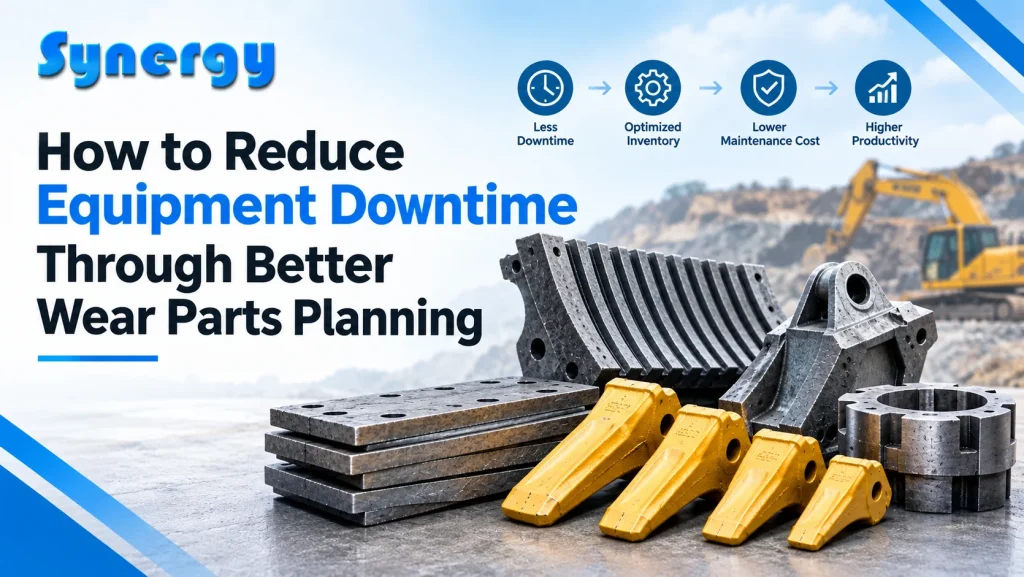
Equipment downtime is one of the major operational challenges faced by mining companies, cement plants, material handling facilities, manufacturing units, and heavy industrial operations. Unexpected component failures can interrupt production, increase maintenance expenses, delay deliveries, and reduce overall equipment efficiency.
One effective way to manage these challenges is to develop a structured wear component planning strategy. By monitoring component condition, understanding wear patterns, maintaining appropriate inventory, and scheduling replacements before critical failures occur, businesses can improve equipment availability and control maintenance costs.
Better wear parts planning helps industrial businesses reduce unplanned downtime by identifying replacement requirements early, maintaining critical spare components, and coordinating procurement with preventive maintenance schedules. The objective is to replace components at the appropriate time without creating unnecessary maintenance work or excessive inventory costs.
For industrial buyers and maintenance teams, India Synergy offers manufacturing and sourcing solutions for different industrial component requirements. This guide explains how to plan component replacements, manage spare inventory, evaluate wear patterns, and establish a practical maintenance strategy.
What Is Wear Parts Planning?
Wear parts planning is the process of identifying, monitoring, procuring, storing, and replacing components that gradually deteriorate during equipment operation.
These components are commonly used in crushers, conveyor systems, mills, chutes, hoppers, material handling equipment, and other industrial machinery exposed to abrasion, impact, friction, or erosion.
A structured planning process helps maintenance and procurement teams understand which components require attention, when replacements may be needed, and how spare parts should be made available.
Typical activities include:
- Identifying critical components across production equipment.
- Reviewing historical failure and replacement records.
- Monitoring component condition and wear rates.
- Estimating future replacement requirements.
- Maintaining suitable spare part inventory.
- Coordinating procurement with maintenance schedules.
- Evaluating supplier lead times and manufacturing capacity.
- Reviewing component performance after replacement.
Effective planning does not mean replacing every component at fixed intervals regardless of condition. Instead, it combines manufacturer recommendations, operating data, inspection findings, and operational risk to determine the most appropriate maintenance approach.
Why Does Equipment Downtime Occur?
Equipment downtime can result from several interconnected problems. Some failures occur unexpectedly, while others develop gradually because of wear, poor maintenance planning, or delayed procurement.
Understanding the causes helps businesses develop a more effective replacement strategy.
1. Excessive Component Wear
Components exposed to abrasive materials, repeated impact, or continuous friction gradually lose material. When wear exceeds acceptable limits, equipment performance may decline or the component may no longer provide adequate protection.
2. Delayed Replacement
Maintenance teams may continue using a worn component because replacement parts are unavailable or because the condition has not been inspected regularly. This can increase the risk of secondary damage and unplanned shutdowns.
3. Inadequate Spare Parts Inventory
If a critical replacement component is not available when required, equipment may remain idle while the maintenance team waits for procurement or manufacturing.
4. Incorrect Component Specifications
A replacement part with incorrect dimensions, unsuitable material properties, or incompatible mounting features may cause installation delays or premature failure.
5. Unreliable Procurement Lead Times
Unexpected manufacturing delays, shipping problems, and incomplete technical specifications can prevent spare components from arriving before a scheduled maintenance shutdown.
6. Poor Coordination Between Teams
Maintenance, procurement, production, and inventory teams may operate with different schedules or incomplete information. Without coordination, businesses may order parts too late or hold unnecessary stock.
Addressing these problems requires a planning process that connects equipment inspection, maintenance scheduling, and procurement.
1. Identify Critical Equipment and Components
The first step in reducing downtime is determining which machines and components have the greatest impact on operations.
Not every component requires the same level of monitoring or inventory protection. A failure in a non-critical component may cause a minor delay, while the failure of a key crusher liner or conveyor wear plate could interrupt an entire production process.
How to Identify Critical Components
Evaluate each component according to:
- Its impact on production if it fails.
- The consequences of failure for equipment safety.
- The availability of alternative equipment.
- The time required to obtain a replacement.
- Historical failure frequency.
- Replacement and installation costs.
- The potential for secondary equipment damage.
Components can then be classified as high, medium, or low priority according to operational risk.
For example, a critical crusher component with a long manufacturing lead time may require advance procurement and dedicated spare inventory. A readily available component used in non-critical equipment may not need the same level of stock protection.
This classification helps businesses focus maintenance resources on the components that matter most.
2. Monitor Wear Patterns and Component Condition
Condition monitoring helps maintenance teams understand how quickly components deteriorate and when intervention may be necessary.
Instead of relying exclusively on fixed replacement intervals, businesses can use inspection data to support more informed decisions.
Common Wear Monitoring Methods
Visual inspection: Maintenance personnel examine components for visible wear, cracking, surface damage, deformation, or uneven material loss.
Dimensional measurement: Thickness, profile, clearance, and other critical dimensions are measured against the specified limits.
Wear mapping: Inspection teams record the locations and severity of wear to identify recurring patterns.
Operational monitoring: Changes in vibration, temperature, pressure, throughput, or other equipment indicators may help reveal developing problems, depending on the machine and component.
Historical performance analysis: Replacement records help estimate service life and identify components that consistently fail earlier than expected.
The appropriate method depends on the component design, equipment accessibility, operating conditions, and potential consequences of failure.
Inspection findings should be recorded consistently so that maintenance teams can compare results over time and establish more reliable replacement forecasts.
3. Establish Preventive Maintenance Schedules
Preventive maintenance involves planned inspections and component replacements intended to reduce the likelihood of unexpected equipment failure.
A maintenance schedule should reflect the equipment manufacturer’s recommendations, operating conditions, inspection results, and previous component performance.
What Should a Wear Component Maintenance Schedule Include?
A practical schedule should identify:
- Equipment and component identification numbers.
- Inspection frequency.
- Required inspection methods.
- Acceptable wear limits.
- Expected replacement windows.
- Required spare components.
- Estimated maintenance duration.
- Responsible personnel.
- Follow-up inspection requirements.
For example, a conveyor system operating continuously in an abrasive environment may need more frequent inspection than equipment used intermittently under lighter conditions.
However, inspection frequency should be based on actual risk and operating experience rather than applying the same schedule to every machine.
A documented maintenance calendar helps procurement teams anticipate demand and arrange replacement components before the planned shutdown.
4. Forecast Replacement Requirements Using Historical Data
Historical maintenance records provide useful information for estimating future component demand.
By analysing replacement frequency, service life, operating hours, and failure causes, businesses can improve procurement planning and reduce emergency orders.
Important Data Points to Track
| Data point | Why it matters |
| Installation date | Establishes when service life began |
| Removal date | Helps estimate actual service life |
| Operating hours | Supports comparisons between usage periods |
| Component material and specification | Helps identify performance differences |
| Wear measurements | Shows the rate and location of material loss |
| Failure reason | Helps distinguish normal wear from abnormal failure |
| Replacement quantity | Supports inventory and purchasing forecasts |
| Supplier lead time | Helps determine when orders must be placed |
| Maintenance cost | Supports total cost analysis |
For components with reasonably predictable wear patterns, these records can help estimate when the next replacement may be required.
For components subject to variable operating conditions, use a range of possible replacement dates rather than relying on a single fixed forecast.
Data quality is important. Forecasts based on incomplete or inconsistent maintenance records may lead to inaccurate purchasing decisions.
5. Maintain the Right Spare Parts Inventory
Spare inventory helps ensure that critical components are available when equipment needs maintenance.
However, holding too much inventory ties up working capital and increases storage, handling, and obsolescence risks. Holding too little can lead to production delays and emergency purchasing.
The objective is to maintain inventory that reflects component criticality, demand variability, supplier lead time, and the consequences of a stockout.
How to Improve Spare Parts Inventory Management
Classify inventory by criticality. Identify components that can stop production or cause significant operational problems if unavailable.
Review consumption patterns. Use historical usage data to estimate regular and seasonal demand.
Account for supplier lead times. Components that require custom manufacturing or long-distance shipping may need earlier ordering.
Define reorder points. Establish stock thresholds based on expected consumption during replenishment lead time and the appropriate safety stock.
Review slow-moving stock. Identify obsolete or rarely used components that may no longer match current equipment requirements.
Track stock accurately. Use consistent part numbers, material specifications, locations, and batch information.
A simple reorder point calculation is:
Reorder point = Expected demand during lead time + Safety stock
For example, if a facility typically consumes four components per month and replenishment takes two months, expected demand during lead time is eight components. Additional safety stock may be required depending on demand variability and the consequences of a stockout.
The actual reorder point should reflect realistic consumption rates and replenishment conditions.
6. Coordinate Procurement With Maintenance Planning
Maintenance teams may identify replacement needs weeks before a component must be changed. Procurement teams can use this information to arrange quotations, technical approvals, manufacturing, and delivery in advance.
When these activities are coordinated, businesses can reduce last-minute purchasing and avoid unnecessary delays during shutdowns.
Recommended Procurement Process
- Identify components approaching their replacement limits.
- Confirm specifications and required quantities.
- Check current inventory and reserved stock.
- Review supplier availability and lead times.
- Obtain quotations from suitable suppliers.
- Complete technical and commercial approvals.
- Place purchase orders with sufficient lead time.
- Track production and delivery milestones.
- Verify the received components before installation.
For custom components, allow additional time for drawing approval, material procurement, tooling, sample inspection, and production.
When sourcing industrial wear parts, buyers should confirm the component specification, material requirements, inspection criteria, quantity, and delivery schedule before releasing an order.
This helps reduce misunderstandings and improves coordination between maintenance and procurement teams.
7. Select Components Based on Application Requirements
The service life of a component depends on more than its purchase price or hardness rating. Material selection, geometry, manufacturing quality, and operating conditions all influence performance.
A component designed for one wear mechanism may not perform effectively in another application.
For example, equipment exposed mainly to sliding abrasion may require different material characteristics from equipment subjected to repeated high-impact loading.
Factors to Consider When Selecting Replacement Components
- Type and abrasiveness of the processed material.
- Impact intensity and loading conditions.
- Operating temperature and environmental exposure.
- Required dimensions and mounting arrangement.
- Material grade and mechanical properties.
- Manufacturing process and quality controls.
- Expected replacement interval.
- Availability of technical documentation.
When an existing component fails prematurely, investigate the failure mechanism before selecting a replacement. Increasing hardness or changing the material without understanding the cause may not solve the problem.
For demanding applications, engineering review and appropriate field testing can help determine whether a different component specification is justified.
8. Reduce Repeat Failures Through Root Cause Analysis
Repeated component failure can increase maintenance workload, consume spare inventory, and create recurring production interruptions.
Replacing a failed component without understanding why it failed may result in the same problem occurring again.
Root cause analysis helps identify the underlying reason for a failure and determine whether corrective action is required.
A Practical Root Cause Analysis Process
Step 1: Document the failure. Record the component, equipment, operating hours, location of damage, and circumstances surrounding the failure.
Step 2: Inspect the component. Examine wear patterns, cracks, deformation, mounting damage, and other relevant evidence.
Step 3: Review operating conditions. Check whether the material processed, equipment settings, loading conditions, or production rates changed.
Step 4: Verify component specifications. Confirm that the material, dimensions, and manufacturing requirements matched the approved specification.
Step 5: Identify the likely cause. Determine whether the failure resulted from normal wear, unsuitable material, installation issues, abnormal loading, or another factor.
Step 6: Implement corrective action. Adjust inspection intervals, operating practices, component specifications, or procurement controls as appropriate.
Step 7: Monitor the result. Compare subsequent component performance with the previous baseline.
This approach turns maintenance history into practical information that can improve future component selection and replacement planning.
9. Consider Total Cost of Ownership
Effective maintenance planning should consider the overall cost of component ownership rather than focusing only on the initial purchase price.
A low-cost component may become expensive if it requires frequent replacements, additional labour, or repeated equipment shutdowns.
A higher-priced component may offer better value if its performance is suitable for the application and it reduces measurable operating costs.
Costs to Include in the Evaluation
- Component purchase price.
- Installation and removal labour.
- Inspection and maintenance expenses.
- Replacement frequency.
- Production losses during downtime.
- Emergency freight and expedited manufacturing.
- Inventory carrying costs.
- Disposal and handling costs.
A simplified calculation is:
Total cost of ownership = Purchase cost + Installation cost + Maintenance cost + Replacement cost + Downtime cost + Inventory and logistics costs
Use actual operating records wherever possible to compare alternatives. Expected service life and downtime savings should be supported by historical performance, engineering evaluation, or appropriate trials.
This approach helps procurement teams make decisions based on operational value rather than unit price alone.
10. Evaluate Supplier Reliability and Manufacturing Lead Times
A maintenance plan can fail if replacement components do not arrive when needed.
Supplier reliability is especially important for custom components, specialized materials, and parts manufactured against customer drawings.
Before approving a supplier, evaluate the following:
- Manufacturing capacity and production planning.
- Material availability.
- Ability to meet technical specifications.
- Quality inspection procedures.
- Batch traceability and documentation.
- Historical delivery performance, where available.
- Communication during production.
- Packaging and shipping arrangements.
- Procedures for handling non-conforming products.
Ask suppliers to confirm realistic lead times and identify any dependencies that could delay production.
For critical components, consider approved alternative suppliers or contingency stock when technically and commercially appropriate. Any alternative source must still meet the required specifications.
11. Improve Shutdown Planning and Replacement Coordination
Planned maintenance shutdowns provide an opportunity to replace worn components, inspect equipment, and complete necessary repairs in a coordinated period.
Poor preparation can extend the shutdown if parts are missing, tools are unavailable, or replacement work takes longer than expected.
How to Prepare for a Maintenance Shutdown
- Create a list of components requiring replacement.
- Confirm quantities and technical specifications.
- Verify that all required parts have arrived.
- Inspect delivered components before the shutdown.
- Prepare tools, lifting equipment, and installation resources.
- Assign responsibilities to maintenance personnel.
- Coordinate replacement work with other scheduled tasks.
- Allow contingency time for unexpected findings.
- Record the condition of removed components.
- Update inventory and maintenance records after completion.
Pre-shutdown verification is especially important when components are custom manufactured or have long procurement lead times.
A structured plan helps teams use maintenance windows efficiently and reduces the risk of extending downtime because of avoidable procurement problems.
12. Use Digital Maintenance and Inventory Tracking
Digital maintenance systems can improve visibility into component condition, spare stock, procurement status, and replacement history.
Even a well-maintained spreadsheet can provide useful information for smaller facilities. Larger operations may benefit from a computerized maintenance management system or an enterprise resource planning platform.
Information Worth Tracking Digitally
- Equipment and component identifiers.
- Inspection findings and wear measurements.
- Maintenance work orders.
- Installation and replacement dates.
- Available and reserved inventory.
- Open purchase orders.
- Supplier lead times.
- Expected delivery dates.
- Material certificates and inspection reports.
- Failure history and corrective actions.
Where practical, set alerts for low inventory, upcoming inspections, and projected replacement dates.
Digital tracking is most useful when teams keep records current and use consistent component identifiers across maintenance, stores, and procurement.
13. Measure the Results of Wear Parts Planning
Businesses should track measurable indicators to determine whether their planning process is improving equipment availability and controlling costs.
Useful key performance indicators include:
Unplanned downtime: The time equipment remains unavailable because of unexpected failures.
Mean time between failures (MTBF): The average operating time between failures for a repairable system, calculated using a consistent definition and reporting period.
Mean time to repair (MTTR): The average time required to restore equipment after a failure, according to the organization’s chosen measurement method.
Emergency purchase frequency: The number or proportion of urgent component orders caused by unplanned requirements.
Spare parts stockout rate: How frequently required components are unavailable when needed.
Maintenance cost per operating hour: Maintenance expenditure relative to equipment operating time.
Component service life: The time or operating hours a component remains in service before replacement.
Review these indicators regularly and investigate significant changes. Improved performance may result from better inventory planning, more appropriate component selection, improved installation practices, or other operational changes.
Avoid evaluating results in isolation. For example, lower inventory levels may appear beneficial but could increase downtime if critical components are no longer available when needed.
Practical Example: Planning Replacements for a Mining Conveyor
Consider a mining operation that experiences repeated interruptions because conveyor wear plates require replacement more frequently than expected.
Initially, the maintenance team orders replacement components only after significant wear or failure occurs. Procurement then has to arrange urgent manufacturing and delivery, extending the shutdown.
A structured planning approach can improve this process.
Step 1: Review historical failures. Record wear plate replacement dates, operating hours, and the location of the most severe wear.
Step 2: Establish inspection intervals. Monitor critical areas and record thickness measurements against approved limits.
Step 3: Estimate replacement demand. Use the inspection data and operating history to forecast the likely replacement window.
Step 4: Confirm component requirements. Verify dimensions, material specifications, and mounting arrangements.
Step 5: Arrange procurement early. Place the order with sufficient lead time and confirm delivery milestones.
Step 6: Maintain suitable spare inventory. Hold an appropriate quantity based on component criticality and replenishment lead time.
Step 7: Review subsequent performance. Compare component service life and downtime with the previous operating baseline.
This example illustrates how inspection, procurement, and inventory planning can work together. Actual improvements depend on operating conditions, component design, and the reliability of the underlying data.
How India Synergy Supports Industrial Wear Parts Requirements
India Synergy provides industrial manufacturing and component sourcing solutions for businesses with different equipment and production requirements.
Its Wear Parts product page presents wear-resistant component categories for buyers evaluating replacement requirements and industrial applications.
When planning future replacements, maintenance and procurement teams should prepare equipment details, component drawings or samples, material specifications, operating conditions, expected quantities, and required delivery dates.
These details help establish the technical requirements for sourcing or manufacturing suitable components and allow the buyer to discuss inspection and documentation needs before placing an order.
By combining component planning with clear technical specifications and timely procurement, industrial businesses can work toward more predictable maintenance schedules and fewer avoidable production interruptions.
Conclusion
Reducing equipment downtime requires more than replacing a component after it fails. Industrial businesses need a coordinated process for monitoring wear, forecasting replacement demand, maintaining critical spare inventory, and arranging procurement before components reach unacceptable condition.
A structured strategy should include equipment criticality assessment, preventive inspections, historical data analysis, supplier lead-time management, quality verification, and total cost evaluation.
When maintenance and procurement teams work together, they can make more informed replacement decisions, reduce emergency purchasing, and improve equipment availability.
India Synergy’s industrial Wear Parts solutions provide a starting point for businesses evaluating component requirements for their industrial equipment.
Frequently Asked Questions
1. How can wear parts planning reduce equipment downtime?
Wear parts planning helps identify replacement needs before critical failures occur. By using inspections, historical data, spare inventory, and procurement schedules, businesses can reduce delays associated with unexpected component failures and unavailable replacements.
2. How often should industrial wear parts be replaced?
Replacement frequency depends on the component material, operating conditions, processed material, impact intensity, and equipment usage. Follow manufacturer recommendations and use inspection data and approved wear limits to determine when replacement is necessary.
3. What is the difference between preventive maintenance and predictive maintenance?
Preventive maintenance involves planned inspections or replacements based on schedules, usage, or established recommendations. Predictive maintenance uses condition data and analytical methods to estimate when maintenance may be required. Both approaches can support effective component planning.
4. How much spare inventory should an industrial facility maintain?
The appropriate quantity depends on component criticality, demand variability, replenishment lead time, storage costs, and the consequences of a stockout. Critical components with long lead times may require more protective inventory than readily available, non-critical parts.
5. Which information helps forecast wear parts replacement requirements?
Useful information includes installation dates, operating hours, inspection measurements, failure records, replacement quantities, component specifications, supplier lead times, and historical service life. Consistent records help improve forecasting accuracy.
6. How can companies prevent repeated wear part failures?
Investigate the root cause of recurring failures. Review material suitability, operating conditions, component geometry, installation practices, and manufacturing quality before deciding whether changes to the maintenance plan or component specification are necessary.
7. Why is supplier lead time important for maintenance planning?
Supplier lead time determines how early replacement components need to be ordered. Longer or less predictable lead times increase the risk of stockouts and extended shutdowns, making advance procurement and suitable inventory planning particularly important.
8. How can businesses reduce the total cost of wear parts?
Evaluate purchase price alongside installation, maintenance, replacement frequency, downtime, logistics, and inventory costs. Select components based on application suitability and verified performance rather than price alone.