





Introduction
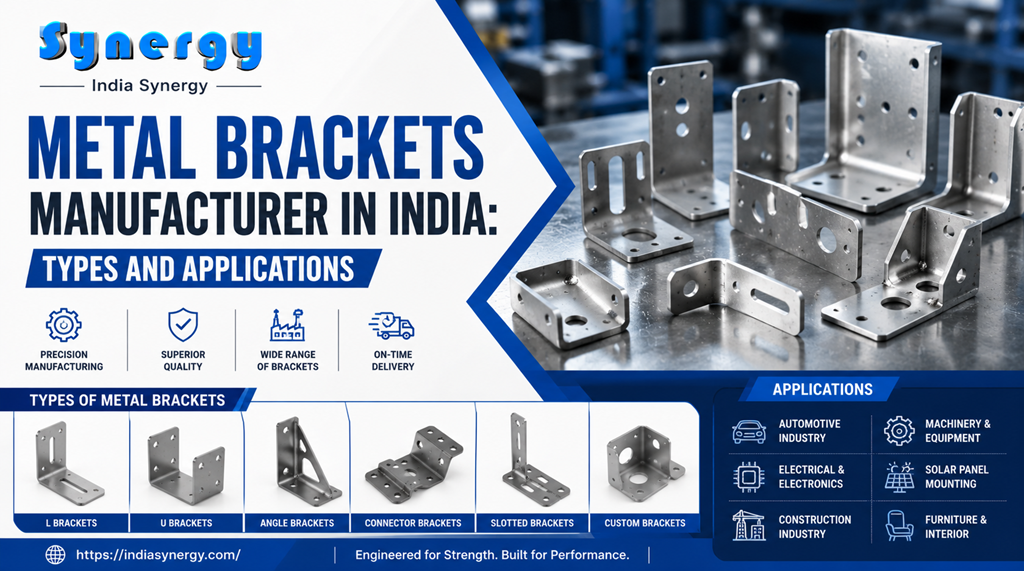
Metal brackets are among the most important components used across modern industries. Although they are often small in size, their role in supporting, connecting, reinforcing, and stabilizing structures is critical. From construction projects and industrial machinery to automotive assemblies and electrical installations, metal brackets provide the structural strength required for safe and efficient operations.
As industries continue to demand stronger, lighter, and more durable components, the need for precision-engineered metal brackets has grown significantly. Manufacturers now require customized solutions that can withstand heavy loads, harsh environments, and continuous operation.
India has become a preferred destination for sourcing high-quality industrial components because of its advanced manufacturing capabilities, skilled workforce, and cost-effective production. Among the leading suppliers in this sector, India Synergy has established itself as a trusted Metal Brackets Manufacturer in India, delivering customized solutions for domestic and international industries.
This guide explores the different types of metal brackets, their manufacturing processes, industrial applications, and the factors businesses should consider when selecting a manufacturing partner.
What Are Metal Brackets?
Metal brackets are support components designed to connect, reinforce, mount, or stabilize two or more structures. They are manufactured in various shapes and sizes depending on their intended application.
These components are commonly used to:
- Support structural loads
- Connect mechanical assemblies
- Secure equipment
- Improve stability
- Reinforce joints
- Reduce movement and vibration
Metal brackets are designed to perform under different operating conditions, including exposure to heavy loads, moisture, vibration, heat, and corrosive environments.
Why Metal Brackets Are Essential in Industrial Applications
Industrial systems rely on structural integrity and precise component alignment. Metal brackets contribute significantly to maintaining equipment performance and operational safety.
Structural Support
Brackets distribute weight evenly across connected components, reducing stress and improving structural stability.
Equipment Stability
Industrial machinery operates under continuous movement and vibration. Brackets prevent unnecessary movement and maintain proper alignment.
Improved Safety
Properly designed brackets reduce the risk of equipment failure, protecting both machinery and workers.
Better Durability
High-quality brackets increase the service life of industrial systems by reinforcing critical connection points.
India Synergy: A Trusted Metal Brackets Manufacturer in India
India Synergy specializes in manufacturing precision-engineered metal components for various industries. The company combines advanced production technologies with strict quality control to deliver reliable and cost-effective solutions.
Core Manufacturing Capabilities
- Sheet metal fabrication
- CNC machining
- Laser cutting
- Welding
- Metal forming
- Surface finishing
Why Industries Choose India Synergy
- Customized manufacturing solutions
- High-quality materials
- Competitive pricing
- Strict quality standards
- International export capabilities
- On-time delivery
India Synergy works closely with customers to develop metal brackets that meet exact technical specifications and performance requirements.
Types of Metal Brackets
Different applications require different bracket designs. Selecting the right bracket depends on load requirements, installation conditions, and environmental factors.
Angle Brackets
Angle brackets are among the most widely used support components.
Common applications include:
- Shelving systems
- Structural reinforcement
- Furniture manufacturing
- Construction frameworks
Their 90-degree design provides excellent stability and support.
L-Shaped Brackets
L-shaped brackets are used to connect two surfaces positioned at right angles.
Applications include:
- Industrial equipment
- Machinery support
- Wall mounting systems
U-Shaped Brackets
U-shaped brackets are designed to hold pipes, rods, and cylindrical components.
Typical applications include:
- Pipe support systems
- Cable management
- Hydraulic systems
T-Brackets
T-brackets provide additional support where multiple structural members intersect.
Industries commonly use them in:
- Heavy equipment
- Construction assemblies
- Structural frameworks
Z-Brackets
Z-shaped brackets are commonly used when offset mounting is required.
These brackets are frequently found in:
- Solar panel installations
- Electrical equipment
- Architectural applications
Mounting Brackets
Mounting brackets secure machinery, equipment, and industrial components.
Common examples include:
- Motor mounts
- Pump supports
- Electrical panel installations
Materials Used in Metal Bracket Manufacturing
Material selection plays a crucial role in bracket performance.
Carbon Steel
Carbon steel offers excellent strength and affordability.
Benefits include:
- High durability
- Good weldability
- Cost-effective manufacturing
Stainless Steel
Stainless steel brackets provide superior corrosion resistance.
They are ideal for:
- Marine applications
- Food processing industries
- Chemical plants
Aluminum
Aluminum brackets are lightweight and resistant to corrosion.
Industries prefer aluminum for:
- Automotive applications
- Aerospace components
- Electrical systems
Galvanized Steel
Galvanized steel brackets are protected with a zinc coating that improves corrosion resistance.
These brackets are commonly used in outdoor environments.
Alloy Steel
Alloy steel provides exceptional strength and wear resistance.
Applications include:
- Mining equipment
- Construction machinery
- Heavy industrial equipment
Manufacturing Processes Used in Metal Bracket Production
Modern manufacturing technologies ensure consistent quality and precision.
Sheet Metal Fabrication
Sheet metal fabrication involves cutting, shaping, and assembling metal sheets into finished products.
This process is widely used because of its flexibility and cost efficiency.
Laser Cutting
Laser cutting provides:
- High accuracy
- Smooth edges
- Reduced material waste
It is particularly effective for producing complex bracket designs.
CNC Machining
Computer Numerical Control (CNC) machining delivers exceptional precision.
Advantages include:
- Tight tolerances
- Repeatable production
- Improved dimensional accuracy
Bending and Forming
Metal bending transforms flat materials into specific shapes using specialized equipment.
Proper forming techniques improve structural strength while maintaining design accuracy.
Welding and Assembly
Welding permanently joins metal components to create stronger assemblies.
Modern welding processes ensure:
- Strong joints
- Better structural integrity
- Enhanced product durability
Surface Finishing Techniques
Protective finishes improve bracket performance and extend product life.
Powder Coating
Powder coating provides:
- Better appearance
- Increased durability
- Improved resistance to wear
Electroplating
Electroplating deposits a protective metallic layer onto the bracket surface.
Benefits include:
- Corrosion protection
- Better conductivity
- Improved surface quality
Galvanization
Galvanization applies a zinc coating that protects steel components from rust.
Corrosion-Resistant Coatings
Specialized coatings protect brackets operating in:
- Marine environments
- Chemical processing plants
- Outdoor installations
Applications of Metal Brackets Across Industries
Construction Industry
Construction projects rely heavily on metal brackets for structural reinforcement.
Applications include:
- Roof support systems
- Steel frameworks
- Wall assemblies
- Bridge construction
Automotive Industry
The automotive sector uses metal brackets to support multiple vehicle systems.
Common applications include:
- Engine mounting
- Chassis assemblies
- Dashboard components
- Exhaust systems
Industrial Machinery
Metal brackets provide support and stability for manufacturing equipment.
Applications include:
- Conveyor systems
- Machine frames
- Production lines
- Material handling equipment
Electrical Industry
Electrical installations require specialized brackets for mounting and securing equipment.
Applications include:
- Control panels
- Cable trays
- Electrical cabinets
- Distribution systems
Renewable Energy Industry
Renewable energy projects increasingly depend on durable metal brackets.
Common applications include:
- Solar panel mounting systems
- Wind energy equipment
- Battery storage systems
Quality Control in Metal Bracket Manufacturing
Quality assurance ensures that every component meets industry standards.
Raw Material Inspection
Manufacturers evaluate material composition before production begins.
Dimensional Inspection
Advanced measuring equipment verifies product dimensions and tolerances.
Mechanical Testing
Mechanical testing evaluates:
- Tensile strength
- Hardness
- Load-bearing capacity
Final Product Verification
Each component undergoes a final inspection before shipment.
Comprehensive testing reduces the possibility of product failure during operation.
Benefits of Sourcing Metal Brackets from India
Competitive Manufacturing Costs
Indian manufacturers provide cost-effective production without compromising quality.
Skilled Engineering Expertise
India has a highly skilled manufacturing workforce with extensive experience in precision engineering.
Advanced Manufacturing Infrastructure
Modern production facilities support large-scale manufacturing and customized production.
Global Export Capabilities
Indian manufacturers supply products to customers across:
- North America
- Europe
- Asia
- Africa
- The Middle East
How to Choose the Right Metal Brackets Manufacturer in India
When selecting a manufacturing partner, businesses should consider several important factors.
Manufacturing Experience
Choose a manufacturer with extensive experience in producing industrial components.
Production Capacity
The manufacturer should have the ability to handle both small and large production volumes.
Quality Standards
Verify certifications, inspection procedures, and testing capabilities.
Customization Capabilities
A reliable manufacturer should offer custom engineering solutions based on drawings, specifications, or samples.
Supply Chain Reliability
Consistent production and timely delivery are essential for uninterrupted operations.
Why India Synergy Is the Preferred Choice
India Synergy offers complete manufacturing solutions for businesses seeking durable and precision-engineered metal brackets.
Key advantages include:
- End-to-end manufacturing services
- High-quality raw materials
- Advanced engineering support
- Customized solutions
- Strict quality control
- International supply capabilities
The company’s customer-focused approach ensures that every product meets industry requirements and performance expectations.
Future Trends in Metal Bracket Manufacturing
The industry continues to evolve with new technologies and manufacturing practices.
Emerging trends include:
- Smart manufacturing
- Automation
- Lightweight materials
- Sustainable production
- Advanced coatings
- Digital quality control
Manufacturers that adopt these technologies will continue to improve efficiency and product performance.
Conclusion
Metal brackets are essential components that support countless industrial applications. Their ability to reinforce structures, stabilize equipment, and improve safety makes them indispensable in construction, automotive, electrical, and manufacturing industries.
Selecting the right manufacturing partner is equally important. Businesses require components that combine durability, precision, and cost efficiency.
As a leading Metal Brackets Manufacturer in India, India Synergy delivers customized, high-quality solutions designed to meet the evolving needs of global industries. Through advanced manufacturing technologies, strict quality control, and extensive engineering expertise, the company continues to provide reliable products that support industrial growth worldwide.
Frequently Asked Questions
What are the most common types of metal brackets?
Angle brackets, L-brackets, U-brackets, T-brackets, Z-brackets, and mounting brackets are among the most commonly used types.
Which materials are used in manufacturing metal brackets?
Carbon steel, stainless steel, aluminum, galvanized steel, and alloy steel are the most commonly used materials.
Can metal brackets be customized?
Yes. Manufacturers can customize brackets according to drawings, dimensions, load requirements, and material specifications.
Which industries use metal brackets?
Construction, automotive, electrical, renewable energy, and industrial manufacturing industries use metal brackets extensively.
What manufacturing processes are used to produce metal brackets?
Common manufacturing processes include laser cutting, CNC machining, sheet metal fabrication, metal forming, and welding.
Why should businesses source metal brackets from India?
India offers competitive manufacturing costs, advanced production facilities, skilled engineers, and strong global supply chains.