





Introduction
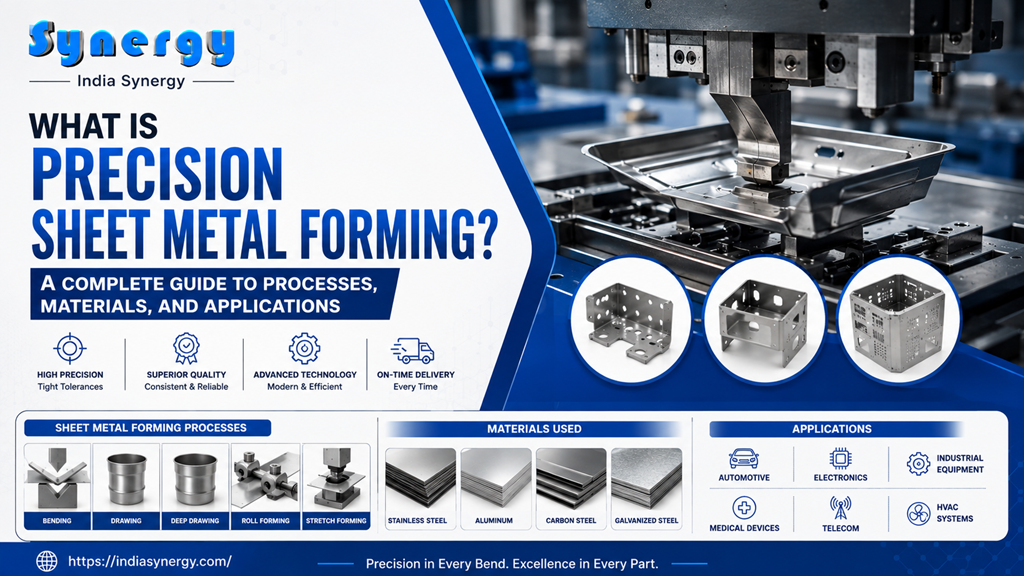
Precision sheet metal forming is a manufacturing process used to transform flat metal sheets into highly accurate components without removing significant amounts of material. The process combines specialized tooling, advanced machinery, and engineering expertise to create complex shapes while maintaining tight tolerances and consistent quality.
Industries such as automotive, aerospace, electronics, construction, medical equipment, and industrial manufacturing rely on precision sheet metal forming to produce durable and lightweight components. As manufacturing technologies continue to evolve, businesses are increasingly looking for cost-effective production methods that deliver exceptional accuracy and repeatability.
India has become a leading destination for precision sheet metal manufacturing because of its strong engineering capabilities, advanced production facilities, and competitive manufacturing costs. Companies seeking reliable production partners often choose experienced manufacturers that offer complete solutions, from design and prototyping to fabrication and final assembly.
This guide explains precision sheet metal forming, its manufacturing processes, materials, benefits, applications, and the factors businesses should consider when selecting a manufacturing partner.
What Is Precision Sheet Metal Forming?
Precision sheet metal forming is a manufacturing technique that converts flat metal sheets into specific shapes through controlled deformation. Unlike machining, which removes material through cutting, forming reshapes the metal while preserving most of the original material.
The objective of precision sheet metal forming is to manufacture components that meet exact design specifications while maintaining structural integrity.
The process is commonly used to manufacture:
- Brackets
- Panels
- Enclosures
- Cabinets
- Housings
- Frames
- Structural components
Modern forming techniques allow manufacturers to create complex geometries while maintaining consistent quality throughout large production runs.
How Does Precision Sheet Metal Forming Work?
The process begins with a flat sheet of metal placed into specialized equipment.
The metal is then subjected to controlled force using dies, presses, rollers, or hydraulic systems. The applied force changes the shape of the material without significantly affecting its mechanical properties.
The basic manufacturing workflow includes:
- Material selection
- Product design
- Tooling preparation
- Metal forming
- Surface finishing
- Quality inspection
- Final assembly
Every stage must be carefully controlled to ensure the finished component meets dimensional and performance requirements.
Precision Sheet Metal Forming vs. Fabrication and Machining
Many businesses use the terms forming, fabrication, and machining interchangeably. However, these manufacturing processes serve different purposes.
| Process | Primary Function | Material Removal |
| Sheet metal forming | Reshapes metal | Minimal |
| Fabrication | Cuts, assembles, and joins components | Moderate |
| CNC machining | Removes material to create a part | Significant |
Precision sheet metal forming is often combined with fabrication and machining to produce complete industrial components.
Common Precision Sheet Metal Forming Processes
Bending
Bending is one of the most widely used sheet metal forming processes.
The metal sheet is placed into a press brake and bent into a predetermined angle.
Common applications include:
- Metal frames
- Brackets
- Enclosures
- Support structures
Stamping
Stamping uses dies and presses to create specific shapes in metal sheets.
The process offers several advantages:
- High production speed
- Excellent repeatability
- Cost-effective mass production
Industries such as automotive and electronics depend heavily on metal stamping.
Deep Drawing
Deep drawing transforms flat metal sheets into three-dimensional components.
Common products manufactured through deep drawing include:
- Containers
- Cylindrical components
- Automotive parts
- Industrial housings
Roll Forming
Roll forming uses a series of rollers to gradually shape metal sheets into continuous profiles.
Applications include:
- Structural channels
- Roofing systems
- Steel frames
Hydroforming
Hydroforming uses hydraulic pressure to shape metal into complex geometries.
Benefits include:
- Reduced material waste
- Better dimensional accuracy
- Improved strength
Stretch Forming
Stretch forming simultaneously stretches and bends the material.
This process is commonly used in industries that require curved components, including aerospace and transportation.
Materials Used in Precision Sheet Metal Forming
Selecting the right material is essential for product performance.
Stainless Steel
Stainless steel offers:
- Excellent corrosion resistance
- High strength
- Long-term durability
It is commonly used in medical, food processing, and industrial applications.
Carbon Steel
Carbon steel is widely used because of its affordability and mechanical strength.
Applications include:
- Construction equipment
- Industrial machinery
- Structural components
Aluminum
Aluminum provides several advantages:
- Lightweight construction
- Excellent corrosion resistance
- Good thermal conductivity
Industries such as aerospace and automotive frequently use aluminum components.
Copper
Copper offers exceptional electrical conductivity.
It is commonly used in:
- Electrical systems
- Electronic equipment
- Power distribution applications
Brass
Brass provides good machinability and corrosion resistance.
Common applications include:
- Decorative components
- Electrical systems
- Precision instruments
Equipment Used in Precision Sheet Metal Forming
Press Brakes
Press brakes are used to bend sheet metal into precise angles and shapes.
Mechanical Presses
Mechanical presses use rotating mechanisms to generate force for metal forming operations.
Hydraulic Presses
Hydraulic systems deliver greater forming force and improve manufacturing flexibility.
CNC-Controlled Machines
Computer-controlled equipment improves:
- Accuracy
- Repeatability
- Production efficiency
CNC technology has transformed modern sheet metal manufacturing.
The Role of CNC Technology in Precision Sheet Metal Forming
Computer Numerical Control (CNC) systems have significantly improved manufacturing capabilities.
Improved Accuracy
Automated systems eliminate many human errors.
Better Repeatability
Every component is produced according to identical specifications.
Faster Production
Automation reduces manufacturing time while increasing productivity.
Reduced Waste
Precise material handling minimizes waste and lowers production costs.
Advantages of Precision Sheet Metal Forming
High Dimensional Accuracy
Precision manufacturing ensures that every component meets exact specifications.
Reduced Material Waste
Because the process reshapes rather than removes material, waste is significantly reduced.
Faster Production Cycles
Automated manufacturing systems increase production efficiency.
Lower Manufacturing Costs
Reduced waste and shorter production cycles result in lower production expenses.
Stronger Components
Properly formed metal retains excellent mechanical properties and structural integrity.
Industrial Applications of Precision Sheet Metal Forming
Automotive Industry
Automotive manufacturers use precision-formed components for:
- Chassis systems
- Engine components
- Body panels
- Mounting brackets
Aerospace Industry
The aerospace sector requires lightweight and highly precise components.
Applications include:
- Aircraft structures
- Interior panels
- Mounting systems
Construction Industry
Construction projects depend on precision-formed components for structural support.
Common applications include:
- Steel frameworks
- Support brackets
- Roofing systems
Electronics Industry
Electronic equipment manufacturers use sheet metal components for:
- Cabinets
- Enclosures
- Server racks
- Control panels
Medical Equipment Manufacturing
Precision sheet metal components are widely used in:
- Diagnostic equipment
- Surgical devices
- Medical cabinets
Common Challenges in Precision Sheet Metal Forming
Material Springback
Metal often attempts to return to its original shape after bending.
Manufacturers overcome this issue through precise tooling and process control.
Cracking
Excessive stress can cause material fractures during forming.
Surface Defects
Improper handling can result in scratches, dents, and other imperfections.
Dimensional Variations
Maintaining tight tolerances requires continuous quality monitoring.
How Manufacturers Ensure Quality
Quality assurance is an essential part of precision sheet metal manufacturing.
Material Inspection
Raw materials undergo chemical and mechanical testing.
Dimensional Verification
Advanced measuring equipment confirms component accuracy.
Surface Inspection
Manufacturers evaluate components for visual and structural defects.
Final Product Testing
Finished products are inspected before shipment to ensure compliance with customer requirements.
Why Businesses Choose India for Precision Sheet Metal Forming
India has emerged as a global manufacturing hub because of several competitive advantages.
Cost-Effective Manufacturing
Indian manufacturers offer competitive pricing without sacrificing quality.
Skilled Workforce
Experienced engineers and technicians support advanced manufacturing operations.
Modern Production Facilities
Many manufacturers have invested in CNC technology, automation, and quality control systems.
Strong Export Capabilities
Indian manufacturers serve customers across:
- The United States
- Europe
- Australia
- Africa
- The Middle East
How to Choose the Right Precision Sheet Metal Manufacturer
Before selecting a manufacturing partner, businesses should evaluate several factors.
Consider the following:
- Manufacturing experience
- Engineering expertise
- Production capacity
- Quality certifications
- Customization capabilities
- Delivery performance
Choosing the right manufacturer can significantly improve product quality and supply chain efficiency.
Future Trends in Precision Sheet Metal Forming
Several technologies are reshaping the manufacturing industry.
Emerging trends include:
- Smart factories
- Industry 4.0 integration
- AI-driven quality control
- Robotic automation
- Sustainable manufacturing
- Digital production monitoring
Manufacturers that adopt these technologies will continue to gain a competitive advantage.
Conclusion
Precision sheet metal forming has become one of the most important manufacturing processes in modern industry. The ability to produce complex, durable, and highly accurate components makes it an essential technology across multiple sectors.
From automotive and aerospace applications to electronics and construction, precision-formed components continue to support innovation and industrial growth.
Businesses seeking high-quality manufacturing solutions should partner with experienced companies that offer advanced engineering capabilities, modern production facilities, and strict quality standards. Selecting the right manufacturing partner ensures long-term product reliability, improved operational efficiency, and reduced production costs.
Frequently Asked Questions
What is precision sheet metal forming?
Precision sheet metal forming is a manufacturing process that reshapes flat metal sheets into highly accurate components without removing significant amounts of material.
Which industries use precision sheet metal forming?
Automotive, aerospace, construction, electronics, medical, and industrial manufacturing industries widely use precision sheet metal components.
What materials are commonly used in sheet metal forming?
Common materials include stainless steel, carbon steel, aluminum, copper, and brass.
What is the difference between sheet metal forming and machining?
Sheet metal forming reshapes metal, while machining removes material through cutting processes.
What are the advantages of precision sheet metal forming?
The process offers high accuracy, reduced waste, faster production, lower costs, and improved component strength.
Which forming process is best for large-scale production?
Metal stamping is often considered one of the most efficient processes for high-volume production.
How does CNC technology improve sheet metal manufacturing?
CNC systems improve accuracy, repeatability, productivity, and quality control.
What should businesses consider when selecting a sheet metal manufacturer?
Manufacturing experience, engineering capabilities, production capacity, quality standards, and customization options should all be considered.