





Introduction
Manufacturing industries continue to demand lightweight, durable, and highly precise metal components that can be produced efficiently and at scale. Traditional fabrication methods often involve multiple manufacturing steps, increasing production costs and extending lead times. To overcome these challenges, manufacturers increasingly rely on deep draw stamping, one of the most efficient metal-forming processes used in modern manufacturing.
Deep draw stamping enables manufacturers to transform flat metal sheets into seamless, three-dimensional components with exceptional dimensional accuracy. The process reduces material waste, improves structural strength, and supports high-volume production.
Industries such as automotive, electronics, aerospace, medical equipment, industrial machinery, and consumer products depend heavily on deep drawn components for their products and assemblies.
As global manufacturing continues to evolve, India has become a preferred destination for precision metal stamping because of its advanced manufacturing capabilities, engineering expertise, and cost-effective production environment.
India Synergy provides comprehensive metal manufacturing solutions, including precision stamping, sheet metal fabrication, CNC machining, welded assemblies, laser cutting, and custom-engineered components for global industries.
This guide explains the deep draw stamping process, materials, applications, benefits, manufacturing challenges, and the factors businesses should consider when selecting a manufacturing partner.
What Is Deep Draw Stamping?
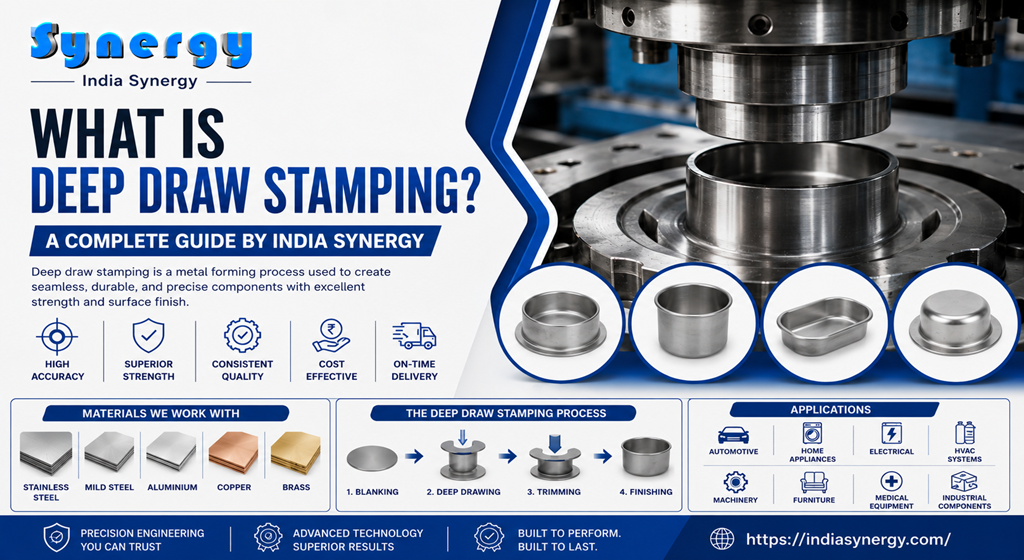
Deep draw stamping is a metal-forming process that converts a flat sheet of metal into a hollow, three-dimensional component by pulling the material into a specially designed die using a punch.
The process is called deep drawing when the depth of the finished component exceeds its diameter.
Unlike traditional machining, which removes material through cutting operations, deep draw stamping reshapes the metal while preserving most of the original material.
This manufacturing technique is widely used to produce components such as:
- Cylindrical containers
- Metal housings
- Electrical enclosures
- Automotive components
- Industrial equipment parts
- Medical device components
Because the process creates seamless parts, deep draw stamping often produces stronger and more durable components than conventional fabrication methods.
How Does Deep Draw Stamping Work?
Deep draw stamping combines mechanical force, specialized tooling, and controlled metal deformation to create complex shapes.
The process follows several important steps.
Step 1: Material Selection
Engineers select the appropriate metal according to the component’s requirements.
Selection criteria include:
- Strength
- Corrosion resistance
- Ductility
- Thickness
- Formability
Step 2: Blank Preparation
A flat metal sheet, commonly called a blank, is cut into a predetermined shape.
The size of the blank directly affects the quality of the finished component.
Step 3: Tooling Setup
Specialized tools are installed inside the stamping press.
These tools include:
- Punch
- Die
- Blank holder
Proper tooling design ensures consistent metal flow during the drawing operation.
Step 4: The Drawing Process
The punch applies pressure to the metal blank and pushes it into the die cavity.
The blank holder controls material movement and prevents defects such as wrinkling.
The metal gradually stretches and takes the desired shape.
Step 5: Trimming and Finishing
Excess material is removed after the drawing operation.
Additional finishing processes may include:
- Surface treatment
- Deburring
- Polishing
- Coating
Step 6: Inspection and Quality Control
The finished component undergoes detailed inspection before shipment.
Manufacturers evaluate:
- Dimensions
- Surface quality
- Structural integrity
Components Used in Deep Draw Stamping
Several essential components work together during the manufacturing process.
Punch
The punch applies force to the metal and shapes the material.
The punch design determines the geometry of the finished component.
Die
The die provides the cavity that forms the metal.
Precision-engineered dies ensure dimensional accuracy.
Blank Holder
The blank holder prevents uncontrolled material movement during the drawing process.
Proper pressure reduces defects and improves product quality.
Metal Blank
The metal blank is the raw material used to create the final product.
Material properties significantly influence forming performance.
Types of Deep Draw Stamping
Different manufacturing requirements require different deep drawing techniques.
Single Draw Stamping
Single draw stamping uses one operation to create the final shape.
This process is suitable for simple components.
Multiple Draw Stamping
Complex components often require multiple drawing operations.
Each stage gradually increases the depth of the part.
Redrawing
Redrawing modifies an already formed component to achieve greater depth.
Reverse Drawing
Reverse drawing changes the direction of material flow to create more complex geometries.
Materials Used in Deep Draw Stamping
Selecting the correct material is critical for successful manufacturing.
Stainless Steel
Stainless steel offers:
- Excellent corrosion resistance
- High strength
- Long-term durability
Common applications include:
- Medical equipment
- Food processing equipment
- Industrial machinery
Carbon Steel
Carbon steel provides:
- Good formability
- Excellent strength
- Affordable production costs
Industries frequently use carbon steel for structural and industrial components.
Aluminum
Aluminum offers several advantages.
These include:
- Lightweight construction
- Excellent corrosion resistance
- High thermal conductivity
Automotive and aerospace manufacturers commonly use aluminum components.
Copper
Copper provides exceptional electrical conductivity.
Applications include:
- Electrical systems
- Power equipment
- Electronic devices
Brass
Brass combines corrosion resistance with excellent machinability.
It is widely used in decorative and electrical applications.
Advantages of Deep Draw Stamping
Deep draw stamping offers several important manufacturing benefits.
Reduced Material Waste
Because the process reshapes rather than removes material, waste is significantly reduced.
This lowers manufacturing costs.
High Production Efficiency
Deep draw stamping supports high-volume production.
Automated systems improve productivity while maintaining consistent quality.
Exceptional Dimensional Accuracy
Precision tooling ensures tight tolerances throughout the manufacturing process.
Improved Structural Strength
Seamless components provide greater structural integrity than welded or assembled parts.
Lower Manufacturing Costs
The ability to produce components quickly and efficiently reduces overall production expenses.
Deep Draw Stamping vs. Traditional Manufacturing Methods
| Manufacturing Method | Material Waste | Production Speed | Precision |
| Deep Draw Stamping | Low | High | Excellent |
| Traditional Fabrication | Moderate | Moderate | Good |
| CNC Machining | High | Moderate | Excellent |
| Welding and Assembly | Moderate | Low | Good |
Deep draw stamping is often the preferred choice for large-scale production because of its efficiency and cost advantages.
Applications of Deep Draw Stamping in Different Industries
Automotive Industry
Automotive manufacturers use deep drawn components in:
- Fuel tanks
- Engine parts
- Transmission components
- Structural assemblies
The process reduces vehicle weight while maintaining durability.
Electrical and Electronics Industry
Precision-stamped components are widely used in:
- Battery enclosures
- Electrical connectors
- Electronic housings
- Control systems
Medical Equipment Industry
Medical manufacturers require components with exceptional precision.
Applications include:
- Surgical instruments
- Medical containers
- Laboratory equipment
Aerospace Industry
The aerospace industry depends on lightweight and highly accurate components.
Examples include:
- Aircraft structures
- Equipment housings
- Specialized assemblies
Industrial Manufacturing
Industrial machinery manufacturers use deep drawn components for:
- Equipment housings
- Protective enclosures
- Machine components
Common Challenges in Deep Draw Stamping
Although the process offers numerous advantages, manufacturers must address several technical challenges.
Wrinkling
Wrinkling occurs when excess material folds during the drawing process.
Cracking
Excessive stretching can cause material fractures.
Material Springback
Metal often attempts to return to its original shape after forming.
Uneven Wall Thickness
Improper process control can create inconsistent material distribution.
How Manufacturers Overcome These Challenges
Experienced manufacturers use several strategies to improve production quality.
Advanced Tooling Design
Precision tooling improves material flow and reduces defects.
Lubrication Systems
Proper lubrication minimizes friction during the drawing process.
Process Optimization
Engineers carefully control:
- Press speed
- Tooling pressure
- Material movement
Simulation Software
Computer simulations help manufacturers identify potential problems before production begins.
Quality Control in Deep Draw Stamping
Quality assurance plays a critical role in precision manufacturing.
Raw Material Inspection
Manufacturers verify material properties before production begins.
Dimensional Verification
Precision measuring equipment confirms compliance with engineering specifications.
Mechanical Testing
Testing procedures evaluate:
- Strength
- Hardness
- Ductility
Surface Inspection
Manufacturers inspect components for:
- Scratches
- Cracks
- Surface defects
Final Product Verification
Every component undergoes a final quality inspection before shipment.
Why Choose India Synergy for Deep Draw Stamping Solutions?
India Synergy provides complete manufacturing solutions for businesses that require precision-engineered metal components.
Advanced Manufacturing Capabilities
The company offers:
- Deep draw stamping
- CNC machining
- Sheet metal fabrication
- Laser cutting
- Welded assemblies
Customized Engineering Solutions
Products are manufactured according to customer requirements, drawings, and technical specifications.
Strict Quality Standards
Comprehensive quality control procedures ensure product consistency.
Global Supply Capabilities
India Synergy serves customers across multiple international markets.
Future Trends in Deep Draw Stamping
Manufacturing technologies continue to evolve.
Emerging trends include:
- Smart factories
- AI-driven manufacturing
- Automated inspection systems
- Industry 4.0 integration
- Sustainable manufacturing practices
These innovations will improve efficiency, precision, and productivity.
Conclusion
Deep draw stamping has transformed modern manufacturing by providing an efficient method for producing durable and highly precise metal components. The process offers several advantages, including reduced material waste, lower production costs, improved structural strength, and faster manufacturing cycles.
As industries continue to demand high-performance components, deep draw stamping will remain one of the most important metal-forming technologies.
India Synergy combines advanced manufacturing capabilities with engineering expertise to deliver precision metal components that meet the evolving requirements of global industries. Whether customers require prototype development or large-scale production, the company provides reliable and cost-effective manufacturing solutions.
Frequently Asked Questions
What is deep draw stamping?
Deep draw stamping is a manufacturing process that transforms flat metal sheets into hollow three-dimensional components through controlled deformation.
Which materials are commonly used in deep draw stamping?
Stainless steel, carbon steel, aluminum, copper, brass, and specialty alloys are commonly used.
What are the advantages of deep draw stamping?
The process offers high production efficiency, reduced material waste, excellent precision, and lower manufacturing costs.
Which industries use deep draw stamped components?
Automotive, aerospace, electronics, medical equipment, and industrial manufacturing industries frequently use deep drawn components.
What causes defects during deep draw stamping?
Wrinkling, cracking, springback, and uneven wall thickness are among the most common defects.
How do manufacturers maintain quality in deep draw stamping?
Manufacturers use material inspection, dimensional verification, mechanical testing, and final quality inspections.
Can deep draw stamping support high-volume production?
Yes. Deep draw stamping is highly efficient and is widely used for large-scale manufacturing.
Why should businesses choose India Synergy?
India Synergy offers advanced manufacturing technologies, customized engineering solutions, strict quality control, and reliable global supply capabilities.