





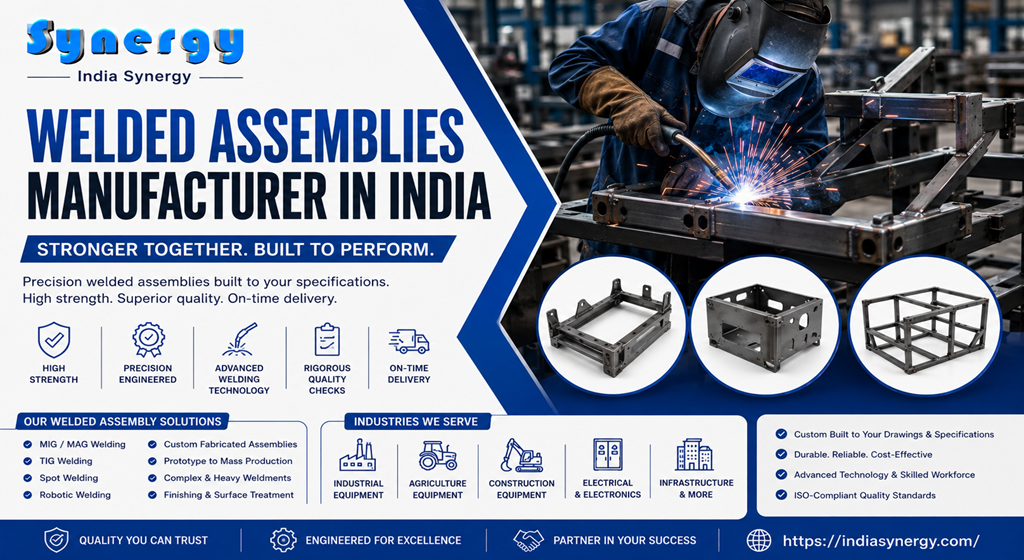
Welded Assemblies Manufacturer in India: How to Choose the Right Supplier | India Synergy
Introduction
Welded assemblies are the foundation of countless industrial products used in construction, mining, transportation, agriculture, power generation, material handling, and heavy engineering. From structural frames and machine components to complex fabricated systems, welded assemblies provide the strength, durability, and reliability required in demanding industrial environments.
As manufacturing projects become more complex, businesses need suppliers that can deliver precision-engineered welded assemblies while maintaining consistent quality standards. Selecting the right manufacturing partner directly affects product performance, operational efficiency, project timelines, and long-term maintenance costs.
India has emerged as a global manufacturing hub for fabricated and welded components due to its advanced production capabilities, skilled workforce, and competitive manufacturing costs. International buyers are increasingly choosing Indian manufacturers for both standard and custom-engineered welded assemblies.
India Synergy is a trusted Welded Assemblies Manufacturer in India, providing complete manufacturing solutions for customers across multiple industries. From engineering and material selection to fabrication, welding, machining, surface treatment, and quality inspection, the company delivers end-to-end manufacturing services designed to meet global standards.
This comprehensive guide explains welded assemblies, manufacturing processes, applications, quality requirements, and the most important factors businesses should consider when selecting the right supplier.
What Are Welded Assemblies?
A welded assembly is a group of individual metal components permanently joined together through a welding process to create a single, functional unit.
Unlike mechanical fasteners such as bolts and screws, welding creates a metallurgical bond between materials. This connection produces stronger joints and improves the structural integrity of the final product.
Welded assemblies are commonly used in:
- Construction equipment
- Mining machinery
- Industrial machinery
- Agricultural equipment
- Automotive systems
- Oil and gas infrastructure
- Material handling systems
Depending on the application, welded assemblies can range from simple support brackets to highly complex fabricated structures.
Why Are Welded Assemblies Important in Modern Manufacturing?
Manufacturers rely on welded assemblies because they provide exceptional strength and design flexibility.
Improved Structural Strength
Welded joints distribute loads more effectively than many mechanical fastening methods.
Benefits include:
- Greater rigidity
- Better load distribution
- Increased structural stability
Enhanced Durability
Industrial equipment often operates in harsh environments.
Properly designed welded assemblies can withstand:
- Heavy loads
- Continuous vibration
- High temperatures
- Mechanical stress
Reduced Weight
Modern welding techniques eliminate the need for excessive fasteners, reducing overall product weight.
This is particularly important in industries such as:
- Automotive manufacturing
- Aerospace engineering
- Transportation equipment
Better Design Flexibility
Welding allows manufacturers to create complex structures that would be difficult to assemble using traditional fastening methods.
India Synergy: A Trusted Welded Assemblies Manufacturer in India
India Synergy specializes in manufacturing high-quality welded assemblies for industrial applications.
The company’s manufacturing capabilities include:
- Metal fabrication
- CNC machining
- Laser cutting
- Welding
- Surface treatment
- Assembly
- Quality testing
By combining engineering expertise with advanced manufacturing technologies, India Synergy delivers products that meet both domestic and international requirements.
Types of Welded Assemblies
Different industries require different types of welded assemblies.
Structural Welded Assemblies
Structural assemblies support buildings, bridges, industrial facilities, and infrastructure projects.
Examples include:
- Support frames
- Structural columns
- Steel frameworks
- Equipment platforms
Heavy Equipment Welded Assemblies
Heavy machinery requires components capable of operating under extreme conditions.
Examples include:
- Excavator frames
- Loader assemblies
- Mining equipment components
- Earth-moving equipment structures
Sheet Metal Welded Assemblies
Sheet metal assemblies are widely used in manufacturing industries.
Common applications include:
- Enclosures
- Cabinets
- Electrical panels
- Machine housings
Precision Welded Assemblies
Precision assemblies require tight tolerances and exceptional dimensional accuracy.
Industries that rely on precision welding include:
- Medical equipment manufacturing
- Electronics
- Aerospace
- Automotive engineering
Custom Welded Assemblies
Many industries require application-specific products.
Custom manufacturing allows businesses to develop assemblies according to:
- Technical drawings
- Engineering specifications
- Performance requirements
- Material preferences
Common Welding Processes Used in Manufacturing
The welding process influences the strength, appearance, and performance of the finished product.
MIG Welding (Metal Inert Gas Welding)
MIG welding is one of the most commonly used industrial processes.
Advantages include:
- High productivity
- Faster welding speeds
- Cost-effective production
Applications include structural fabrication and industrial equipment manufacturing.
TIG Welding (Tungsten Inert Gas Welding)
TIG welding provides superior precision and excellent weld quality.
This process is widely used for:
- Stainless steel fabrication
- Aluminum components
- Precision manufacturing
Arc Welding
Arc welding uses an electrical current to generate heat and join metals.
Industries prefer this method for:
- Construction projects
- Heavy fabrication
- Industrial equipment manufacturing
Resistance Welding
Resistance welding uses electrical resistance and pressure to join metal components.
Applications include:
- Automotive manufacturing
- High-volume production
Robotic Welding
Automation has transformed modern manufacturing.
Robotic welding provides:
- Consistent quality
- Faster production
- Better repeatability
- Reduced human error
Materials Used in Welded Assembly Manufacturing
Choosing the right material is essential for long-term product performance.
Carbon Steel
Carbon steel offers:
- Excellent strength
- Good weldability
- Affordable manufacturing costs
Stainless Steel
Stainless steel provides:
- Corrosion resistance
- High durability
- Excellent surface quality
It is widely used in food processing, pharmaceutical, and chemical industries.
Aluminum
Aluminum delivers:
- Lightweight construction
- Corrosion resistance
- High thermal conductivity
Industries such as transportation and aerospace frequently use aluminum assemblies.
Alloy Steel
Alloy steel is ideal for demanding applications that require:
- High impact resistance
- Superior wear resistance
- Greater mechanical strength
Industries That Depend on Welded Assemblies
Construction Industry
Construction companies use welded assemblies in:
- Buildings
- Bridges
- Infrastructure projects
- Structural support systems
Mining Industry
Mining equipment requires durable welded structures capable of operating under extreme conditions.
Applications include:
- Crushers
- Conveyors
- Excavators
- Material handling equipment
Agricultural Equipment Manufacturing
Agricultural machinery uses welded assemblies in:
- Tractors
- Harvesters
- Cultivation equipment
Automotive Industry
Vehicle manufacturers use welded components in:
- Chassis systems
- Engine supports
- Suspension systems
Oil and Gas Industry
The oil and gas sector requires specialized welded assemblies for:
- Pipelines
- Storage facilities
- Processing equipment
The Welded Assembly Manufacturing Process
Engineering and Design
The process begins with product design and engineering analysis.
Manufacturers use advanced software to:
- Create three-dimensional models
- Analyze structural performance
- Optimize designs
Material Selection
Engineers select materials according to:
- Load requirements
- Environmental conditions
- Mechanical properties
Cutting and Preparation
Components are prepared through:
- Laser cutting
- Plasma cutting
- CNC machining
Proper preparation improves weld quality.
Welding and Assembly
Individual components are assembled according to engineering drawings.
Strict process controls ensure:
- Consistent weld penetration
- Proper alignment
- Strong joints
Surface Finishing
Surface treatments improve product durability.
Common finishing processes include:
- Powder coating
- Galvanization
- Sandblasting
- Painting
Quality Control in Welded Assembly Manufacturing
Quality assurance is one of the most important factors in welded component manufacturing.
Raw Material Inspection
Manufacturers evaluate material quality before production begins.
Weld Quality Testing
Every weld must meet specific quality standards.
Manufacturers evaluate:
- Weld penetration
- Surface quality
- Joint strength
Dimensional Verification
Precision measuring equipment ensures compliance with engineering specifications.
Non-Destructive Testing (NDT)
NDT techniques identify internal defects without damaging the component.
Common methods include:
- Ultrasonic testing
- Magnetic particle inspection
- Dye penetrant testing
- Radiographic inspection
Final Product Inspection
Finished assemblies undergo comprehensive inspections before shipment.
How to Choose the Right Welded Assemblies Supplier
Selecting the right supplier requires a detailed evaluation.
Evaluate Manufacturing Experience
An experienced manufacturer understands industry requirements and production challenges.
Consider:
- Years of experience
- Industry specialization
- Previous projects
Assess Manufacturing Capabilities
A reliable supplier should offer:
- Fabrication
- Welding
- Machining
- Surface treatment
- Assembly
An integrated manufacturing approach reduces production complexity.
Verify Quality Certifications
Look for manufacturers that follow recognized quality standards.
Important considerations include:
- Inspection procedures
- Testing capabilities
- Documentation systems
Review Production Capacity
Evaluate whether the manufacturer can support:
- Prototype development
- Small production runs
- Large-scale manufacturing
Examine Engineering Support
Engineering expertise plays a significant role in product development.
Strong engineering teams can:
- Improve designs
- Reduce costs
- Enhance product performance
Assess Supply Chain Reliability
Reliable delivery schedules are essential for maintaining production continuity.
Manufacturers should demonstrate:
- Effective logistics systems
- Inventory management
- Consistent lead times
Common Mistakes to Avoid When Selecting a Supplier
Many businesses focus exclusively on pricing.
This approach often creates long-term challenges.
Avoid these common mistakes:
- Choosing the lowest-priced supplier
- Ignoring quality certifications
- Overlooking manufacturing capabilities
- Failing to verify production capacity
- Not evaluating delivery performance
The right supplier should provide both quality and value.
Why Businesses Choose India for Welded Assembly Manufacturing
India offers several manufacturing advantages.
Cost-Effective Production
Competitive manufacturing costs improve project profitability.
Skilled Workforce
India has a large pool of experienced engineers and certified welders.
Advanced Manufacturing Facilities
Modern manufacturing plants support:
- Automation
- Robotics
- CNC technologies
- Precision fabrication
Strong Export Capabilities
Indian manufacturers supply products to customers across:
- North America
- Europe
- Australia
- Africa
- The Middle East
Why Choose India Synergy?
India Synergy delivers complete welded assembly manufacturing solutions.
Advanced Manufacturing Infrastructure
Modern facilities support complex production requirements.
End-to-End Manufacturing Services
Customers benefit from:
- Engineering support
- Material sourcing
- Fabrication
- Machining
- Welding
- Quality testing
Customized Solutions
Products are manufactured according to customer specifications.
Consistent Quality
Strict inspection procedures ensure product reliability.
On-Time Delivery
Efficient production planning and logistics support timely deliveries.
Future Trends in Welded Assembly Manufacturing
Several innovations are transforming the welding industry.
Emerging trends include:
- Robotic welding
- Artificial intelligence
- Industry 4.0
- Smart manufacturing
- Automated quality inspection
- Sustainable production methods
Manufacturers that adopt these technologies will continue to improve productivity and product quality.
Conclusion
Welded assemblies play a critical role in modern manufacturing. Their strength, durability, and design flexibility make them essential across construction, mining, automotive, agriculture, and industrial applications.
Choosing the right supplier is equally important. Manufacturing expertise, quality control, engineering capabilities, and production capacity directly influence product performance.
As a leading Welded Assemblies Manufacturer in India, India Synergy combines advanced manufacturing technologies with engineering excellence to deliver reliable and cost-effective solutions for global industries.
Businesses looking for a long-term manufacturing partner can depend on India Synergy for customized, high-quality welded assemblies designed to meet the most demanding industrial requirements.
Frequently Asked Questions
What are welded assemblies?
Welded assemblies are groups of metal components permanently joined together through various welding processes to create a complete product.
Which industries use welded assemblies?
Construction, mining, automotive, agriculture, oil and gas, and industrial manufacturing industries rely heavily on welded assemblies.
What materials are commonly used in welded assemblies?
Carbon steel, stainless steel, aluminum, and alloy steel are the most commonly used materials.
How do manufacturers ensure weld quality?
Manufacturers use quality inspections, dimensional verification, weld testing, and non-destructive testing techniques.
Does India Synergy manufacture custom welded assemblies?
Yes. India Synergy provides customized welded assemblies according to customer drawings, specifications, and application requirements.
What should businesses consider when selecting a welded assemblies supplier?
Manufacturing experience, quality standards, engineering support, production capacity, and delivery performance should all be evaluated.
Why should companies source welded assemblies from India?
India offers competitive manufacturing costs, advanced production technologies, skilled engineers, and strong export capabilities.
What is the future of welded assembly manufacturing?
Automation, robotic welding, artificial intelligence, and Industry 4.0 technologies are shaping the future of welded assembly manufacturing.