




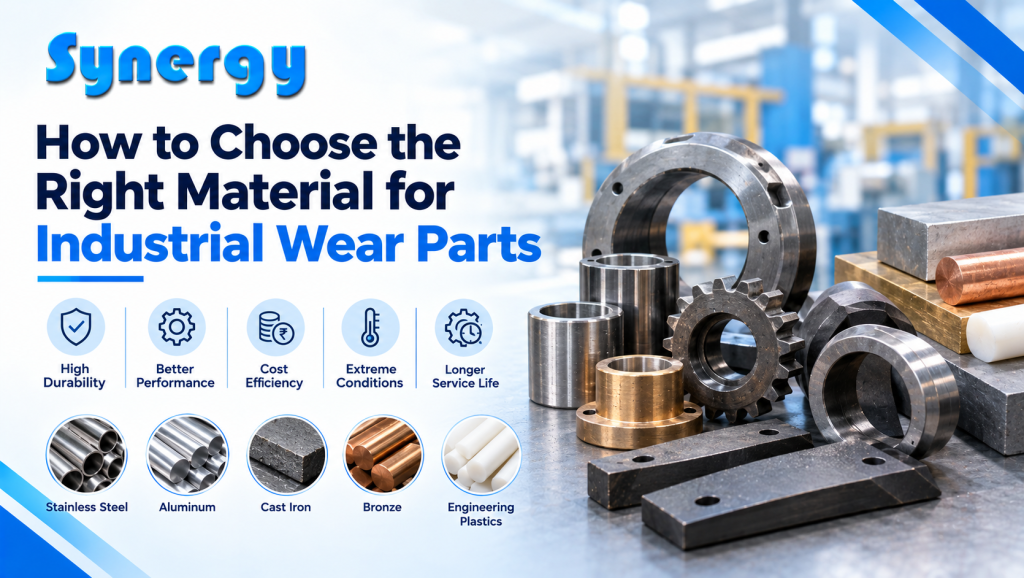
Selecting the right material for industrial wear parts is essential for improving equipment life, reducing maintenance costs, and maintaining reliable production. Components used in mining, cement manufacturing, crushing, material handling, and construction are exposed to different combinations of abrasion, impact, friction, pressure, and temperature. A material that performs well in one application may wear out quickly in another.
The best material for a wear part depends on the operating environment, the type of wear, the hardness of the processed material, impact intensity, component design, and expected service life. Common options include manganese steel, high-chromium white iron, abrasion-resistant steel, hardened alloy steel, and carbide-based materials or overlays for specialized applications.
For industrial buyers, engineers, and maintenance teams, material selection should be based on actual operating conditions rather than hardness or price alone. Understanding the properties of different wear-resistant materials helps businesses select suitable components and make better long-term maintenance decisions.
What Are Industrial Wear Parts?
Industrial wear parts are components designed to resist gradual material loss, surface damage, deformation, or deterioration during equipment operation. They are commonly installed in machinery that processes, moves, crushes, grinds, or handles abrasive and heavy materials.
Examples include:
- Crusher liners and jaw plates.
- Mill liners and grinding components.
- Bucket teeth and excavator wear components.
- Chute liners and conveyor wear plates.
- High-chromium wear parts.
- Manganese steel wear components.
- Abrasion-resistant plates and custom wear components.
These parts protect equipment structures and working surfaces from excessive wear. Their performance depends on both the material selected and how effectively the component is designed, manufactured, installed, and maintained.
Why Does Material Selection Matter for Wear Parts?
Material selection directly affects component durability, replacement frequency, equipment availability, and total operating costs.
1. Improves Wear Resistance
Different materials respond differently to abrasive particles, sliding friction, repeated impacts, and compressive forces. Selecting a material that matches the dominant wear mechanism can help extend component service life.
For example, a high-hardness material may resist sliding abrasion effectively, while a material with greater toughness may perform better where heavy impact is common.
2. Reduces Maintenance Frequency
When a component wears too quickly, maintenance teams must replace it more frequently. Each replacement may involve labor, lifting equipment, production interruption, and inspection.
A suitable material can help reduce replacement frequency and improve maintenance planning.
3. Protects Equipment Performance
Excessive wear can change equipment clearances, affect product size, reduce material flow, and damage adjacent components. Appropriate wear-resistant materials help maintain the intended working geometry for longer.
4. Supports Better Lifecycle Costs
The cheapest component is not necessarily the least expensive option over its service life. A lower-priced part that requires frequent replacement may cost more than a durable alternative.
Material selection should therefore consider purchase price, expected service life, installation cost, downtime, and replacement availability.
Common Materials Used in Industrial Wear Parts
Different wear-resistant materials are designed to address different combinations of abrasion, impact, deformation, and operating conditions.
1. Manganese Steel
Manganese steel, often associated with austenitic manganese steel grades, is widely used in applications involving severe impact and compressive loading.
One of its important characteristics is work hardening. Under suitable operating conditions, the surface can become harder as it experiences repeated deformation, while the underlying material retains toughness.
Key characteristics:
- High toughness and impact resistance.
- Ability to work harden under appropriate conditions.
- Resistance to cracking in demanding impact applications.
- Suitability for selected crushing and heavy-duty applications.
Common applications:
- Jaw crusher plates.
- Gyratory crusher liners.
- Selected cone crusher components.
- Other components exposed to heavy impact and compressive forces.
Manganese steel may not be the best choice for every low-impact, highly abrasive application. Its performance depends on whether operating conditions generate the deformation needed for effective work hardening.
2. High-Chromium White Iron
High-chromium white iron contains hard chromium-rich carbides within a metallic matrix. These hard phases provide strong resistance to abrasive wear in suitable operating environments.
Key characteristics:
- High abrasion resistance.
- Hard carbide structures.
- Suitability for selected grinding and material-processing applications.
- Potential for long service life where impact loading is controlled.
Common applications:
- Selected mill liners.
- Grinding components.
- Slurry-handling wear components.
- Abrasion-resistant parts used in mineral processing.
High-chromium white iron can be brittle compared with tougher steel materials. Applications involving severe impact or significant shock loading require careful evaluation before selection.
3. Abrasion-Resistant Steel
Abrasion-resistant steel is designed to provide a balance of hardness, strength, and toughness. Specific properties vary by grade, thickness, processing method, and heat treatment.
Key characteristics:
- Resistance to sliding abrasion.
- Good strength for structural and wear applications.
- Potential for fabrication and machining using approved procedures.
- Availability in different hardness ranges.
Common applications:
- Chute liners.
- Conveyor wear plates.
- Hoppers and material-handling equipment.
- Bucket liners.
- Selected construction and mining components.
When choosing abrasion-resistant steel, engineers should evaluate more than the nominal hardness. Plate thickness, impact conditions, attachment method, operating temperature, and fabrication requirements also influence performance.
4. Hardened Alloy Steel
Hardened alloy steels are used where strength, toughness, fatigue resistance, and wear performance must be balanced.
Their properties depend on alloy composition, heat treatment, section thickness, and manufacturing quality.
Key characteristics:
- Good strength and toughness when properly selected.
- Potential resistance to repeated loading and deformation.
- Suitability for precision-engineered components.
- Flexibility across a range of industrial applications.
Common applications:
- Pins and shafts.
- Selected machine components.
- Wear-resistant mechanical parts.
- Components exposed to repeated loading and contact.
Hardened alloy steel is not a single material specification. The required grade and heat-treatment condition should be selected according to the component’s actual service requirements.
5. Carbide-Based Materials and Wear Overlays
Tungsten carbide and other carbide-based materials offer very high hardness and can be used in applications requiring exceptional abrasion resistance. Carbide particles may also be incorporated into specialized wear overlays or composite structures.
Key characteristics:
- High resistance to abrasive material loss.
- Suitability for specialized high-wear applications.
- Availability in different forms, coatings, or composite systems.
- Potential for localized protection in areas exposed to severe abrasion.
Common applications:
- Selected cutting and drilling tools.
- Specialized industrial wear surfaces.
- Components exposed to highly abrasive materials.
- Engineered wear overlays for specific applications.
Carbide-based solutions can involve higher initial costs and may have limitations under heavy impact. Their use should be justified by the severity of the wear problem and the expected operational benefits.
Comparison of Common Wear-Resistant Materials
| Material | Main Strength | Typical Consideration | Common Application Examples |
| Manganese steel | Toughness and impact resistance | Benefits depend on suitable work-hardening conditions | Crusher jaw plates and selected crusher liners |
| High-chromium white iron | High abrasion resistance | Can be less suitable for severe impact | Selected mill liners and grinding components |
| Abrasion-resistant steel | Balance of hardness and toughness | Grade, thickness, and fabrication matter | Chute liners and wear plates |
| Hardened alloy steel | Strength and mechanical durability | Performance depends on grade and heat treatment | Pins, shafts, and selected machine components |
| Carbide-based materials | Very high abrasion resistance | Cost and impact limitations require evaluation | Specialized wear surfaces and cutting applications |
This comparison is a starting point, not a universal ranking. The most suitable material depends on the specific equipment, feed material, operating conditions, and failure history.
Key Factors to Consider When Selecting Wear Part Materials
1. Identify the Dominant Wear Mechanism
The first step is to understand how the component is losing material or becoming damaged.
Abrasion: Hard particles scrape or grind against a surface, gradually removing material.
Impact wear: Repeated collisions cause surface damage, deformation, chipping, or cracking.
Erosion: Fast-moving particles or fluids gradually remove material from a surface.
Adhesive wear: Contact between surfaces can cause material transfer, friction, or localized damage.
Corrosive wear: Chemical reactions or corrosive environments accelerate material deterioration, sometimes in combination with abrasion.
Many industrial components experience more than one mechanism. Material selection should address the dominant mechanism while accounting for secondary risks.
2. Evaluate Impact Intensity
Impact intensity is an important consideration when choosing between hard, abrasion-resistant materials and tougher alternatives.
Where large rocks, heavy scrap, or other materials strike a component forcefully, toughness and resistance to cracking may be essential.
For lower-impact applications dominated by sliding abrasion, harder materials may offer better wear performance. However, the final decision should consider component geometry and actual service conditions.
3. Understand the Processed Material
The material passing through equipment influences wear rates.
Important characteristics include:
- Particle size and shape.
- Mineral hardness.
- Abrasiveness.
- Moisture content.
- Presence of sharp or angular particles.
- Operating temperature and chemical characteristics.
For example, abrasive mineral feed may place different demands on a liner than softer bulk material. Changes in feed composition should trigger a review of existing wear-part performance.
4. Check Hardness and Toughness Together
Hardness describes resistance to localized indentation or deformation. Toughness describes the ability to absorb energy before fracturing.
These properties are related to material structure and processing, but one cannot be used as a substitute for the other.
A very hard material may resist abrasion but fail under heavy impact. A tougher material may withstand impact while experiencing faster wear in an abrasive environment.
The goal is to find the appropriate balance for the application rather than simply choosing the highest available hardness.
5. Consider Operating Temperature and Environment
Temperature can influence material strength, hardness, oxidation behavior, and dimensional stability. Moisture, chemicals, and corrosive substances may also affect service life.
For components operating in elevated-temperature or corrosive environments, evaluate the material’s suitability under the actual operating conditions.
Where necessary, consider corrosion-resistant alloys, protective systems, or material combinations designed for the application.
6. Evaluate Component Design and Thickness
Material performance cannot be separated from component design.
Thickness, shape, support, mounting arrangement, clearances, and stress concentrations all affect how a wear part performs.
A material that performs well in a thick, well-supported liner may not perform similarly in a thin component with sharp corners or uneven loading.
Engineering evaluation should therefore consider the entire component rather than focusing only on its material grade.
7. Review Manufacturing and Heat Treatment
Casting quality, forging practices, heat treatment, machining, and finishing can significantly influence final component properties.
Potential problems include internal defects, inconsistent hardness, dimensional variation, and residual stresses.
For critical applications, buyers should define the required specifications and appropriate inspection criteria before ordering. These may include dimensional checks, hardness testing, material verification, or other application-specific tests.
8. Consider Maintenance and Replacement Requirements
The best material should fit the maintenance strategy as well as the operating environment.
Evaluate how easily the component can be inspected, removed, replaced, and stocked. Consider whether a longer-lasting material justifies its additional purchase cost and whether it is available within the required lead time.
A technically suitable material may still be impractical if its sourcing requirements create unacceptable maintenance delays.
How to Match Wear Part Materials to Different Industries
Mining and Mineral Processing
Mining operations often involve abrasive ores, large particle sizes, heavy impact, and continuous production demands.
Crusher liners may require a different material strategy from mill liners because the dominant loading conditions can vary. Tougher materials may be appropriate for severe impact, while high-abrasion materials may suit selected grinding applications.
Material selection should be based on equipment design, ore characteristics, operating history, and the component’s location within the process.
Cement Manufacturing
Cement plants handle raw materials, clinker, aggregates, and other abrasive substances across crushing, grinding, conveying, and storage operations.
Chute liners, selected mill components, and material-handling wear parts may require abrasion resistance, impact tolerance, or both.
The best material depends on the material being handled, particle movement, temperature, and equipment configuration.
Construction and Earthmoving
Construction and earthmoving equipment operates in variable ground conditions and may encounter abrasive soil, rock, gravel, and demolition material.
Bucket teeth, cutting edges, and related wear components must balance abrasion resistance, toughness, and the ability to withstand repeated loading.
Material selection should consider the machine, ground conditions, operating intensity, and replacement process.
Bulk Material Handling
Chutes, hoppers, transfer points, and conveyor systems may experience sliding abrasion, impact at transfer points, and material buildup.
Engineers should examine where the material strikes the equipment, how it flows, and whether impact or sliding abrasion is responsible for most of the wear.
This helps determine whether a harder wear plate, a tougher material, or a specialized wear protection solution is appropriate.
Common Mistakes to Avoid When Choosing Wear-Resistant Materials
Choosing Material Based on Hardness Alone
Hardness is important, but it does not fully predict service life. Ignoring impact, toughness, geometry, and operating conditions can result in premature failure.
Selecting the Lowest-Priced Option
Purchase price should be evaluated alongside replacement frequency, installation labor, downtime, and delivery costs.
Using the Same Material Across Every Application
Different components experience different wear mechanisms. A material suitable for a crusher liner may not be the best choice for a chute liner or a precision mechanical component.
Ignoring Failure History
Repeated cracking, chipping, deformation, or rapid surface loss can indicate that the current material is unsuitable or that another operating factor needs attention.
Document failure patterns and use them to improve future specifications.
Overlooking Installation and Fitment
Incorrect dimensions, poor alignment, unsuitable fasteners, or inadequate support can shorten service life regardless of material quality.
Follow the approved installation procedure and verify fitment before returning equipment to service.
How to Evaluate Wear Part Performance After Installation
Material selection should be treated as an ongoing improvement process rather than a one-time purchasing decision.
After installing a new material or component, record the installation date, operating hours, throughput, material conditions, and inspection findings.
Measure wear using an appropriate and repeatable method. Compare service life with the previous component under similar operating conditions, where possible.
Evaluate the following indicators:
- Operating hours before replacement.
- Material processed before replacement.
- Wear rate or remaining component thickness.
- Frequency of cracking, chipping, or deformation.
- Maintenance labor and downtime.
- Total cost per operating hour or unit of production.
Where conditions differ significantly between test periods, document those differences before concluding.
For critical applications, trialing a new material on a limited number of components may help validate performance before a wider change is introduced.
How India Synergy Can Support Wear Parts Requirements
Selecting industrial wear parts involves more than identifying a material with high hardness. Buyers need to consider the intended application, operating conditions, component design, dimensional requirements, and manufacturing quality.
India Synergy works with industrial manufacturing and sourcing requirements for different component categories. When discussing wear-part requirements, buyers should provide available equipment details, drawings, material specifications, operating conditions, and information about previous component failures.
This information helps establish the technical requirements for evaluating suitable manufacturing and sourcing options.
Explore the India Synergy Wear Parts category to review the range of wear-resistant component categories relevant to industrial applications.
Conclusion
Choosing the right material for industrial wear parts requires a clear understanding of abrasion, impact, toughness, hardness, operating temperature, component design, and maintenance requirements.
Manganese steel may suit selected high-impact applications, high-chromium white iron may be appropriate for demanding abrasive environments, and abrasion-resistant steel can provide a useful balance of hardness and toughness. Hardened alloy steels and carbide-based materials serve other specialized requirements.
There is no single material that performs best in every application. Industrial buyers should evaluate the dominant wear mechanism, review operating history, verify manufacturing quality, and compare total lifecycle costs before making a decision.
A structured material-selection process can help businesses improve wear-part reliability, plan maintenance more effectively, and make better-informed purchasing decisions.
Frequently Asked Questions
1. Which material is best for industrial wear parts?
The best material depends on the wear mechanism and operating conditions. Manganese steel can suit selected high-impact applications, while high-chromium white iron and abrasion-resistant steel may suit particular abrasive environments. Material selection should also consider toughness, component design, and service history.
2. What is the difference between hardness and toughness in wear parts?
Hardness measures resistance to localized indentation or deformation, while toughness describes the ability to absorb energy before fracturing. Wear parts often require a balance of both properties to resist abrasion without failing under impact.
3. Why is manganese steel used for crusher wear parts?
Manganese steel is used in selected crusher applications because of its toughness and ability to work harden under appropriate impact and compressive conditions. Its suitability depends on the crusher design, feed material, and operating environment.
4. When should high-chromium white iron be considered?
High-chromium white iron may be suitable for applications requiring strong abrasion resistance, such as selected grinding and mineral-processing components. Its suitability should be carefully evaluated where severe impact or shock loading is present.
5. Does higher hardness always mean longer wear-part life?
No. Higher hardness may improve abrasion resistance in some applications, but it does not guarantee longer service life. Impact intensity, toughness, material structure, installation, and operating conditions also affect performance.
6. How can businesses reduce wear-part replacement frequency?
Businesses can review material selection, improve installation practices, monitor wear patterns, maintain suitable operating conditions, and inspect components regularly. Using failure data to refine future specifications can also improve service life.
7. What tests can help evaluate wear-part material quality?
Depending on the component and application, relevant checks may include material verification, hardness testing, dimensional inspection, metallurgical examination, and non-destructive testing. The appropriate inspection plan should be defined by the component’s requirements and risk level.
8. How should businesses compare the cost of different wear-part materials?
Compare purchase price, expected service life, installation labor, replacement frequency, downtime, and maintenance requirements. Cost per operating hour or unit of production can provide a more useful comparison than purchase price alone.