




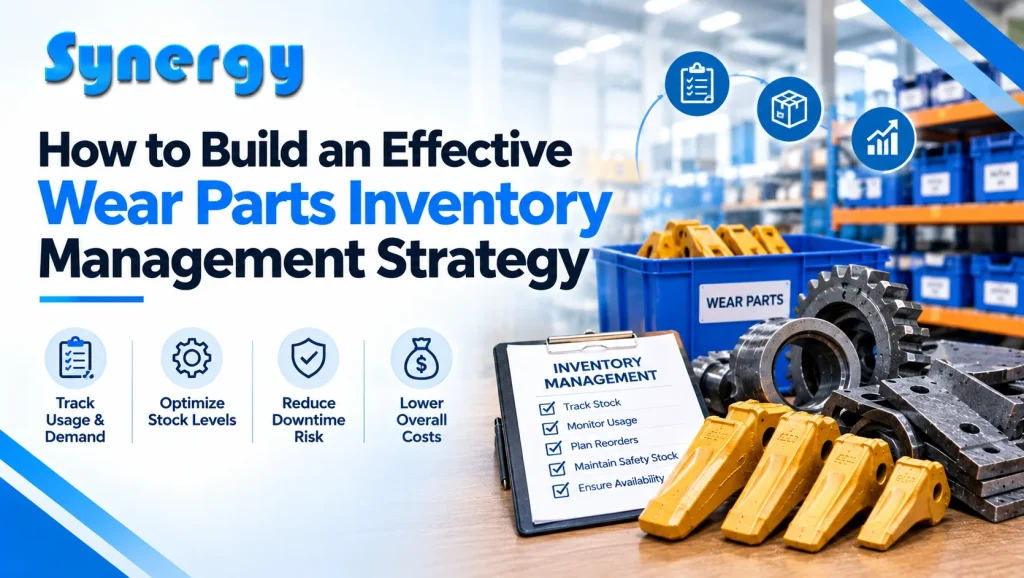
Industrial equipment operating in mining, cement, construction, and material processing industries depends on reliable wear parts to maintain productivity. Components such as crusher liners, mill liners, wear plates, chute liners, and bucket teeth gradually deteriorate because of friction, impact, abrasion, and heavy operating loads. If replacement parts are unavailable when needed, equipment downtime can interrupt production schedules and increase operating costs.
An effective wear parts inventory management strategy helps businesses maintain the right components in the right quantities at the right time. It balances part availability with inventory costs, reduces emergency purchasing, and supports planned maintenance.
For industrial buyers, maintenance managers, and procurement teams, the goal is not simply to stock more spare parts. It is to identify critical components, forecast replacement requirements, evaluate supplier lead times, and establish a reliable replenishment process.
What Is Wear Parts Inventory Management?
Wear parts inventory management is the process of planning, purchasing, storing, tracking, and replenishing components that experience wear during industrial operations.
Unlike general spare parts, wear parts often have predictable service lives influenced by operating conditions, material characteristics, equipment design, and maintenance practices. Some components require frequent replacement, while others may remain in service for extended periods.
An effective inventory strategy considers:
- Equipment type and operating conditions.
- Historical wear and replacement frequency.
- Part criticality and production impact.
- Supplier availability and manufacturing lead times.
- Storage requirements and inventory carrying costs.
- Quality standards and compatibility with existing equipment.
By coordinating these factors, companies can reduce unexpected shortages while avoiding unnecessary stock accumulation.
Why Is Wear Parts Inventory Planning Important?
Poor inventory planning can affect production, maintenance schedules, procurement budgets, and customer commitments. A missing wear component may keep an entire production line out of operation, even when other equipment and resources are available.
1. Reduce Unplanned Equipment Downtime
When a critical wear part fails and no replacement is available, maintenance teams may need to wait for procurement, manufacturing, or transportation. These delays can extend equipment downtime.
Maintaining an appropriate quantity of critical components helps maintenance teams complete replacements faster and return equipment to operation sooner.
2. Control Inventory and Procurement Costs
Keeping excessive quantities of every component can tie up working capital and increase storage expenses. On the other hand, maintaining insufficient stock can lead to emergency orders, expedited shipping, and production losses.
A balanced inventory plan considers both the cost of holding a part and the potential cost of not having it available.
3. Improve Maintenance Scheduling
Inventory planning becomes more effective when it is connected to preventive maintenance schedules. If a component is expected to require replacement during a planned shutdown, procurement teams can arrange its availability in advance.
This coordination reduces last-minute purchasing and helps maintenance teams complete scheduled work efficiently.
4. Improve Supplier Coordination
Industrial wear parts may require custom dimensions, specific materials, heat treatment, machining, or other manufacturing processes. These requirements can affect production lead times.
Sharing forecasts with reliable suppliers gives both parties better visibility into future requirements and supports more consistent replenishment.
Step-by-Step Process for Building a Wear Parts Inventory Strategy
Step 1: Identify All Wear Parts Used in Your Equipment
Begin by creating a comprehensive list of wear components installed across your machinery and production lines.
Include components such as:
- Crusher liners and jaw plates.
- Mill liners and grinding components.
- Wear plates and chute liners.
- Bucket teeth and other earthmoving wear components.
- High-chrome and manganese steel wear parts.
- Custom abrasion-resistant and impact-resistant components.
Record the part number, equipment model, dimensions, material specification, manufacturer, and compatible applications wherever possible.
Accurate identification helps prevent incorrect orders and reduces the risk of receiving components that cannot be installed.
Step 2: Classify Parts According to Criticality
Not every wear part requires the same inventory priority. A component that directly affects a critical production line may need a different stocking strategy from a part that can be replaced without interrupting operations.
Consider these factors when classifying components:
- Production impact: How much production would be affected if the part became unavailable?
- Failure frequency: How often does the component require replacement?
- Replacement lead time: How long does it take to source or manufacture the part?
- Availability of alternatives: Can a compatible component be obtained from another qualified source?
- Failure consequences: Could component failure damage other equipment or create a safety concern?
Parts with high production impact, long replenishment lead times, and limited alternatives generally deserve greater planning attention.
Step 3: Analyze Historical Consumption Data
Historical usage provides a practical starting point for forecasting future requirements.
Review purchasing records, maintenance reports, equipment logs, and stock movements to determine how many units of each component are consumed over a specific period.
For example, if a facility replaces a particular liner set approximately six times per year, that pattern can inform its annual purchasing forecast. However, consumption may change when production volumes, material hardness, feed conditions, or equipment settings change.
Use historical data as a baseline rather than assuming future demand will always remain constant.
Step 4: Calculate Reorder Points
A reorder point indicates when a new purchase order should be initiated to prevent stock from running out before replenishment arrives.
A basic formula is:
Reorder Point = Average Daily Usage × Supplier Lead Time + Safety Stock
For example, suppose a plant consumes two wear plates per day, and the supplier’s lead time is 15 days. If the business maintains safety stock of 10 plates, the reorder point is:
Reorder Point = (2 × 15) + 10 = 40 wear plates.
When available inventory reaches approximately 40 plates, procurement should initiate replenishment, assuming the usage and lead-time estimates remain appropriate.
For variable demand or uncertain delivery schedules, companies may need higher safety stock or more advanced forecasting methods.
Step 5: Establish Appropriate Safety Stock
Safety stock provides a buffer against unexpected demand increases, delayed deliveries, and changes in operating conditions.
The required buffer depends on the business’s risk tolerance and the reliability of its supply chain.
Consider increasing safety stock when:
- A component is essential to continuous production.
- Replacement manufacturing requires specialized processes.
- Supplier lead times fluctuate significantly.
- Transportation or import delays are common.
- Consumption varies with feed material or operating intensity.
Avoid assigning the same safety-stock quantity to every component. High-value custom parts and inexpensive standard components may require very different stocking policies.
Step 6: Account for Supplier Manufacturing Lead Times
Supplier lead time includes more than transportation. Depending on the component, it may include technical approval, drawing confirmation, raw-material sourcing, casting or forging, machining, heat treatment, inspection, and dispatch.
For custom wear parts, verify that the lead-time estimate covers the complete manufacturing process.
Discuss the following with suppliers:
- Standard and custom order lead times.
- Minimum order quantities.
- Drawing and specification approval requirements.
- Production capacity during peak demand.
- Inspection and documentation requirements.
- Packaging, shipping, and delivery arrangements.
Businesses sourcing components from international suppliers should also account for customs clearance and potential transportation delays.
Step 7: Set Minimum and Maximum Stock Levels
Minimum and maximum stock levels help maintain consistent inventory without excessive purchasing.
The minimum level should reflect expected consumption, replenishment lead time, and the required safety buffer. The maximum level should consider expected demand, storage capacity, budget, order quantities, and the risk of holding excess stock.
Review these levels periodically. A stock policy that worked during low production may be inadequate after a capacity expansion or a change in material throughput.
Step 8: Monitor Wear Parts Inventory Regularly
Inventory records are only useful when they accurately reflect the physical stock available.
Implement a regular process for tracking receipts, issues, returns, damaged parts, reserved inventory, and pending purchase orders.
Useful controls include:
- Barcode-based or digital inventory tracking.
- Periodic cycle counting.
- Clear identification and labeling of storage locations.
- Separation of usable, damaged, and obsolete components.
- Recording part numbers and equipment compatibility.
- Regular reconciliation of physical stock and system records.
For smaller operations, a well-maintained spreadsheet may be sufficient initially. Larger facilities may benefit from an inventory management system integrated with maintenance and procurement software.
Which Inventory Management Methods Work Best for Wear Parts?
Different inventory methods can be used together to improve control and purchasing decisions.
ABC Analysis
ABC analysis classifies inventory according to its financial value or another selected business measure.
- A items: Components with high annual inventory value that require close financial monitoring.
- B items: Components requiring a moderate level of control.
- C items: Lower-value items that can often be managed through simpler replenishment rules.
For wear parts, ABC analysis should not be used alone. A relatively inexpensive component can still be operationally critical if its absence stops production.
Criticality-Based Classification
Criticality-based classification prioritizes components according to the consequences of unavailability or failure.
A criticality assessment can consider production interruption, equipment damage, safety implications, and sourcing difficulty.
Combining criticality with inventory value provides a more useful picture than cost-based classification alone.
Demand-Based Forecasting
Demand-based forecasting estimates future requirements using historical consumption, planned production, equipment condition, and maintenance schedules.
For components with stable consumption, a simple average may provide a reasonable starting point. For components affected by changing feed material, operating hours, or seasonal production, more frequent forecast reviews may be necessary.
Just-in-Time Replenishment
Just-in-time replenishment aims to receive components close to the time they are needed, reducing the quantity held in storage.
This approach may work for readily available components with reliable suppliers and predictable delivery schedules. It is riskier for custom wear parts with long manufacturing lead times or significant production consequences if unavailable.
For critical components, a hybrid strategy that combines planned replenishment with safety stock is often more practical.
Common Wear Parts Inventory Management Mistakes
Even businesses with established purchasing processes can experience inventory problems when wear parts are not managed according to their operating requirements.
Relying Only on Historical Consumption
Past usage does not always reflect future demand. Equipment upgrades, higher production volumes, material changes, and harsher operating conditions can increase wear rates.
Update forecasts when operating conditions change.
Ignoring Supplier Lead-Time Variability
Using an optimistic lead-time estimate can cause a reorder to be placed too late. Use realistic delivery estimates and monitor actual supplier performance.
Overstocking Every Component
Excess inventory increases carrying costs and may leave businesses with parts that no longer match equipment requirements. Prioritize inventory according to criticality, demand, and sourcing difficulty.
Failing to Track Component Specifications
Similar-looking wear parts may differ in dimensions, material grade, hardness, or mounting configuration. Inaccurate records can result in incorrect orders and costly delays.
Maintain approved drawings, part numbers, revision histories, and equipment compatibility records.
Not Reviewing Obsolete Inventory
Changes in equipment design can make previously stocked parts unsuitable. Review slow-moving and obsolete inventory regularly, especially after machinery modifications or supplier changes.
Separating Procurement From Maintenance Planning
Maintenance teams understand wear patterns and equipment requirements, while procurement teams manage supplier relationships and purchasing. When these teams work independently, stock levels may not reflect actual operational needs.
Regular coordination helps align maintenance forecasts, purchase orders, and delivery schedules.
How to Select a Reliable Wear Parts Supplier
Supplier reliability is a key part of inventory management because product quality, manufacturing consistency, and delivery performance directly influence replenishment planning.
Evaluate potential suppliers using the following criteria:
Manufacturing capability: Confirm that the supplier can produce the required component types, dimensions, and material specifications.
Quality control: Ask about material verification, dimensional inspection, hardness testing where applicable, and other relevant quality checks.
Technical support: Determine whether the supplier can review drawings, clarify specifications, and support custom component requirements.
Lead-time reliability: Compare quoted lead times with actual delivery performance wherever historical information is available.
Documentation: Ensure that drawings, material specifications, inspection reports, and other required records can be supplied.
Scalability: Consider whether the supplier can support changes in order quantities as production requirements evolve.
India Synergy supports industrial buyers looking for manufacturing and sourcing solutions. Explore the India Synergy Wear Parts range to learn more about wear-resistant component requirements and available product categories.
How India Synergy Can Support Your Wear Parts Sourcing Strategy
Effective inventory planning depends on accurate specifications, dependable manufacturing, and clear communication between buyers and suppliers.
India Synergy works with industrial sourcing and manufacturing requirements across different component categories. When evaluating wear parts, buyers should communicate the intended application, equipment model, operating environment, material requirements, drawings, and expected consumption.
This information helps establish a clearer basis for evaluating component suitability, production requirements, and replenishment planning.
Before placing an order, confirm the approved specifications, inspection expectations, manufacturing lead time, order quantity, and delivery schedule. These details can help procurement teams coordinate purchases with planned maintenance activities.
To learn more about the company and its industrial manufacturing capabilities, visit India Synergy.
Key Performance Indicators for Wear Parts Inventory
Track a small set of practical indicators to evaluate whether your inventory strategy is working.
| KPI | What It Measures | Why It Matters |
| Stockout frequency | How often required parts are unavailable | Highlights supply and forecasting problems |
| Inventory turnover | How frequently inventory is consumed and replenished | Helps identify excess or slow-moving stock |
| Supplier lead-time adherence | Whether deliveries arrive within agreed timelines | Supports reliable reorder planning |
| Emergency purchase rate | Frequency of unplanned purchases | Indicates weaknesses in forecasting or replenishment |
| Inventory accuracy | Agreement between recorded and physical stock | Reduces purchasing and maintenance errors |
| Obsolete inventory value | Value of stock no longer required or compatible | Helps control avoidable inventory costs |
| Maintenance-related downtime | Downtime associated with component replacement or availability | Connects inventory performance with operational outcomes |
Review these indicators monthly or quarterly, depending on the scale of operations. Use the results to adjust reorder points, safety stock, supplier arrangements, and forecasting assumptions.
Conclusion
An effective wear parts inventory management strategy combines component identification, criticality assessment, consumption analysis, reorder planning, safety stock, supplier coordination, and accurate inventory records.
The best approach is not to maximize stock levels or minimize inventory at any cost. Instead, businesses should maintain sufficient quantities of critical components while controlling unnecessary purchasing and storage expenses.
By connecting inventory decisions with equipment condition, maintenance schedules, and supplier lead times, industrial organizations can improve component availability, reduce emergency procurement, and support more predictable production.
India Synergy encourages industrial buyers to evaluate their wear parts requirements carefully and align sourcing decisions with equipment specifications, operating conditions, and long-term maintenance objectives.
Frequently Asked Questions
1. What is the best way to manage industrial wear parts inventory?
The best approach is to classify components by criticality, analyze historical usage, calculate reorder points, maintain appropriate safety stock, and monitor supplier lead times. Inventory policies should reflect the production impact and replacement difficulty of each component.
2. How do you calculate a reorder point for wear parts?
A basic reorder point is calculated by multiplying average daily usage by supplier lead time and adding safety stock. The calculation should be reviewed whenever demand, delivery times, or operating conditions change.
3. How much safety stock should a company maintain?
Safety stock depends on demand variability, supplier reliability, replenishment time, and the consequences of a stockout. Critical components with long manufacturing lead times may require larger buffers than readily available, non-critical items.
4. Why is wear parts inventory management important in mining and manufacturing?
It helps ensure that replacement components are available when needed, reducing delays caused by stock shortages. It can also improve maintenance planning, purchasing efficiency, and control over inventory costs.
5. Should all wear parts be kept in stock?
No. Stocking decisions should consider criticality, usage frequency, procurement lead time, component value, and availability of alternatives. Some parts justify safety stock, while others can be ordered according to planned demand.
6. How often should wear parts inventory levels be reviewed?
Critical components should be monitored frequently, while a broader inventory review can be conducted monthly or quarterly. Reviews should also take place after major equipment changes, production increases, or significant supplier delays.
7. How can businesses reduce excess wear parts inventory?
Businesses can improve forecasting, establish minimum and maximum stock levels, review slow-moving items, coordinate procurement with maintenance schedules, and avoid ordering components without considering actual demand.
8. What should buyers check before ordering replacement wear parts?
Buyers should confirm dimensions, material specifications, equipment compatibility, expected operating conditions, quality documentation, manufacturing lead time, order quantity, and delivery requirements before approving an order.