




Industrial wear parts play an important role in maintaining the performance and reliability of equipment used in mining, cement production, material handling, construction, and heavy manufacturing. These components are exposed to demanding operating conditions, including abrasion, impact, friction, erosion, and repeated mechanical loading.
Over time, wear can reduce component thickness, change surface geometry, affect equipment efficiency, and eventually lead to component failure. When a wear part fails earlier than expected, businesses may experience unplanned downtime, increased maintenance costs, production interruptions, and unexpected replacement expenses.
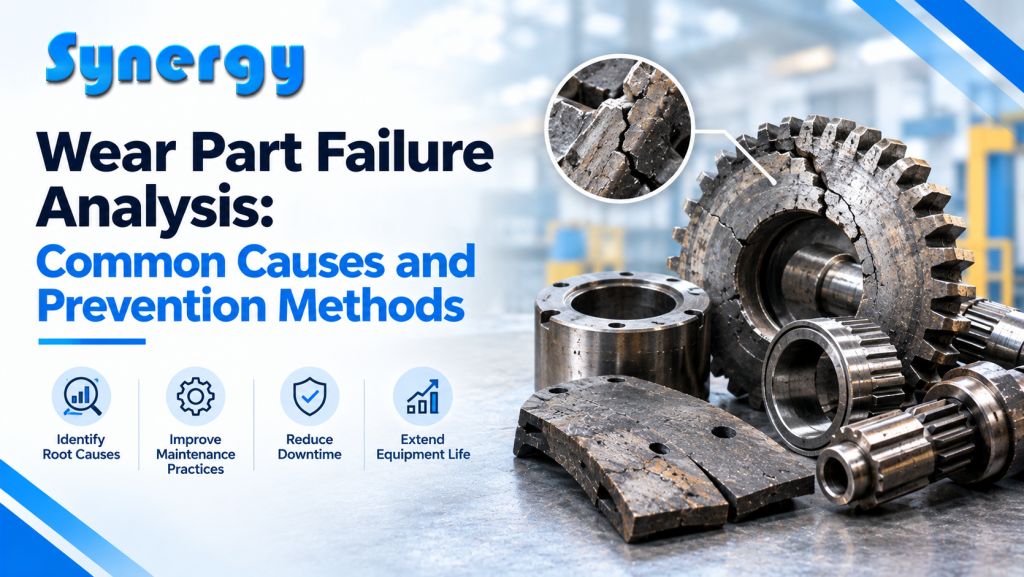
Wear part failure analysis is the systematic process of identifying why a component has worn out, cracked, deformed, or failed and determining how to prevent the same problem from recurring. It involves examining the damaged component, reviewing operating conditions, verifying material properties, checking installation practices, and analysing maintenance records.
For industrial buyers and maintenance teams, understanding the causes of wear part failure helps improve component selection, maintenance planning, and equipment reliability. This guide from India Synergy explains common wear mechanisms, practical investigation methods, and preventive strategies for industrial applications.
What Is Wear Part Failure Analysis?
Wear part failure analysis is an engineering investigation used to determine the reasons behind premature wear, unexpected damage, or component breakdown.
The objective is not simply to replace a damaged component. It is to understand whether the failure resulted from normal wear, unsuitable material selection, incorrect installation, excessive loading, manufacturing defects, or changes in operating conditions.
For example, a crusher liner that wears out quickly may be experiencing unusually abrasive feed material, incorrect operating settings, uneven loading, or a material mismatch. Replacing the liner with another component of the same specification without investigating the cause may not solve the problem.
A structured failure analysis generally involves:
- Documenting the failure and operating conditions.
- Inspecting the damaged component.
- Identifying the dominant wear mechanism.
- Reviewing material specifications and manufacturing records.
- Checking installation and equipment alignment.
- Comparing service life with historical performance.
- Identifying the probable root cause.
- Implementing corrective actions and monitoring the results.
The depth of the investigation depends on the component’s criticality, the severity of the failure, and the potential consequences for equipment safety and production.
Why Do Industrial Wear Parts Fail Prematurely?
Wear parts are designed to withstand material loss and mechanical stress, but their service life depends on several interacting factors. Even a component made from a suitable material can fail early if it operates under conditions outside its design requirements.
The most common contributing factors include:
- Excessive abrasion from hard or abrasive materials.
- Repeated impact or shock loading.
- Incorrect material selection.
- Fatigue caused by repeated mechanical stress.
- Corrosion or chemical exposure.
- Incorrect component dimensions or fitment.
- Manufacturing defects or inconsistent material properties.
- Poor installation and maintenance practices.
- Changes in equipment settings or operating conditions.
- Delayed inspection and replacement.
Identifying the actual failure mechanism is essential because different problems require different corrective actions. Increasing material hardness, for instance, may not solve a failure caused by impact fracture, poor mounting, or excessive mechanical stress.
1. Abrasive Wear: Material Loss From Friction and Contact
Abrasive wear occurs when hard particles or rough surfaces remove material from a component during contact or relative movement.
It is common in mining, mineral processing, cement manufacturing, aggregate handling, and other industries that process abrasive materials.
Common Causes of Abrasive Wear
- Continuous contact with hard mineral particles.
- High material throughput.
- Incorrect material selection.
- Excessive sliding or rubbing contact.
- Uneven material distribution.
- Inadequate protection in high-wear areas.
For example, a chute transporting abrasive minerals may develop localized thinning where material repeatedly strikes or slides along the same surface.
How to Identify Abrasive Wear
Typical signs include surface scratches, grooves, thinning, directional wear marks, and gradual loss of material. The appearance depends on particle shape, hardness, movement, and the component material.
Inspection teams should record the location and depth of wear and compare the findings with previous measurements.
Prevention Methods
Select a material suitable for the abrasive environment, improve material flow where feasible, and monitor areas that experience the highest wear.
Depending on the application, manganese steel, high-chrome materials, chromium carbide overlay plates, or other wear-resistant solutions may be considered. Material selection should account for impact exposure and component design rather than abrasion resistance alone.
Regular thickness measurements and wear mapping can help maintenance teams anticipate replacement requirements before the component reaches its specified wear limit.
2. Impact Wear: Damage From Repeated or Sudden Loading
Impact wear occurs when a component experiences repeated collisions or sudden forces from falling, moving, or crushing material.
It is common in crushing equipment, mining machinery, heavy material handling systems, and equipment that processes large or irregular particles.
Common Causes of Impact-Related Failure
- High-energy material impacts.
- Excessively large feed material.
- Sudden changes in loading.
- Incorrect equipment operating settings.
- Insufficient component toughness.
- Poor support or mounting conditions.
Impact-related damage can appear as dents, deformation, cracking, chipping, or fracture.
How to Prevent Impact-Related Failure
First, determine whether the component is experiencing loads beyond its intended operating conditions. Review feed size, equipment settings, material flow, and mounting arrangements.
The selected material must provide an appropriate balance between hardness and toughness. A very hard but insufficiently tough material may be vulnerable to cracking under severe impact.
Maintenance teams should also inspect mounting points and supporting structures. A component that is not properly supported may experience localized stress and premature damage.
Where appropriate, engineering review can help determine whether a change in material, thickness, geometry, or operating practice is justified.
3. Fatigue Failure: Damage From Repeated Stress
Fatigue occurs when repeated or fluctuating stresses cause progressive damage that may eventually result in cracking or fracture.
A component does not necessarily need to experience a single unusually large load to fail from fatigue. Repeated stress cycles can initiate and propagate cracks over time.
Common Causes of Fatigue
- Repeated cyclic loading.
- Stress concentrations around holes or corners.
- Vibration or fluctuating forces.
- Poor alignment.
- Manufacturing discontinuities.
- Inadequate design for actual service loads.
Signs of Fatigue Failure
Inspection may reveal cracks near mounting holes, corners, welds, or other areas where stress is concentrated. The component may eventually fracture even if the surrounding material appears relatively unworn.
A detailed investigation may be needed to distinguish fatigue from impact fracture, manufacturing defects, or other failure mechanisms.
Prevention Methods
Review the component’s loading conditions, design geometry, mounting arrangement, and material properties. Correct alignment issues and investigate vibration or repeated overloads.
Where the consequences of failure are significant, engineering assessment and suitable non-destructive testing may be appropriate.
Avoid simply replacing the damaged part without investigating why the stress developed in the first place.
4. Corrosion and Erosion: Environmental Damage
Corrosion is the deterioration of a material caused by chemical or electrochemical reactions with its environment. Erosion involves material removal caused by moving fluids, particles, or droplets striking a surface.
Both mechanisms can contribute to premature component failure, particularly in wet processing, pumping, chemical handling, and slurry transportation applications.
Common Contributing Factors
- Exposure to moisture or corrosive chemicals.
- Abrasive particles carried in a liquid or gas.
- High fluid velocity.
- Turbulence or repeated particle impact.
- Unsuitable material selection.
- Inadequate protective coatings or surface treatments.
Prevention Methods
Assess the chemical composition of the operating environment, temperature, moisture levels, and flow conditions. Select materials and protective systems suitable for the specific environment.
For slurry-handling applications, evaluate both abrasion and erosion because the two mechanisms can interact. A solution designed only for dry abrasion may not perform as expected under wet operating conditions.
Inspect affected components regularly and review whether changes to fluid flow, particle concentration, or equipment geometry could reduce localized damage.
5. Incorrect Material Selection
Material mismatch is a common reason why a component fails to achieve its expected service life.
A material suitable for severe abrasion may not be ideal for repeated high-impact loading. Similarly, a material selected for mechanical wear may not provide sufficient resistance to corrosion in a chemically aggressive environment.
Why Material Selection Matters
Important material characteristics include:
- Hardness.
- Toughness.
- Abrasion resistance.
- Impact resistance.
- Corrosion resistance.
- Temperature suitability.
- Microstructure and heat treatment.
- Compatibility with the manufacturing process.
The importance of each property depends on the operating conditions and component design.
How to Prevent Material-Related Failures
Document the component’s actual operating environment before choosing a replacement. Review previous failure reports and compare the specified material with the conditions under which the component operates.
Where required, request material certificates, chemical composition results, hardness reports, and other relevant inspection documentation.
If the current material repeatedly fails, investigate whether a different grade or design is appropriate. Any proposed change should be evaluated against the component’s complete performance requirements.
6. Manufacturing Defects and Quality Issues
Manufacturing defects can contribute to premature wear, cracking, deformation, or inconsistent performance.
Potential defects depend on the manufacturing method. Cast components, welded assemblies, machined parts, and hardfaced plates have different inspection requirements.
Examples may include unacceptable porosity, inclusions, cracks, dimensional deviations, poor weld quality, or inconsistent material properties.
How Manufacturing Quality Affects Performance
A component may meet its overall dimensional requirements but still contain a defect that reduces its ability to withstand operating loads.
Similarly, inconsistent material properties between batches can cause replacement components to perform differently even when they appear identical.
Prevention Methods
Establish clear technical specifications and quality acceptance criteria before production.
Depending on the component, relevant controls may include:
- Material verification.
- Hardness testing.
- Dimensional inspection.
- Visual examination.
- Weld inspection.
- Heat treatment verification.
- Appropriate non-destructive testing.
- Batch identification and traceability.
The inspection methods should match the component design, manufacturing process, applicable standards, and consequences of failure.
When investigating a failed part, compare its manufacturing and inspection records with the approved requirements before concluding that a defect caused the failure.
7. Incorrect Installation and Equipment Misalignment
Even a correctly manufactured component can fail prematurely if it is installed incorrectly or operates in an unsuitable mechanical arrangement.
Installation problems may create uneven loading, localized stress, excessive vibration, movement, or contact between surfaces that should remain separated.
Common Installation Problems
- Incorrect tightening of fasteners.
- Misaligned mounting surfaces.
- Incorrect component orientation.
- Improper clearances.
- Missing or unsuitable fasteners.
- Incorrect installation sequence.
- Damaged supporting structures.
Prevention Methods
Use approved installation instructions and verify component identification before fitting. Inspect mounting surfaces, fasteners, alignment, and clearances as appropriate.
Maintenance personnel should use the specified fastening methods and tightening requirements. Where necessary, verify alignment before returning equipment to service.
Record installation details and inspect the component after an appropriate operating period. This can help distinguish installation-related problems from material or manufacturing issues.
8. Operating Conditions That Accelerate Wear
Changes in operating conditions can alter the rate and pattern of component deterioration.
For example, an increase in production throughput may expose a component to more material contact per operating hour. Changes in particle size or hardness may increase abrasion or impact. Temperature changes may also affect the suitability of a material or protective system.
Operating Factors to Review
- Feed rate and production throughput.
- Particle size and material hardness.
- Equipment speed and operating settings.
- Temperature and moisture.
- Impact intensity.
- Material distribution.
- Start-stop frequency.
- Abnormal vibration or loading.
When a component begins failing earlier than expected, compare its operating conditions with those recorded during previous service periods.
If conditions have changed, update the maintenance plan and reassess whether the component specification remains appropriate.
9. Poor Maintenance Planning and Delayed Replacement
A component that has exceeded its acceptable wear limit may damage surrounding equipment or cause an unexpected shutdown.
However, replacing components too early can also increase maintenance costs and generate unnecessary waste.
Effective maintenance planning balances component condition, operating risk, replacement lead time, and the consequences of failure.
Recommended Maintenance Practices
- Define inspection intervals for critical components.
- Record wear measurements consistently.
- Establish approved minimum thicknesses or other rejection limits.
- Track component service life and failure history.
- Maintain appropriate stock of critical replacement parts.
- Arrange procurement before expected replacement dates.
- Schedule replacement during planned shutdowns where practical.
For components with predictable wear patterns, historical records can help estimate future replacement needs. For components with highly variable service conditions, use condition monitoring and risk-based inspections to guide decisions.
A Step-by-Step Wear Part Failure Analysis Process
A systematic investigation helps maintenance teams move from observing damage to identifying the underlying cause.
Step 1: Record the Failure
Document the component identification, equipment, installation date, operating hours, failure date, and circumstances surrounding the event.
Take photographs before removing or cleaning the component when practical.
Step 2: Preserve Relevant Evidence
Record the component’s condition, orientation, location of damage, and any unusual wear patterns. Avoid actions that could remove evidence needed for further examination.
Step 3: Inspect the Component
Look for abrasion, deformation, cracks, fractures, corrosion, uneven wear, or other relevant damage.
Record dimensional measurements and compare them with previous inspections or approved limits.
Step 4: Review Material and Manufacturing Records
Check the material grade, batch information, certificates, inspection results, and manufacturing requirements. Determine whether the component complied with the approved specification.
Step 5: Examine Operating Conditions
Review the processed material, throughput, equipment settings, loading conditions, maintenance history, and any recent operational changes.
Step 6: Identify the Root Cause
Determine which factors most likely contributed to the failure. Multiple causes may be involved, such as unsuitable material combined with abnormal loading.
Where evidence is insufficient, arrange additional inspection or testing rather than relying on assumptions.
Step 7: Implement Corrective Actions
Corrective measures may include changing inspection frequency, adjusting operating practices, improving installation procedures, modifying component design, or reviewing material selection.
Step 8: Verify the Improvement
Monitor the replacement component under comparable conditions and compare its performance with the previous baseline.
A corrective action is most useful when its effectiveness can be demonstrated through inspection results, service life, or reduced failure frequency.
How to Measure and Improve Wear Part Service Life
Component service life should be measured using a consistent method so that performance comparisons are meaningful.
Depending on the application, useful measures include operating hours, production tonnage, material processed, or calendar time in service.
For example, comparing two components by calendar days alone may be misleading if one operated at a higher throughput or under more abrasive conditions.
Important Performance Indicators
| Performance indicator | What it helps measure |
| Service life | Time or operating hours before replacement |
| Wear rate | Rate of material loss under defined conditions |
| Failure frequency | How often similar components fail |
| Unplanned downtime | Production time lost to unexpected failures |
| Replacement cost | Direct cost of component replacement |
| Maintenance labour | Time and labour required for inspection and replacement |
| Cost per operating hour | Maintenance expenditure relative to equipment usage |
Use these indicators to identify recurring problems and assess whether corrective actions are producing measurable improvements.
Comparisons should account for differences in operating conditions, material handled, component specifications, and measurement methods.
Preventive Strategies for Different Industrial Applications
Different industries experience different wear mechanisms. Preventive measures should therefore be matched to the application.
Mining and Mineral Processing
Mining equipment may experience heavy abrasion, impact, and variable material loading. Inspect critical liners, crusher components, and material-contact surfaces regularly. Track wear patterns and ensure replacement parts are available before planned maintenance windows.
Cement Manufacturing
Cement production and material handling may expose components to abrasive particles, high throughput, and demanding operating conditions. Focus inspections on high-wear areas and review component material suitability and replacement schedules.
Conveyor and Material Handling Systems
Conveyors, chutes, and hoppers may experience localized wear caused by material flow, sliding contact, and impact. Monitor transfer points, loading zones, and areas where material repeatedly strikes or rubs against surfaces.
Heavy Equipment and Construction
Components may experience a combination of abrasion, impact, vibration, and fluctuating loads. Inspect mounting points, fasteners, and structural interfaces alongside the wear surface.
Across all these applications, maintenance teams should combine condition monitoring, suitable material selection, and planned procurement to reduce avoidable component failures.
How India Synergy Supports Industrial Wear Parts Requirements
India Synergy provides industrial manufacturing and component sourcing solutions for businesses seeking wear-resistant components for demanding operating environments.
The appropriate component depends on the equipment design, material handled, wear mechanism, operating conditions, and required material properties. A clear technical specification helps establish which manufacturing and material options are suitable for a particular application.
When evaluating a replacement requirement, buyers should prepare:
- Component drawings or reference samples.
- Equipment details and operating conditions.
- Material grade and dimensional requirements.
- Existing service-life and failure records.
- Expected order quantities.
- Inspection and documentation requirements.
- Target delivery schedules.
These details help maintenance and procurement teams assess replacement options and communicate technical requirements to a supplier.
Businesses can explore India Synergy’s Wear Parts solutions when reviewing component categories and manufacturing requirements for industrial applications.
For broader information about the company’s manufacturing capabilities, visit India Synergy.
Conclusion
Wear part failure analysis is an important part of industrial maintenance because it helps businesses understand why components deteriorate, crack, deform, or fail before their expected service life.
Common causes include abrasive wear, impact, fatigue, corrosion, unsuitable material selection, manufacturing defects, installation errors, and changing operating conditions. Each failure mechanism requires an appropriate investigation rather than a one-size-fits-all solution.
A structured approach should include documenting the failure, inspecting the component, reviewing material and operating records, identifying the root cause, implementing corrective measures, and monitoring subsequent performance.
By combining failure analysis with preventive maintenance, appropriate component selection, and reliable procurement planning, industrial businesses can work toward fewer unexpected failures, better maintenance decisions, and more predictable equipment performance.
Frequently Asked Questions
1. What is wear part failure analysis?
Wear part failure analysis is the systematic investigation of a damaged or prematurely worn component to determine the causes of failure and identify corrective actions. It may involve visual inspection, dimensional measurements, material verification, operating data analysis, and additional engineering tests.
2. What are the most common causes of wear part failure?
Common causes include abrasion, impact, fatigue, corrosion, erosion, unsuitable material selection, manufacturing defects, incorrect installation, excessive loading, and inadequate maintenance planning. Several factors may contribute to a single failure.
3. How can premature wear be reduced?
Premature wear can often be reduced by selecting materials appropriate for the application, monitoring component condition, maintaining correct equipment settings, improving installation practices, and replacing components according to approved wear limits.
4. Why does material selection matter for industrial wear parts?
Different materials have different combinations of hardness, toughness, abrasion resistance, and corrosion resistance. Selecting a material based on the actual wear mechanism helps reduce the risk of premature deterioration or fracture.
5. How do you identify abrasive wear?
Abrasive wear often produces scratches, grooves, thinning, and gradual material loss. Inspection teams should document the location and depth of wear and compare measurements with previous records to assess its progression.
6. Can incorrect installation cause premature component failure?
Yes. Misalignment, unsuitable clearances, incorrect fastening, and poor support can create uneven loading and localized stress. Following approved installation procedures helps reduce these risks.
7. What information is required for a wear part failure investigation?
Useful information includes component specifications, photographs, installation and removal dates, operating hours, wear measurements, material certificates, inspection reports, maintenance records, and details of the operating environment.
8. How can businesses measure wear part performance?
Businesses can track service life, operating hours, wear rate, failure frequency, downtime, replacement cost, and maintenance labour. Comparisons are most useful when operating conditions and measurement methods are consistent.
Improve Your Industrial Component Planning
Understanding why components fail is the first step toward selecting appropriate replacements and improving maintenance practices. Review your equipment requirements, document recurring wear patterns, and establish clear material and inspection specifications before approving replacement components.