





Introduction
Precision manufacturing has become a key requirement across industries such as automotive, construction, aerospace, electrical equipment, heavy engineering, agriculture, and industrial machinery. Manufacturers are constantly searching for production methods that deliver exceptional accuracy, reduce material waste, and improve production efficiency.
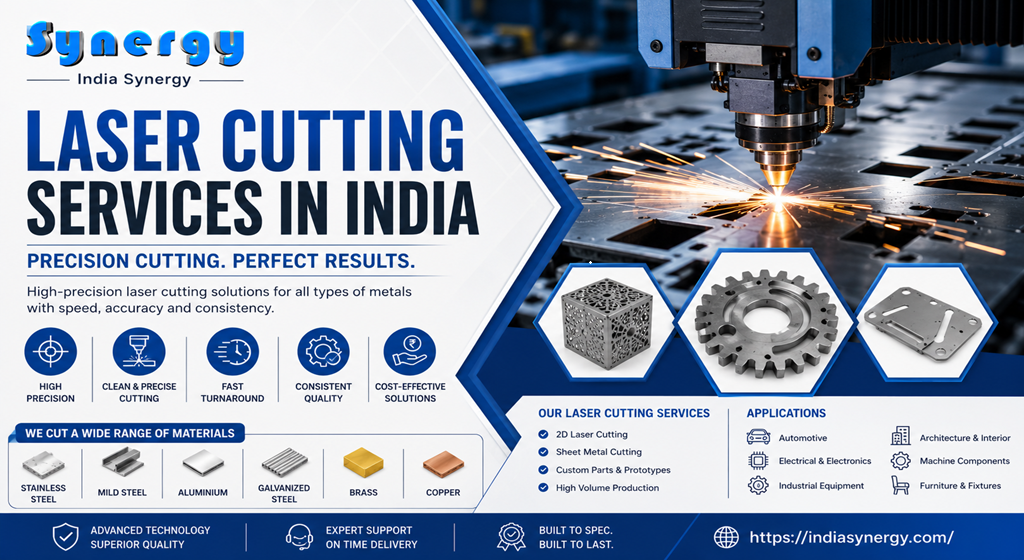
Laser cutting has emerged as one of the most advanced manufacturing technologies because it allows businesses to produce highly accurate metal components with exceptional speed and consistency. Unlike traditional cutting methods, laser cutting uses a focused beam of light to cut, engrave, or shape materials with minimal distortion.
As global demand for precision-engineered components continues to increase, India has become an important manufacturing destination for laser cutting services. Modern production facilities, advanced machinery, experienced engineers, and competitive manufacturing costs have positioned Indian manufacturers among the leading suppliers in the global market.
India Synergy is a trusted provider of laser cutting services in India, offering customized manufacturing solutions for businesses across multiple industries. From prototype development to large-scale production, the company delivers precision-engineered components that meet international quality standards.
This comprehensive guide explains laser cutting technology, its manufacturing process, applications, benefits, and why India is becoming a preferred destination for laser cutting services.
What Is Laser Cutting?
Laser cutting is a manufacturing process that uses a concentrated beam of light to cut materials with extreme precision.
The term LASER stands for Light Amplification by Stimulated Emission of Radiation. During the cutting process, the laser beam generates intense heat that melts, burns, or vaporizes the material.
A computer-controlled system guides the laser along a predefined cutting path, ensuring exceptional accuracy and repeatability.
Laser cutting is widely used for processing:
- Stainless steel
- Carbon steel
- Aluminum
- Copper
- Brass
- Titanium
- Various industrial alloys
The process is suitable for both simple and highly complex component designs.
How Does the Laser Cutting Process Work?
The laser cutting process combines advanced optics, computerized controls, and high-energy laser beams to produce precise cuts.
The manufacturing workflow typically includes the following steps:
1. Product Design
Engineers create digital component designs using Computer-Aided Design (CAD) software.
2. Material Selection
Manufacturers select materials based on:
- Strength requirements
- Thickness
- Corrosion resistance
- End-use applications
3. CNC Programming
The design is converted into machine instructions that control the laser cutting system.
4. Laser Processing
The laser beam follows the programmed path and cuts the material according to the design specifications.
5. Inspection and Finishing
The finished components undergo dimensional verification and quality inspection before delivery.
This automated process ensures consistent quality across both small and large production volumes.
Types of Laser Cutting Technologies
Different laser technologies are used depending on the material and application.
Fiber Laser Cutting
Fiber lasers have become the preferred choice for modern manufacturing.
Benefits include:
- High cutting speeds
- Superior energy efficiency
- Lower maintenance requirements
- Exceptional precision
Fiber lasers are ideal for cutting metals such as stainless steel, carbon steel, aluminum, and brass.
CO₂ Laser Cutting
CO₂ lasers use a gas mixture to generate the laser beam.
They are commonly used for:
- Sheet metal fabrication
- Plastic processing
- Non-metallic materials
CO₂ systems remain popular because of their versatility.
Crystal Laser Cutting
Crystal laser systems deliver high-intensity beams suitable for specialized applications.
These systems are typically used when extreme precision is required.
CNC Laser Cutting
Computer Numerical Control (CNC) technology improves:
- Accuracy
- Repeatability
- Automation
- Production efficiency
CNC-controlled systems minimize human error and ensure consistent manufacturing quality.
Materials Used in Laser Cutting
Stainless Steel
Stainless steel is one of the most commonly processed materials in laser cutting.
Advantages include:
- Excellent corrosion resistance
- High durability
- Superior mechanical strength
Applications include:
- Food processing equipment
- Medical devices
- Industrial machinery
Carbon Steel
Carbon steel is widely used because of its strength and cost-effectiveness.
Applications include:
- Structural components
- Construction equipment
- Industrial machinery
Aluminum
Aluminum provides several benefits:
- Lightweight properties
- Excellent corrosion resistance
- High thermal conductivity
Industries such as aerospace and automotive depend heavily on aluminum components.
Copper
Copper is widely used in electrical applications because of its excellent conductivity.
Common applications include:
- Electrical systems
- Power distribution equipment
- Electronic components
Brass
Brass combines corrosion resistance with good machinability.
Typical applications include:
- Decorative products
- Electrical equipment
- Precision components
Applications of Laser Cutting in the Automotive Industry
The automotive industry requires highly precise components to maintain product quality and safety.
Laser-cut components are used in:
- Chassis systems
- Engine components
- Exhaust systems
- Structural assemblies
- Mounting brackets
Laser technology allows manufacturers to produce lightweight components while maintaining structural strength.
Applications of Laser Cutting in the Construction Industry
Construction companies use laser-cut components for numerous applications.
Examples include:
- Structural steel fabrication
- Architectural elements
- Support systems
- Building frameworks
The accuracy of laser cutting ensures proper component alignment during installation.
Applications of Laser Cutting in Industrial Machinery
Industrial equipment manufacturers rely on laser-cut components for:
- Machine frames
- Conveyor systems
- Equipment enclosures
- Structural supports
Laser processing improves production efficiency while reducing manufacturing errors.
Applications of Laser Cutting in the Electrical and Electronics Industry
The electrical industry requires components with precise dimensions and smooth finishes.
Common applications include:
- Electrical cabinets
- Control panels
- Server racks
- Switchgear components
Precision cutting ensures accurate component assembly and reliable system performance.
Applications of Laser Cutting in the Aerospace Industry
Aerospace manufacturing requires exceptional precision.
Laser cutting supports the production of:
- Aircraft components
- Structural panels
- Lightweight assemblies
- Specialized metal parts
The process allows manufacturers to maintain strict dimensional tolerances.
Key Benefits of Laser Cutting Services
Exceptional Precision
Laser cutting delivers highly accurate components with extremely tight tolerances.
This level of precision is difficult to achieve using conventional cutting methods.
Faster Production
Automated systems significantly reduce manufacturing time.
This enables manufacturers to meet tight production schedules without compromising quality.
Reduced Material Waste
Traditional cutting processes often generate excessive waste.
Laser technology optimizes material usage and improves production efficiency.
Smooth and Clean Edges
Laser-cut components require minimal secondary processing.
Benefits include:
- Better surface quality
- Reduced finishing costs
- Faster assembly
Greater Design Flexibility
Laser cutting supports:
- Complex geometries
- Intricate patterns
- Customized designs
Manufacturers can create components that would be difficult to produce through conventional methods.
Laser Cutting vs. Traditional Metal Cutting Methods
| Feature | Laser Cutting | Mechanical Cutting | Plasma Cutting |
| Precision | Excellent | Moderate | Good |
| Material Waste | Low | Moderate | High |
| Edge Quality | Excellent | Moderate | Fair |
| Production Speed | High | Moderate | High |
| Complex Designs | Excellent | Limited | Moderate |
Laser cutting consistently delivers better precision and cleaner results.
Quality Control in Laser Cutting Services
Quality assurance is an essential part of precision manufacturing.
Material Inspection
Manufacturers verify the quality of raw materials before production.
Dimensional Verification
Advanced measuring equipment ensures compliance with design specifications.
Surface Evaluation
Finished components are inspected for:
- Burrs
- Surface defects
- Distortion
Final Product Testing
Components undergo final inspections before packaging and shipment.
Strict quality control reduces defects and improves customer satisfaction.
Custom Laser Cutting Services
Modern industries increasingly require customized manufacturing solutions.
India Synergy offers:
Prototype Development
Engineering teams create and test prototypes before full-scale production.
Low-Volume Manufacturing
Small production runs support specialized projects.
High-Volume Manufacturing
Automated systems ensure efficient large-scale production.
OEM and Contract Manufacturing
India Synergy supports original equipment manufacturers with customized production services.
Why Choose Laser Cutting Services in India?
India has become a preferred manufacturing destination because of several advantages.
Cost-Effective Production
Indian manufacturers offer competitive pricing while maintaining high-quality standards.
Advanced Manufacturing Infrastructure
Modern production facilities utilize the latest CNC and laser technologies.
Skilled Engineering Workforce
Experienced engineers provide technical expertise throughout the manufacturing process.
Strong Global Supply Chains
Indian manufacturers export products worldwide while maintaining reliable delivery schedules.
Why Choose India Synergy?
India Synergy has built a strong reputation by delivering precision-engineered manufacturing solutions.
Advanced Manufacturing Capabilities
The company combines:
- Laser cutting
- CNC machining
- Fabrication
- Assembly
- Quality testing
Customized Engineering Solutions
Every project receives dedicated engineering support to ensure optimal performance.
International Quality Standards
Strict quality control procedures ensure that every component meets customer requirements.
Reliable Delivery
Efficient manufacturing and logistics systems enable timely product delivery.
Future Trends in Laser Cutting Technology
Several emerging technologies are transforming the manufacturing industry.
Key trends include:
- Industry 4.0 integration
- Artificial intelligence in manufacturing
- Smart factories
- Robotic automation
- Sustainable manufacturing practices
These innovations will continue to improve efficiency, productivity, and product quality.
Conclusion
Laser cutting has revolutionized modern manufacturing by providing exceptional precision, faster production, and superior material utilization. Industries worldwide are adopting this technology to manufacture complex components with greater efficiency and consistency.
India has emerged as a leading destination for precision manufacturing because of its advanced production capabilities and cost advantages.
As a trusted provider of laser cutting services in India, India Synergy delivers customized manufacturing solutions for businesses across multiple industries. Through advanced technology, engineering expertise, and strict quality standards, the company continues to help global manufacturers achieve greater efficiency and improved product performance.
Frequently Asked Questions
What are laser cutting services?
Laser cutting services use a focused laser beam to cut and shape materials with exceptional precision.
Which materials can be processed using laser cutting?
Common materials include stainless steel, carbon steel, aluminum, copper, brass, and industrial alloys.
What are the primary benefits of laser cutting?
The major benefits include precision, reduced waste, faster production, cleaner edges, and greater design flexibility.
Which industries use laser cutting services?
Automotive, aerospace, construction, electronics, heavy engineering, and industrial manufacturing industries use laser cutting extensively.
How does laser cutting differ from plasma cutting?
Laser cutting offers better precision and cleaner edges, while plasma cutting is typically used for thicker materials.
Does India Synergy provide customized laser cutting solutions?
Yes. India Synergy offers customized manufacturing solutions, including prototype development, OEM production, and large-scale manufacturing.
Why should businesses choose laser cutting services in India?
India offers cost-effective manufacturing, advanced technology, experienced engineers, and reliable global supply chains.
How do manufacturers ensure the quality of laser-cut components?
Manufacturers use material inspection, dimensional verification, surface evaluation, and final product testing to maintain quality standards.